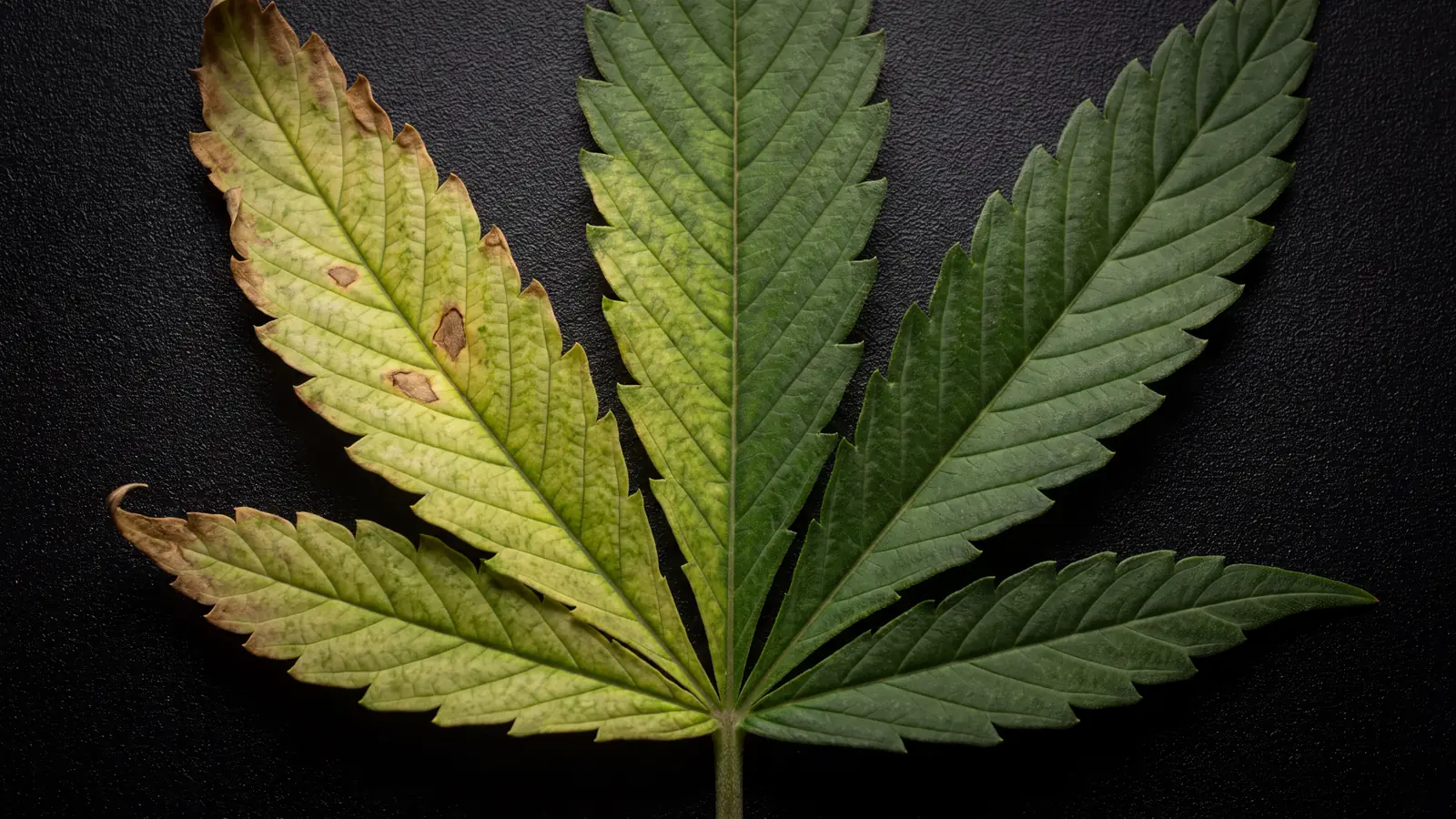
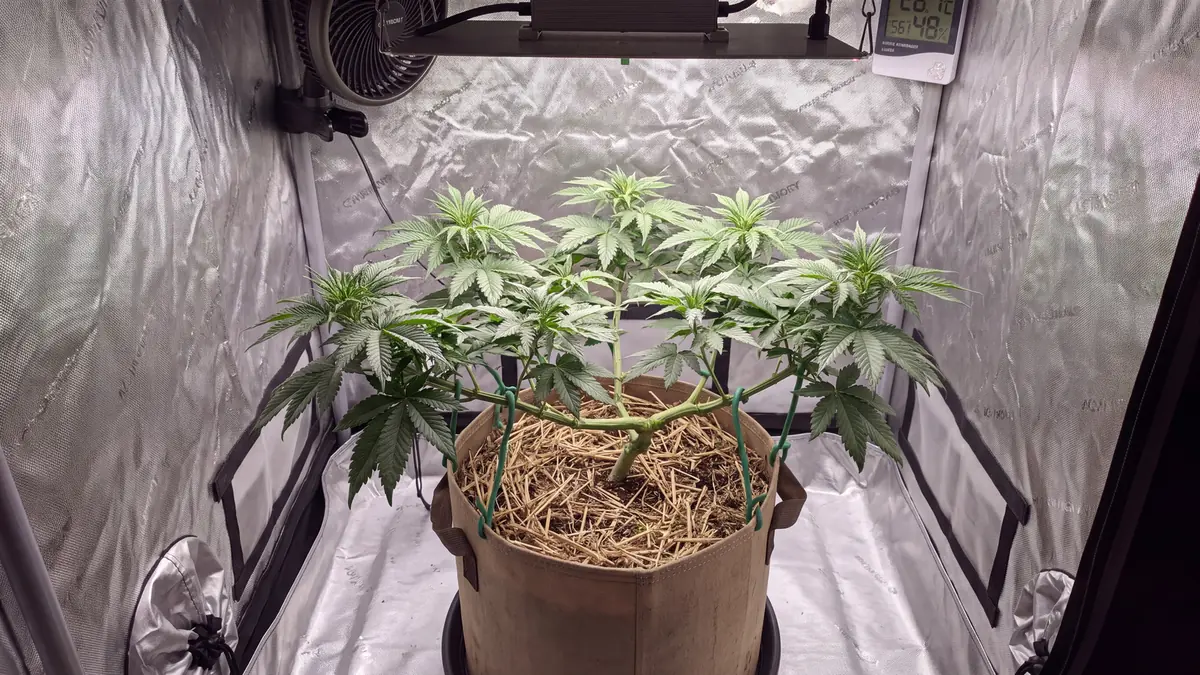
Low stress training (LST) means gently bending a cannabis plant's stems and tying them down so it grows wide and flat. Nothing gets cut, so there's little to no recovery time. Start in early veg while the stems are soft, then make small adjustments every few days as the plant grows. The biggest payoff? Every bud site gets direct light, meaning bigger, better buds at harvest.
LST is a simple technique and the go-to training method for plants grown from autoflower seeds, which can’t spare time to recover from cuts. It works just as well on photoperiods. Below, you’ll learn when to start (and stop) LST, what tools you need, how to do low stress training step by step, and which mistakes to avoid.
What Is LST? Low Stress Training Explained
Low stress training (LST) is a cannabis training method where you bend the main stem and branches sideways and tie them in place, usually to the rim of the pot or to stakes in the soil. It’s done mostly during veg, while the stems are still flexible. Nothing is cut or crushed. The goal is to turn one tall main stem into a wide, flat canopy with several tops growing at the same height.
The “low stress” label refers to the lack of tissue damage. LST still puts mild stress on the plant, but it’s minor compared to high stress training (HST) methods like topping, FIMing and supercropping. Those methods cut or crush the plant, and it needs time to heal before it grows normally again. LST leaves every stem intact.
After a bend, the leaves usually turn back toward the light within a day, and growth carries on at its normal pace.
How Does LST Work on Cannabis?
LST works by taking away the main tip's height advantage so the side branches can catch up. Left alone, a cannabis plant pushes its strongest growth into whichever tip sits highest. This habit, called apical dominance, gives you one tall leader with weaker branches below it.
Bend that leader over until its tip sits level with or below the side branches, and it loses its lead. The lower branches strengthen and start climbing toward the light, and new shoots push up from the nodes along the bent stem.
Light is the other half of the story. Under a fixed grow light, the tallest tip sits closest to the source and shades everything beneath it. A flat canopy puts more bud sites in strong, direct light at the same time, so fewer of them finish thin and airy.
The new shape sticks, too. As stems thicken, they stiffen in the position you've held them in, so the plant keeps its frame once the ties come off.
Benefits of Low Stress Training Weed Plants
LST gets you a bigger, more even harvest from the same plant and the same light, with no recovery time. Here’s what that looks like in practice:
- Higher yields from the same light: More bud sites sit at canopy height, so more of them develop fully. You get more usable bud without upgrading your lighting.
- Several main colas: You end up with multiple tops of similar size, not one dominant cola surrounded by small popcorn buds.
- Height control: A plant that grows out instead of up fits more easily under low tent ceilings. Outdoors, it stays lower and less noticeable.
- Better airflow: Spreading the branches opens up the center of the plant. Air moves through the canopy more easily, which lowers the chance of humid pockets forming around dense buds.
- No downtime: Nothing gets cut, so the plant never pauses to heal, which is especially useful for fast-flowering plants.
- Cheap and forgiving: All you need are soft plant ties or garden wire and a few anchor points. If a bend goes wrong, you can loosen the tie and try again.
- Works with other methods: LST pairs well with techniques like topping on photoperiods and forms the base of a Screen of Green (ScrOG) setup.
When to Start Low Stress Training (And When to Stop)
Start LST early in the vegetative stage, once your cannabis plant has several nodes, side branches are starting to form, and the stems still bend easily. Stop making major new bends once the flowering stretch ends and buds are forming. Both limits come down to the same thing: young stems flex, and older ones turn woody and snap.
Your cannabis plant is ready for low stress training when it shows:
- Several established nodes, with side branches visibly developing.
- Stems that give under light finger pressure and hold a new angle without creaking.
- Steady, active growth well past the seedling stage.
- Plenty of upward growth still ahead, so there's something left to redirect.
Try a gentle bend before you commit. A stem that flexes smoothly is ready. One that feels stiff and protests is telling you to work on younger growth instead.
Winding down LST doesn't mean dropping everything and walking away. During the flowering stretch, keep tucking any tip that climbs above the rest. After that, stick to light tucks and tie checks, because a stem that keeps thickening under an old tie still needs room.
LST Timing for Photoperiods vs Autoflowers
Start LST on photoperiods once the plant has around 4–6 nodes, and keep training through veg and into the first 2–3 weeks of flower, until the stretch ends. Autoflowers need an earlier start, usually at 3–4 nodes, and most of the training should happen before they start flowering. Their whole training window lasts only a few weeks.
When you’re growing from photoperiod feminized weed seeds, indoor plants stay in veg until you flip the lights to 12/12. If the canopy needs more time to fill out, you can simply veg longer. Many growers flip at about half their target height, because the stretch can add a lot more.
Autoflowering plants don’t wait for a 12/12 light schedule. They grow fast, bloom automatically, and their training window can’t be extended, so LST on autoflowers calls for gentler bends and more frequent tie checks during their fastest growth.
What You Need for Low Stress Training
You only need a few basic supplies to start low stress training your weed plants: something soft to tie with and something solid to tie to. Thin string or wire can bite into a stem and girdle it as it thickens, and you often won't notice until weeks later, so avoid those.
Good options include:
- Ties: soft plant ties, coated plant wire, or strips of fabric.
- Anchors: the rim of a fabric pot (holes or safety pins work well), the lip of a plastic pot, or stakes pushed into the medium.
- Repairs: soft plant tape, in case a stem cracks while you're bending it.
How to LST Cannabis Step by Step
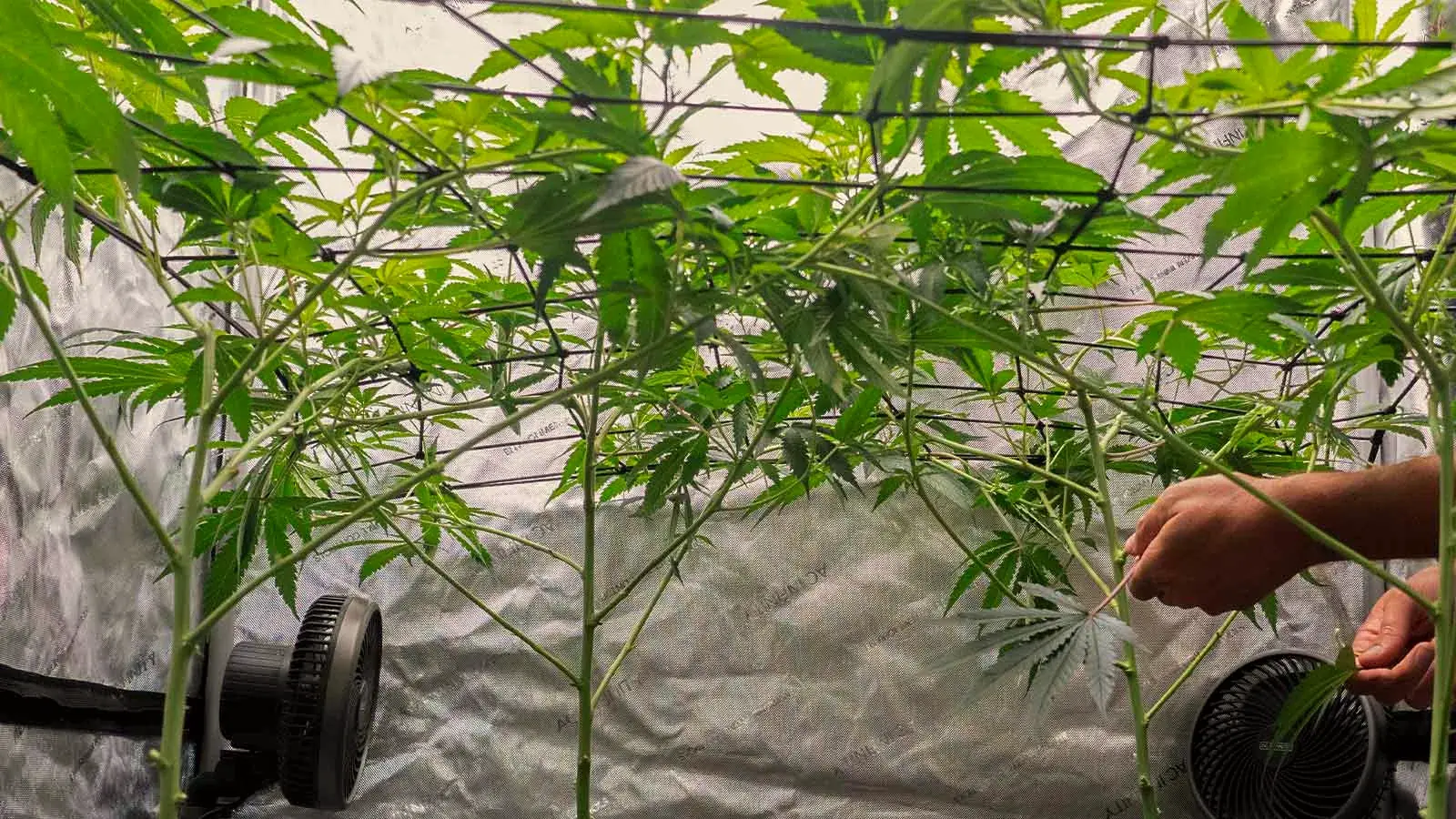
To LST cannabis, bend the main stem down and away from the center, tie it in place, then repeat with every new tip that climbs above the rest. Check the plant every few days and keep going until the canopy sits flat and even. Every training session follows the same order, from the tallest tip outward. Work through these low stress training steps each time:
- Set up anchor points on the pot. Your ties need somewhere to attach before you bend anything. Drill small holes around the rim of a plastic pot, or use the handles and rim of a fabric pot. Anchor everything to the pot itself, never to the floor or the tent, so you can still lift and move the plant. If you’re transplanting a young plant, set it slightly off-center to give the main stem more room to travel.
- Find the dominant tip. With your anchors ready, pick the growth you need to bring down first. It’s usually the highest point on the plant, and on an untrained marijuana plant you’ll spot it at a glance.
- Support the base of the stem. Hold the main stem near the soil with one hand before you bend. This keeps the pressure in the bend and stops it from tugging on the root zone.
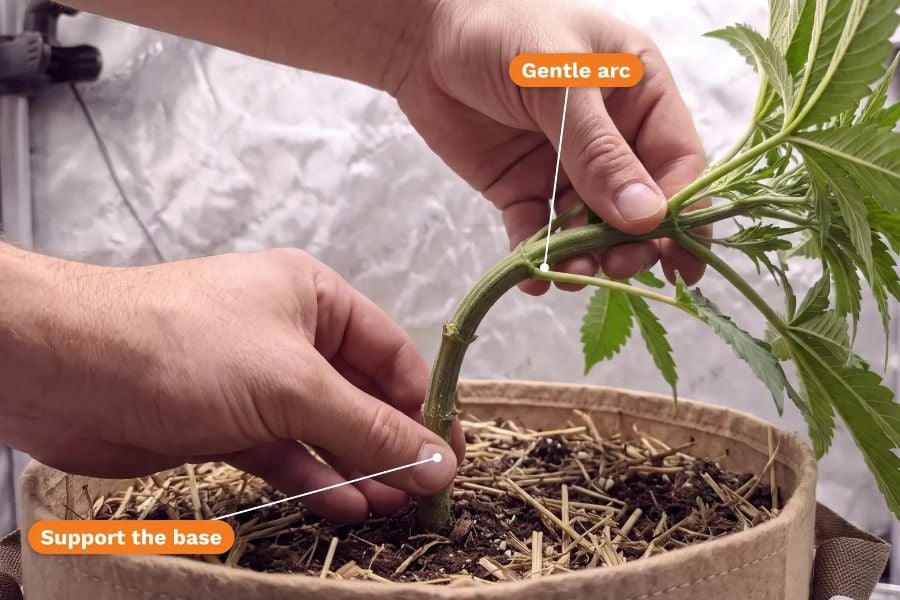
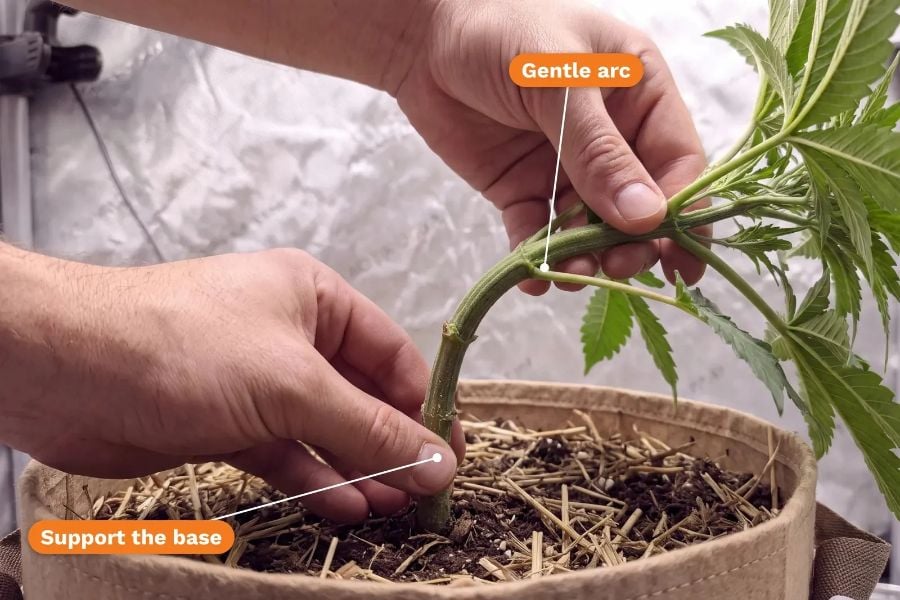
- Bend slowly into a gentle arc. Ease the stem down and away from the center without forming a sharp kink. If it resists, take it partway now and finish over the next few sessions. If a stem cracks, wrap it with plant tape and it will usually heal within a few days.
- Tie the stem loosely to an anchor. Once the stem is in position, secure it so the tip sits level with or below the side branches. That’s the height that takes away its lead. Use soft plant ties and leave a loop wider than the stem, so the tie holds without squeezing as the stem thickens.
- Re-check and adjust every few days. New growth pulls the plant out of position, so loosen, move, or re-anchor ties as it fills in. Watch for any tie starting to dig into a thickening stem.
- Repeat outward on each new tip. Bring any tip that rises above the canopy down and away from the center, then tie it toward an open part of the rim. Keep going throughout the veg period until the top of the plant is flat. Once flowering starts, switch to light tucks and tie checks.
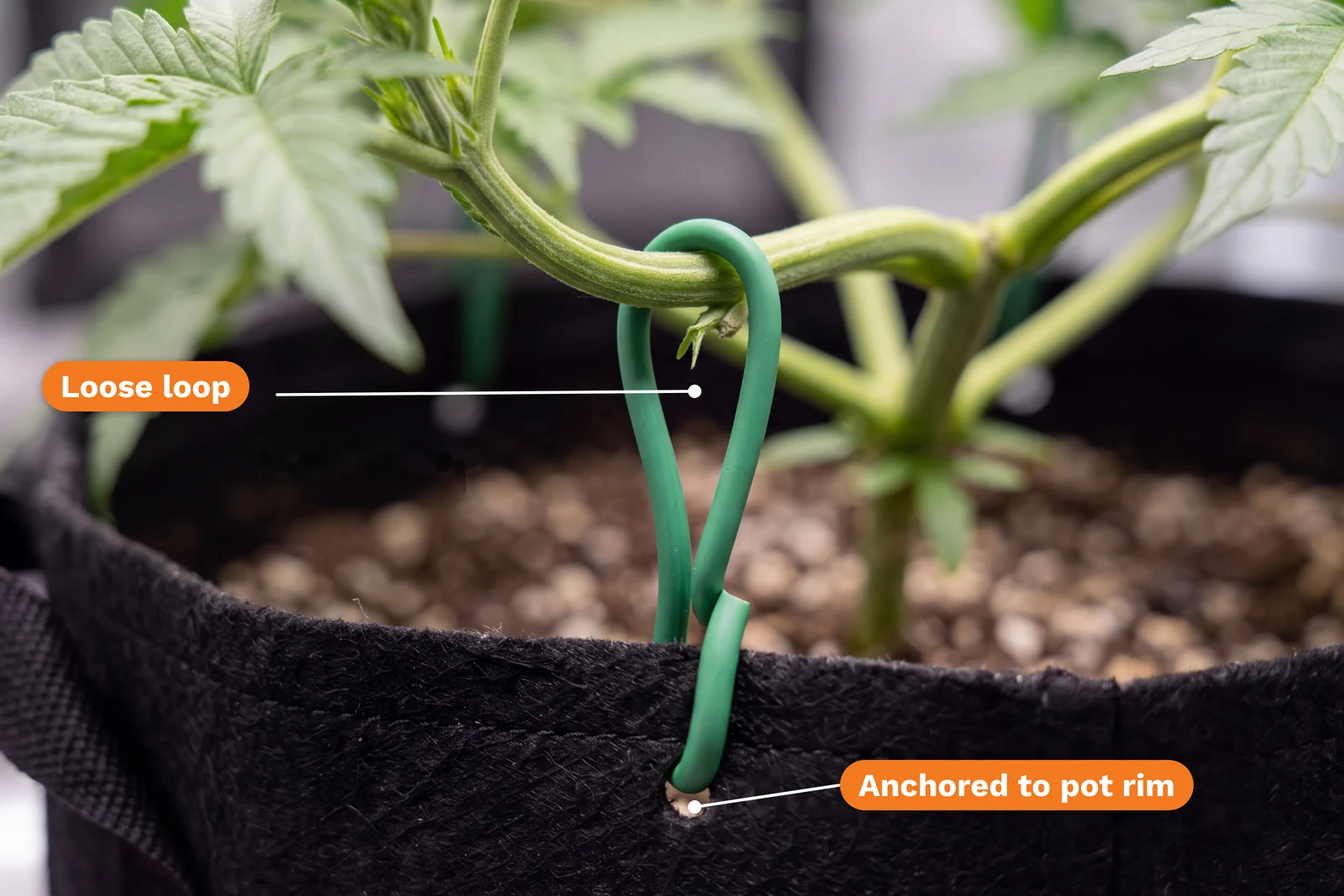
Not every correction needs a new tie. If a tip has only just pulled ahead, tuck it under an existing tie or a neighboring branch. Tucking is quicker and leaves nothing behind that could constrict the stem later.
Low Stress Training Diagram: The Pattern From Above
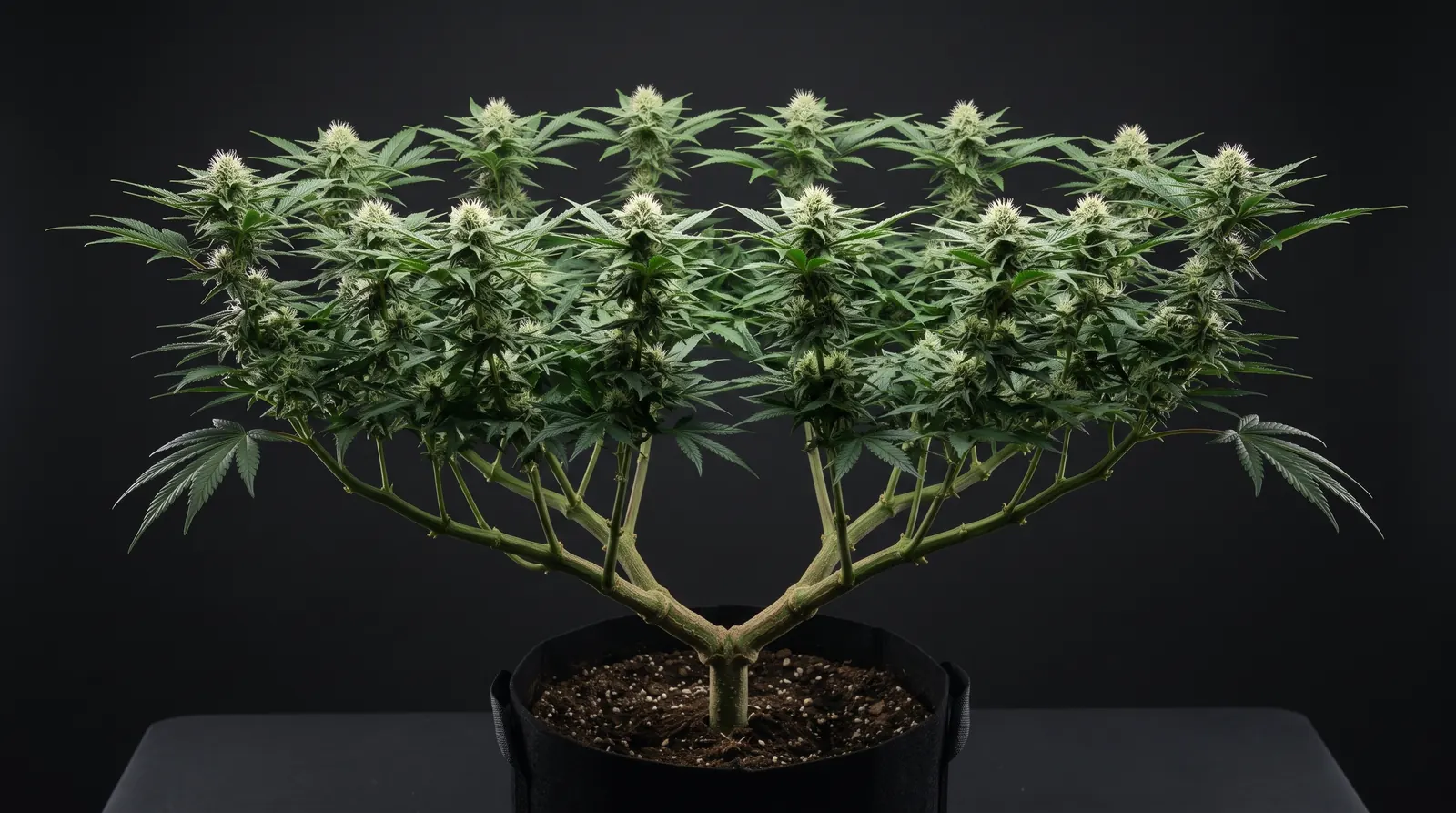
From above, a well-trained weed plant looks like a wheel, with branches spreading out from the base like spokes. The main stem is pulled toward one edge of the pot and tied there, so nothing stacks up over the middle. Each side branch is then drawn toward a different open part of the rim, giving every top its own space under the light.
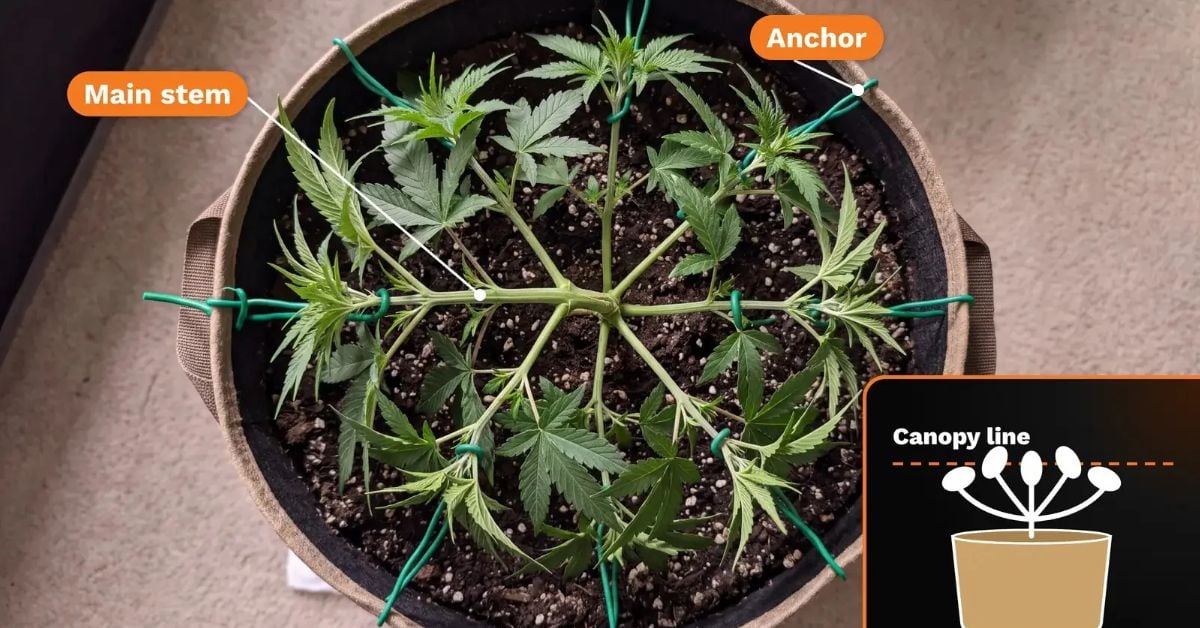
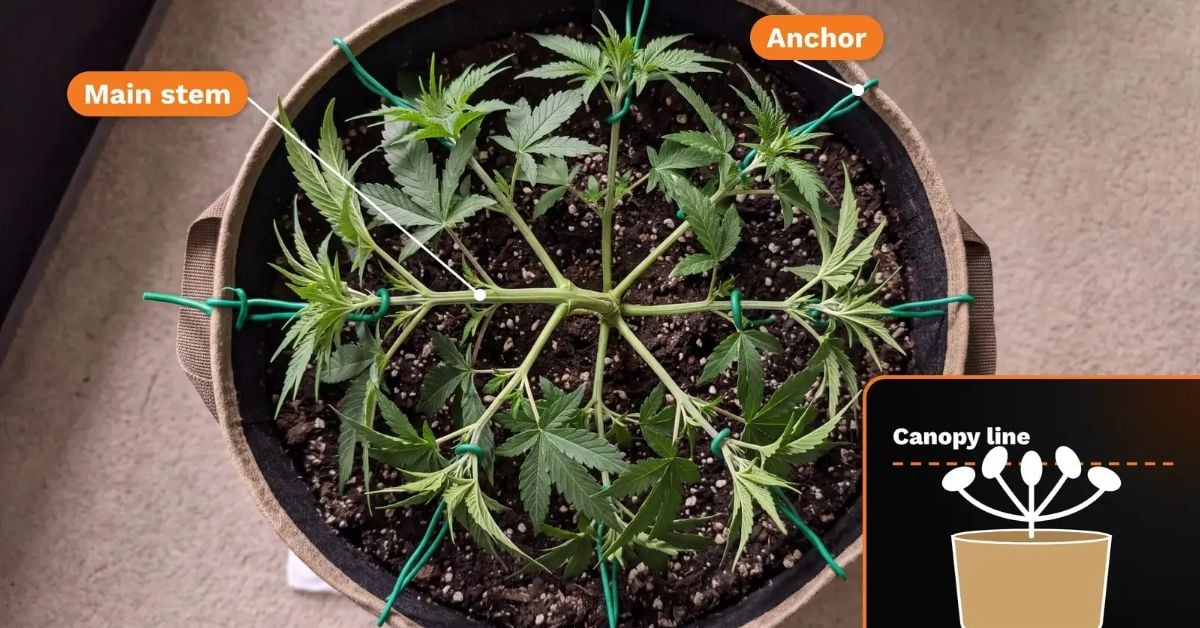
From the side, every tip sits at roughly the same height, called the canopy line. The plant keeps getting wider while its top stays level. A low stress training round is done when nothing pokes above that line. That usually lasts only a few days before new growth pushes a tip above it again.
Before and After Low Stress Training: What to Expect
After LST, your weed plant grows wider instead of taller, with several tops at a similar height and no single leader towering over the rest. Here's how a plant typically changes:
| Aspect | Before LST | After LST |
| Tops | One main leader well above the rest | Several tops at a similar height |
| Lower branches | Shaded and lagging behind | Thicker, turned upward, and catching up |
| Footprint | Narrow, with growth stacked over the center | Wider, spreading toward the pot rim |
| Canopy profile | Uneven, stepped from top to bottom | Flat and roughly level |
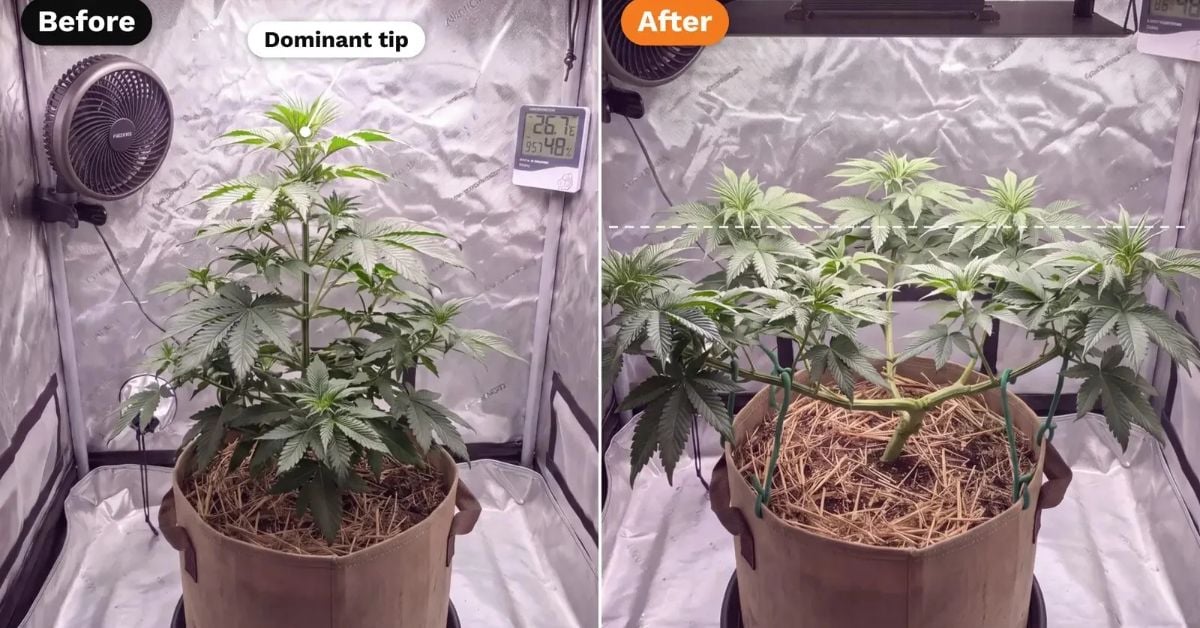
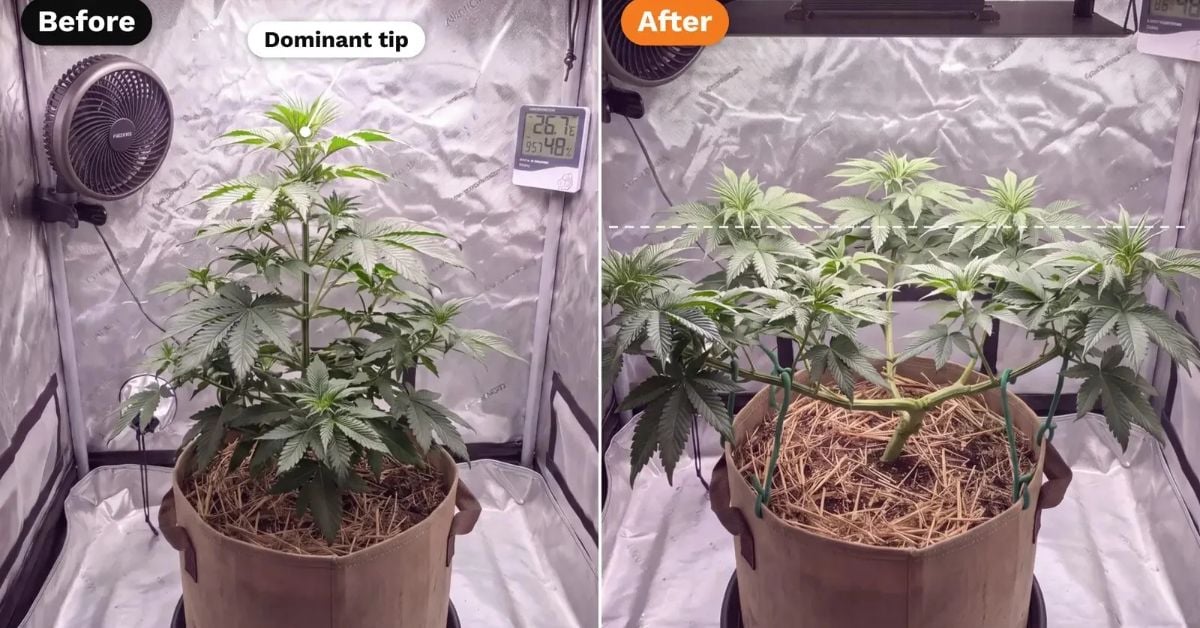
Changes start fast. Within a day of the first tie-down, the bent tip turns back up toward the light. Over the next few days, new shoots push up from the nodes along the bent stem, which are now the plant's high points.
Over the following weeks, the side branches thicken where they turn upward and the plant fills out sideways. Don't expect a bigger-looking plant. The clearest change is a wider spread with a level top.
Judge your progress by how even the canopy line is, not by how neat the plant looks. A lopsided plant with tops at a consistent height is doing its job. If two or three tops are level and one is still ahead, bring it down at your next check.
Common LST Training Mistakes and How to Fix Them
Most LST problems come from moving too fast, tying too tight, or starting too late. Catch them early and nearly all of them are fixable:
| LST Mistake | What You'll See | How to Fix It |
| Bending too fast or too far | The stem creaks, kinks sharply or splits along one side | Release some tension and finish the bend over several sessions |
| A cracked or split stem | A partial break with both sides still attached | Wrap it with soft plant tape so the broken edges touch, then leave it to heal |
| A fully snapped stem | The branch has come off completely | It won't reattach. Trim the stub cleanly and train the branches that are left |
| Ties left too tight | A dent where the tie sits or swelling on either side of it | Loosen the tie and move it to a slightly different spot on the stem |
| Starting too late | A woody main stem that resists bending | Leave the hardened stem alone and train the younger upper growth and new side branches |
| A crowded center | Growth bunching in the middle and shading itself | Spread the tips out toward the edges instead of adding more ties in the middle |
| A tip escaping the canopy | One stem climbing clear of the rest | Bring it back down at your next check, before it gets too thick to bend easily |
| Anchors pulling on the roots | The plant tilts or the medium lifts | Re-anchor to the pot rim, a stake, or a frame so the pull isn't on the root ball |
Low Stress Training vs High Stress Training
The main difference between low stress and high stress training (HST) is tissue damage. LST redirects growth by bending stems that stay intact. HST methods like topping redirect it by cutting or injuring the plant, so there's a wound and a recovery period attached.
| Aspect | Low Stress Training | High Stress Training |
| Technique | Bend and secure stems | Cut or deliberately injure growth |
| Tissue damage | None | Yes, by design |
| Recovery time | Little to none | A few days of slower growth |
| Your effort | Small adjustments every few days | Concentrated into single actions |
| Best for | Any grow you can check regularly, including autoflowers | Photoperiods with veg time to spare |
The real choice is about time. LST trades ongoing attention for no recovery pause. HST trades a short setback for a single action you don't have to maintain. That's why bending is the safer default for autoflowers working against a fixed clock.
You don't have to pick just one, though. A popular combo is topping your plants early to create several main colas, then using LST to spread them out across the pot. Topping multiplies the tops, and LST lines them up at the same height.
Which Weed Plants and Grow Spaces Benefit Most From LST?
Indoor grows with limited headroom and tall, stretchy plants with flexible stems and plenty of side branching benefit most from low stress training. Here’s how the payoff changes depending on the plant and the space:
- Sativa-leaning plants and stretchy hybrids: These gain the most, because they have the most height to redirect into width. Their thinner, more flexible stems also bend easily without cracking.
- Indica-leaning plants: They tend to grow short and bushy, with tight spacing between nodes, so they’re already close to the shape LST aims for. Training still evens out the canopy and opens up the dense center of the plant, where airflow is often poor.
- Tents and small grow rooms: The light hangs at a fixed height, so every inch of headroom counts. LST keeps tall plants under control. That makes stretchier genetics a realistic choice when you’re picking marijuana seeds for a tight space.
- Outdoor grows: The sun moves across the sky and reaches the plant from more than one angle, so light distance matters less. But a lower, wider plant still handles wind better, stays more discreet, and is easier to support with a cage or trellis. Start early in the season, before large photoperiods outgrow their ties.