Cannabis aphids are tiny, soft-bodied insects that suck sap from new growth and leaf undersides. Their color changes with species and life stage, so look for their pear shape and the two small tubes on their rear end instead. To get rid of them, spray or prune them off, follow up with insecticidal soap, and add beneficial insects.
At first, most growers don't spot these insects at all. They notice sticky leaves, oddly curled new growth, or a line of ants marching up a stem. Colonies build quickly, so catching the problem early matters more than which product you eventually reach for.
Start today with whatever you have on hand, and keep conventional insecticides as a last resort. Plants in flower narrow your options even further, because anything you put on a bud stays in the finished flower. This is especially important when growing autoflower weed, which has a shorter lifecycle and less time to recover from pest damage.
This guide covers cannabis aphid identification, damage, how fast they spread, treatment, and prevention, in that order.
How to Identify Cannabis Aphids on Plants
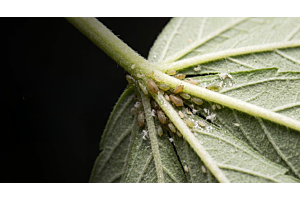
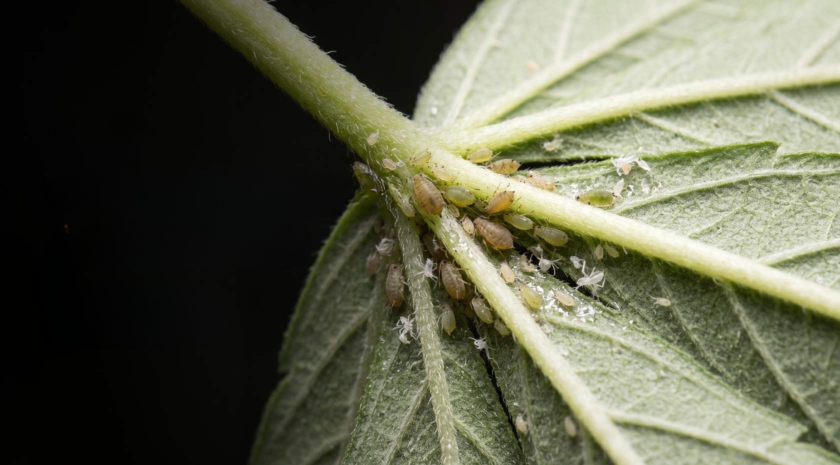
You can identify cannabis aphids by their body shape and where they feed. Look for soft, pear-shaped insects up to about 1/8 inch long, sitting in clusters on new growth and leaf undersides. The same pest can be green, black, brown, yellow, pink, red, or almost white, depending on species and life stage, so color alone isn’t a helpful clue.
One colony can hold adults, pale young, and winged individuals at the same time. Work from what the insect looks like and where it sits, and color stops being a problem.
What Do Aphids Look Like at Each Life Stage?
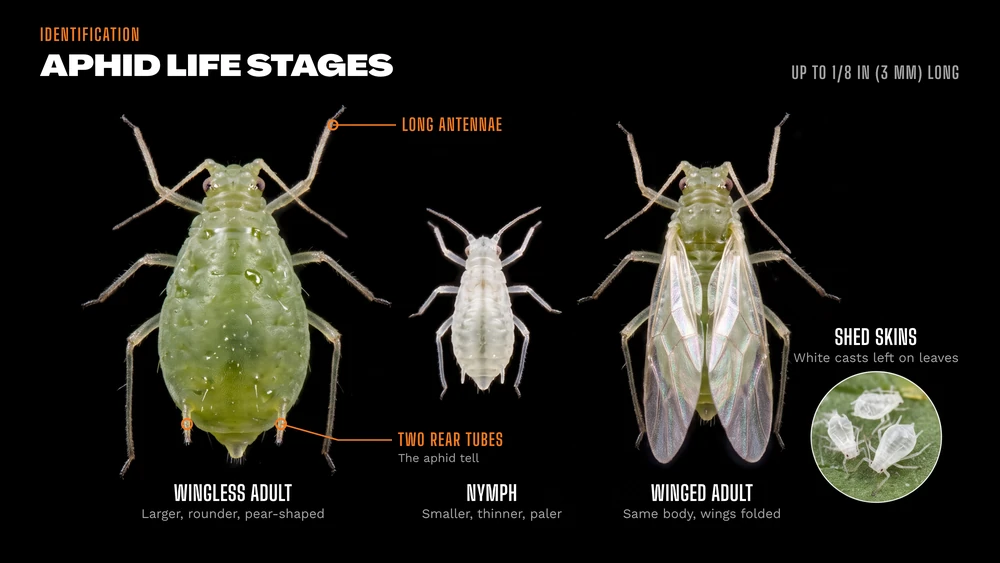
Adult aphids are soft and pear-shaped, with long antennae and two small tube-like projections at the rear. That rear pair of tubes is the detail that separates aphids from most other small insects on a cannabis leaf. The three forms you’ll see:
- Adults are the larger, rounder bodies in the cluster, and they're usually wingless while the colony is settled and feeding.
- Nymphs (the baby aphids) are smaller, thinner versions of the adults, often in a lighter shade of the same color. On a dark leaf or a bud they look like tiny specks, so they often get mistaken for eggs, mold, or thrips.
- Winged adults have the same body as the wingless ones. Growers call them greenflies or blackflies, but they're the same pest, not a new one.
During active growth, female aphids give birth to live young without mating, so indoors you’re looking for insects, not eggs. Outdoors, some species switch to mating in fall as the days shorten and lay tiny, glossy black eggs that survive the winter, often on nearby trees and shrubs.
Which Aphid Species Turn Up on Cannabis?
Most aphids found on cannabis are green peach aphids, but they aren’t the only ones. The cannabis aphid (Phorodon cannabis) feeds almost exclusively on hemp and cannabis, and black bean aphids show up now and then. Color varies within every one of those species, so you can't name yours from the shade of the cluster.
For most of what you're about to do, the species makes no difference. A contact spray kills any aphid it touches. The exception is biological control, where the beneficial insect is matched to the size of the aphid, so it pays to look closer if you're planning a release.
Where to Look on the Weed Plant
Cannabis aphids concentrate on soft, protected tissue, which is rarely the part of the plant growers look at most. Check these five places:
- Shoot tips and fresh leaves, the softest tissue on the plant and usually the first place a colony settles.
- Leaf undersides, the main protected feeding site and a place a quick glance never reaches.
- Stem junctions and the base of leaf stalks, where clusters tuck into the angle.
- Inside curled leaves, which you'll need to unfold, because the curl is both a symptom and a hiding place.
- Inside bud structure on flowering plants, where adults and pale nymphs settle between the calyxes.
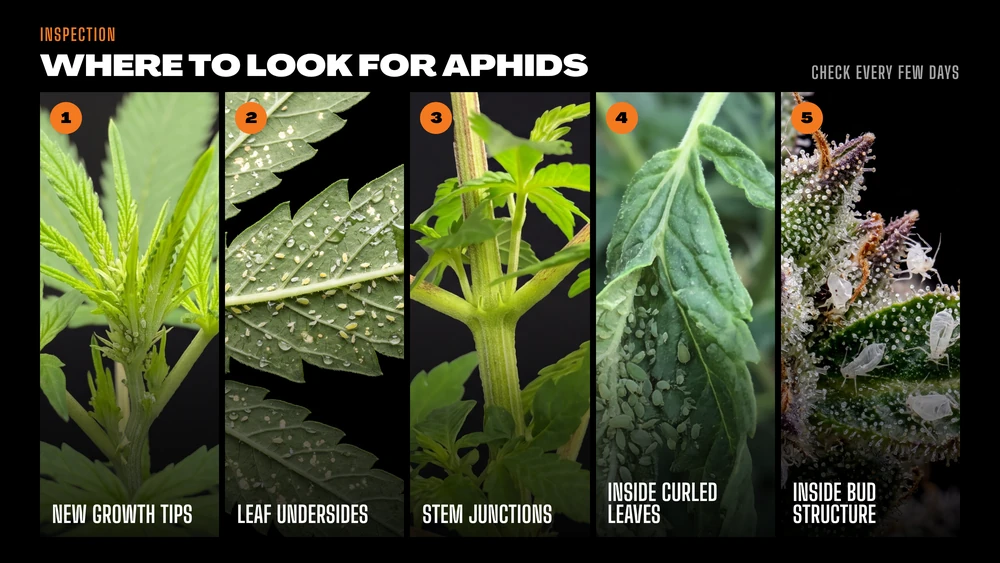
You're looking for clusters and pale specks, not a single insect. A hand lens makes an aphid infestation much easier to confirm.
Cannabis Pests That Get Mistaken for Aphids
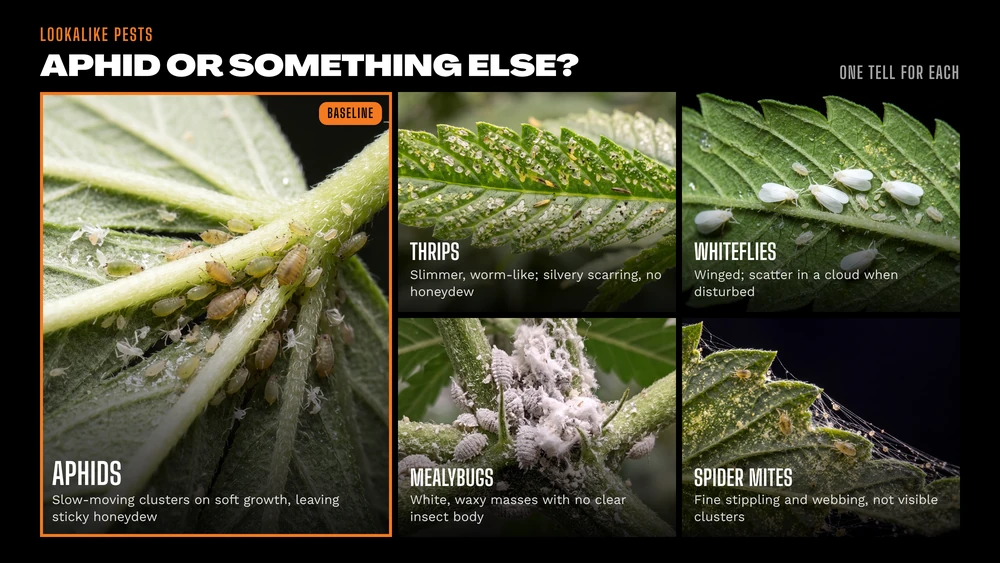
Thrips, whiteflies, fungus gnats, mealybugs, and spider mites are the cannabis pests most often mistaken for aphids, because they're a similar size and turn up in the same places. Aphids form slow-moving clusters and leave sticky residue, and each lookalike has one reliable tell:
- Thrips are slimmer and more worm-like than pale aphid nymphs, and they leave silvery scarring instead of sticky honeydew.
- Whiteflies have wings and scatter in a cloud when you disturb the plant, while aphids barely move.
- Fungus gnats are dark flies that rise off the surface of the growing medium instead of clustering on foliage.
- Mealybugs look like white, waxy masses with no clear insect body visible.
- Spider mites leave fine stippling and webbing, not clusters of visible insects.
Signs of an Aphid Infestation and the Damage They Cause
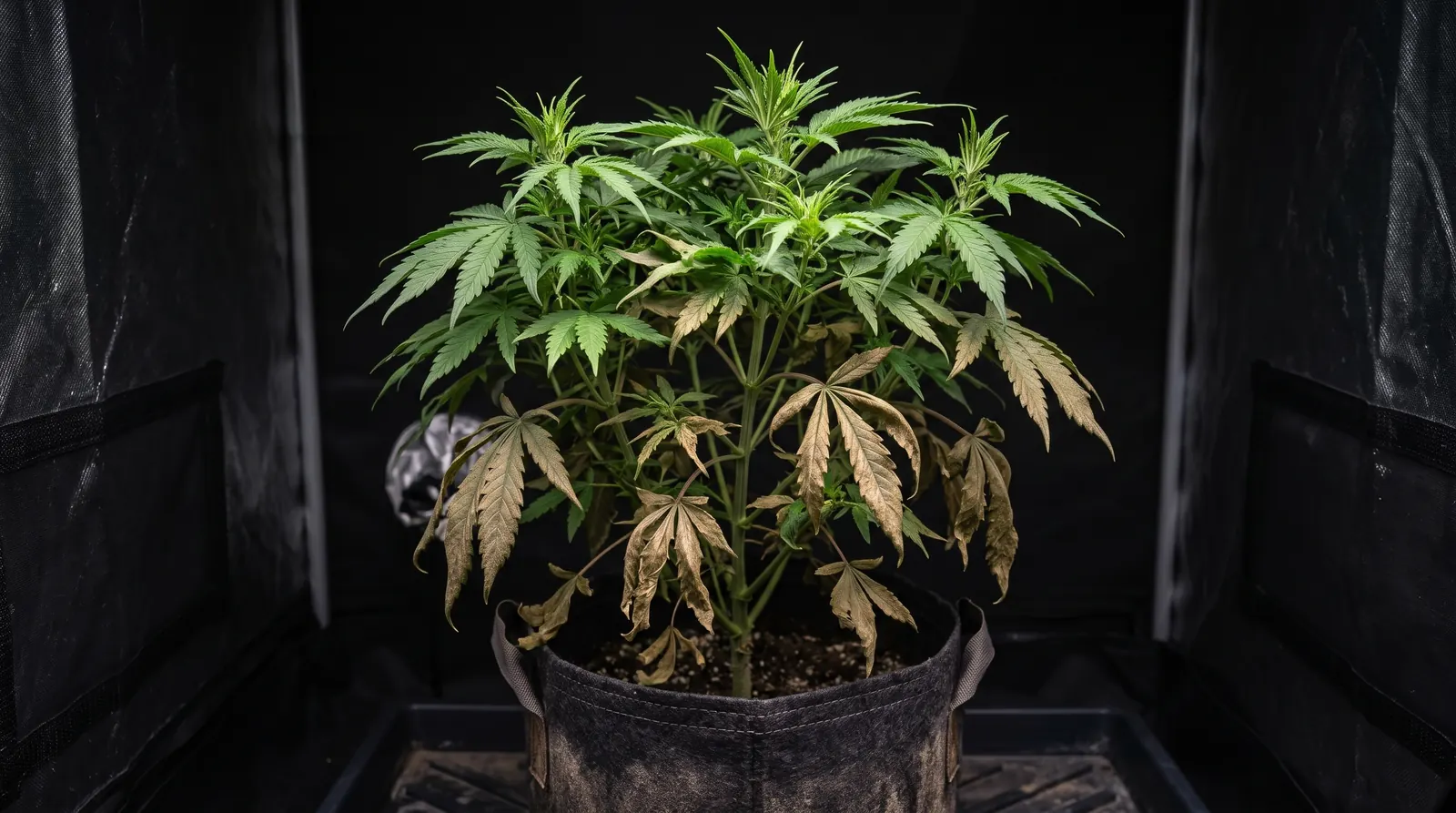
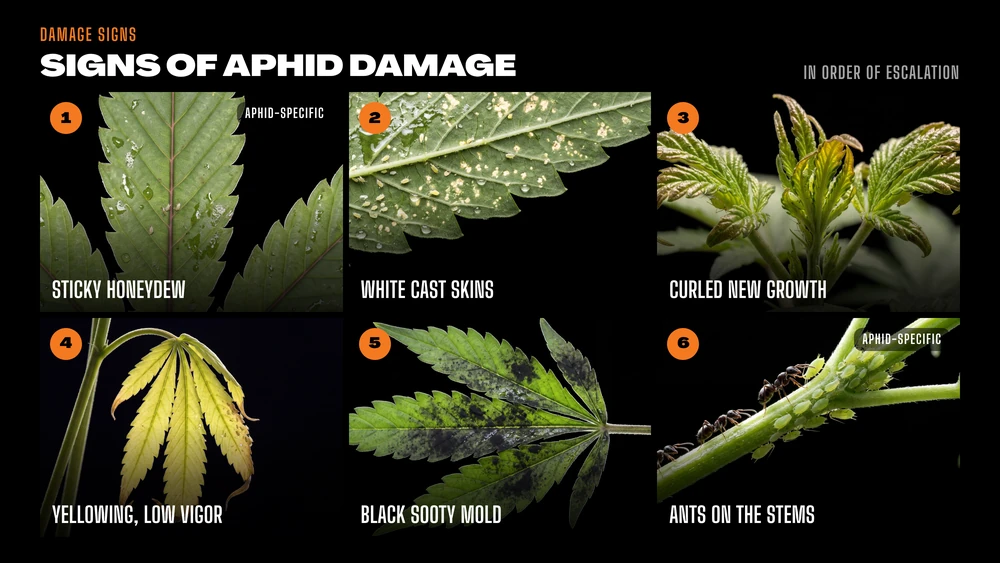
Aphids drain sap from new growth, which makes it curl and yellow, and heavy feeding leads to wilting and stunting. They also excrete sticky honeydew onto the leaves and buds. Black sooty mold grows on these honeydew deposits, and this, in turn, attracts ants that protect the colony. The white cast skins aphids shed as they grow stay behind after the insects move, too.
Sooty mold blackens tissue and interferes with normal leaf function, so the honeydew can end up doing more damage than the feeding itself. On flowering plants, this residue and the insects themselves physically contaminate the flower.
What you’ll actually see, roughly in order of escalation:
- Sticky, shiny patches on leaves and on anything sitting under the plant.
- White specks of cast skins on leaves and buds.
- Curled or twisted new growth.
- Yellowing and a general loss of vigor.
- A black film on leaves, stems, or bud material.
- Ants moving steadily up and down the stems.
Aphids can also transmit plant viruses and carry pathogen spores on their bodies, which is one more reason to address an infestation as soon as possible.
How Fast Aphids Multiply and How Often to Check Your Plants
Young aphids mature and start breeding in roughly 7 to 10 days in warm conditions, and each female produces several young per day. Check new growth and leaf undersides every few days during warm vegetative growth. Cooler temperatures slow the cycle, but don’t stretch checks out to a weekly walk-through.
That development window sets your checking interval. Space inspections further apart and a whole generation can arrive, mature, and start breeding between looks. That’s how a plant that looked clean at one check can carry a visible colony by the next.
Winged aphids are the other timing signal. They appear when the colony is crowded or the host plant is declining, which means dispersal is already underway, so when you see one, check the neighboring plants right away.
How to Get Rid of Aphids on Cannabis Plants
To get rid of aphids on cannabis plants, reduce the population physically first, follow with contact organics applied thoroughly and repeatedly, use biological control for sustained pressure, and keep conventional insecticides for last.
Numbers rebuild quickly, so starting today with the simplest option beats waiting three days for a better one. Rotating between products also lowers the chance of pests adapting to any one of them. Approval for cannabis varies by jurisdiction, so check the label and your local approved-product list before anything goes on your weed plant.
Step 1: Knock Down the Population Physically
Start by knocking the population down physically with water, pruning, and isolation. Fewer insects means fewer survivors between spray applications, so every step that follows works better.
Do these in order:
- Spray the aphids off with water. A firm stream knocks aphids off foliage and handles light infestations on its own, as long as it reaches the leaf undersides where colonies sit. Be sure to do this repeatedly, not just once.
- Prune the worst of the infestation. Cutting off heavily infested leaves and shoot tips removes a large share of the colony in one go.
- Isolate the marijuana plant. Move it away from the rest of the grow, and move it gently so you don't shake insects onto its neighbors on the way out.
- Inspect everything else. The affected plant is the one you know about, not necessarily the only one.
- Deal with any ants. Ants tend and defend aphid colonies, so they’ll undo your other steps if you leave them. Wrap tape around the base of the stem or pot and coat it with a sticky insect barrier, then set ant bait stations on the ground along their trail, away from the plant.
Step 2: Use Organic Sprays That Kill Aphids on Contact
Once the numbers are down, contact sprays like insecticidal soap, neem oil, pyrethrin, and spinosad kill the aphids that are left. They kill what they touch and leave little or nothing behind, so coverage and repeat timing decide the outcome. Remember to rotate products instead of leaning on one.
- Insecticidal soaps and fatty acid salts kill on contact by breaking down the insect's waxy outer layer. They leave very little residue, which is both the upside and the catch, because nothing stays behind to kill the nymphs that appear afterward.
- Neem oil disrupts feeding and reproduction. Oil and water separate, so keep mixing as you work, and apply it with the lights off or in the evening to lower the risk of leaf burn.
- Pyrethrin quickly knocks down exposed aphids but doesn't stay active for long. It’s derived from chrysanthemum-family flowers. Use it as a knockdown tool, not a standing defense.
- Spinosad kills aphids through contact or ingestion. It’s made by fermenting a soil bacterium, but the mixed solution doesn't stay effective for long, so only mix what you'll use and follow the label.
Two rules apply to every one of them. Wet the leaf undersides and growing tips or the application has failed before it started, and repeat across several days, because new nymphs keep coming from the aphids you missed.
Approval status for cannabis differs by jurisdiction, and some products sold to home growers aren't permitted commercially. The label and your local list decide what you can actually use, and flowering plants carry extra restrictions, covered below.
Step 3: Leverage Beneficial Insects and Biological Control
Once sprays have cut the numbers down, release beneficial insects like ladybugs, lacewings, or parasitoid wasps to keep aphids in check. They suppress the population gradually instead of clearing it in a week, which makes them a management tool, not a rescue.
Don’t rely on them alone against a heavy infestation, because they’re at their weakest against a huge population. After you release them, hold off on contact sprays, because the sprays kill beneficials as easily as they kill aphids.
- Ladybugs eat aphids as adults and as larvae, and the larvae are the more reliable feeders. Released adults often fly out of an indoor space within days.
- Lacewings usually arrive as eggs or young larvae, and it's the larvae that feed heavily on aphids. They do well in enclosed indoor rooms.
- Parasitoid wasps lay their eggs in aphids and leave bronze, papery mummies behind, and those mummies confirm the release is working. Different wasp types are matched to different aphid sizes, the one place where knowing your species pays off.
- Predatory midges are used by some growers against established hotspots and are generally sold for warm, humid conditions.
Releases usually fail for reasons that have nothing to do with the release rate. Parasitoid activity drops sharply in rooms that run too cold or too hot, so a program can quietly do nothing while the insects are alive and present.
Confirm the working temperature range with your supplier, and log temperature at canopy height across the full light cycle instead of trusting a daily average.
Why Chemical Insecticides Are a Last Resort
Chemical insecticides are a last resort because most garden-center products aren't safe for a plant you'll consume. If a product isn't considered appropriate for plants that will be eaten, it isn't appropriate for cannabis. That one test rules out most of what sits on the shelf.
- Systemic insecticides like imidacloprid move into plant tissue and persist there. That rules them out entirely for flowering cannabis and makes them questionable at any stage.
- Nervous-system insecticides like malathion, chlorpyrifos, and acephate are labeled for ornamentals and shade trees, and that's where they belong.
- Harsh chemical treatments can also damage the plant itself and harm beneficial organisms, including the ones living in your medium.
Exhaust the contact organics and biological options before you get here.
How to Get Rid of Aphids During Flowering
To get rid of aphids during flowering, stick to methods that leave nothing on the buds. Remove infested leaves and shoots by hand, spot-treat foliage away from the flowers, control ants, and release beneficial insects. Flowering changes what’s safe to put on the plant and how close to harvest you can still act.
Oils and strongly scented products, neem in particular, must not reach buds, because the taste and odor stay in the material you intend to consume. Avoid heavy canopy wetting too. Dense flowers hold moisture, and soaking them adds a mold risk on top of the pest you already have.
Buds already coated in honeydew, sooty mold, cast skins, and insect bodies are contaminated, and growers commonly cut that material away and discard it instead of trying to clean it. The closer you are to harvest, the more the job shifts from treating to triage.
Check anything you consider spraying in flower against the label and your local approved-product list, including any stated interval before harvest.
Root Aphids vs Leaf Aphids on Weed Plants
Root aphids are a different pest from the ones on your leaves. They feed on roots inside the growing medium, while leaf aphids feed on the foliage. That difference changes how you find and treat them.
A plant with root aphids stunts, yellows, and wilts while the canopy looks clean, so growers often mistake it for one of the many nutrient deficiencies or overwatering. Look for insects at the base of the stem or on the surface of the medium, and for winged aphids nearby.
Leaf sprays can’t reach root aphids, so if a thorough foliar treatment changed nothing, check the root zone. Once confirmed, treat a root aphid problem with soil-targeted drenches and beneficial organisms applied to the root zone.
A thin layer of clean sand over the medium also adds a physical barrier. Root aphids favor a consistently wet medium, so avoid keeping it soaked. Move infested containers slowly and keep the medium contained, because shed material spreads the problem wherever it lands.
How Aphids Get Into Your Grow and How to Keep Them Out
Indoors, aphids get in through unscreened vents, new plants, your clothing and tools, and raw soil. Outdoors, they simply fly in. To keep them out, close off each indoor route, avoid conditions that help them thrive, and scout regularly to catch whatever slips through.
How to close each indoor route:
- Unscreened intake vents let winged aphids fly straight in. Screen them, and hang yellow sticky traps near the canopy for early warning.
- Incoming plant material carries aphids and their young into a clean room. Quarantine and inspect new plants before they join the grow. A clone comes with a history you didn’t see, while starting from cannabis seeds gives you control of the plant from day one.
- Your own clothing, hands, and tools carry insects between rooms and in from the garden outside. Wash your hands, change clothes after working outdoors, and clean your tools between rooms.
- Raw or reused soil can bring pests in with the medium itself. Use a fresh, bagged potting mix instead of garden soil or medium from a previous grow.
Once aphids are inside, a few conditions make things worse. Soft, lush growth from heavy nitrogen feeding is linked to more aphid pressure, so don’t push extra nitrogen beyond what your plants need. Warmth speeds up breeding, so check more often when temperatures climb.
Keeping the space clean and clearing dead leaves and debris removes shelter and makes aphids easier to spot. An indoor room also has no natural predators, so your scouting routine is your main defense.
Outdoors, there’s no realistic way to stop winged aphids from flying into an open garden, so outdoor growing leans on early detection over exclusion. Plant companions like marigolds or chives nearby, and leave ladybugs, lacewings, and other resident predators alone to do their work.