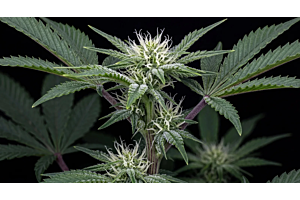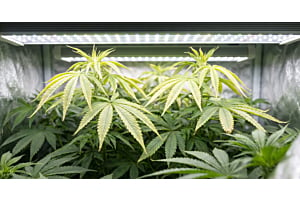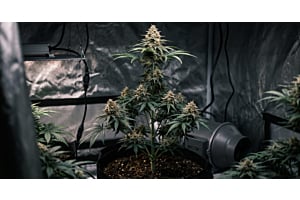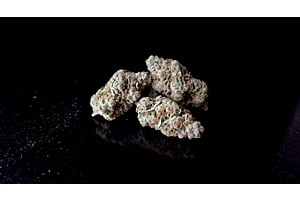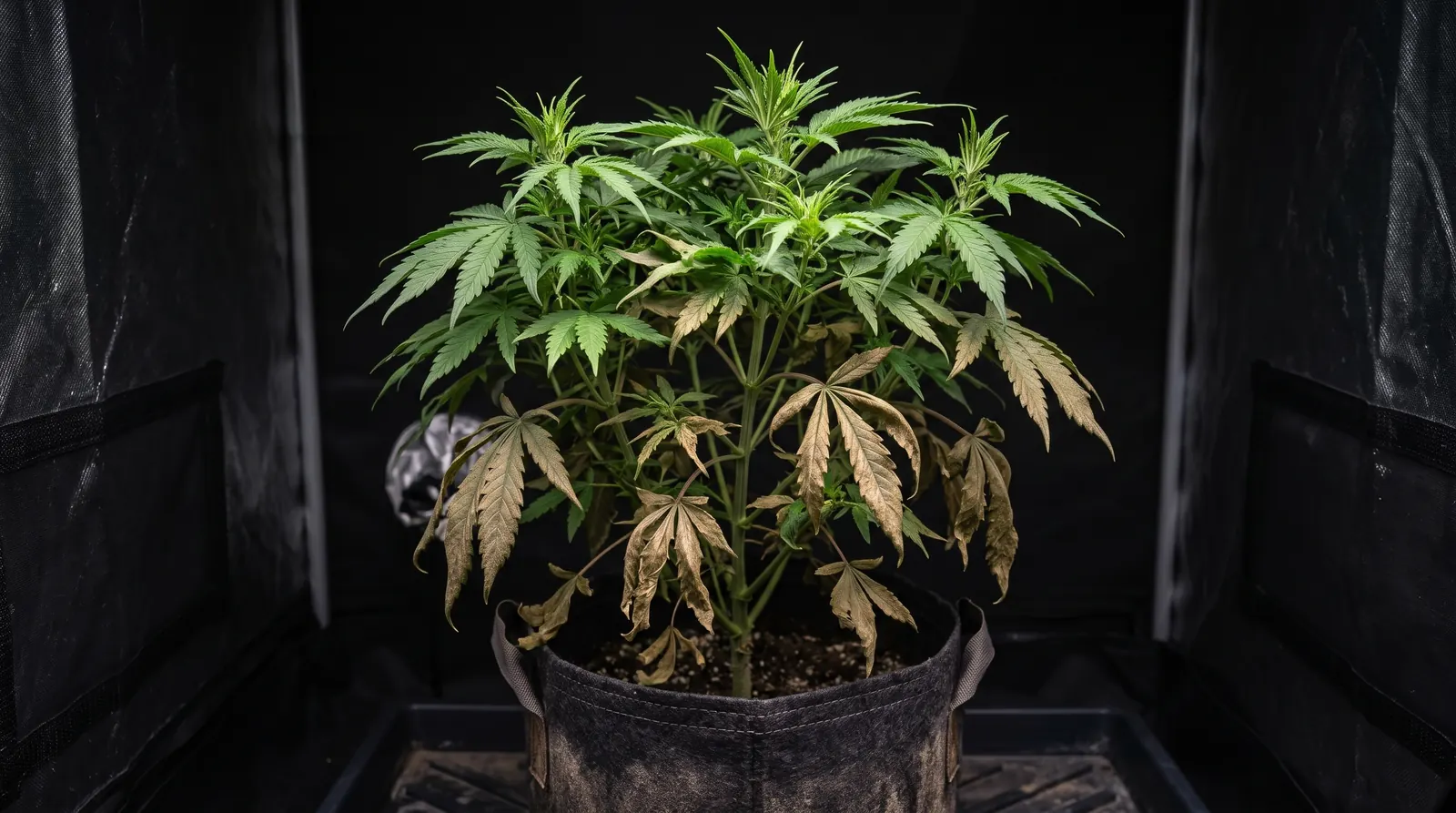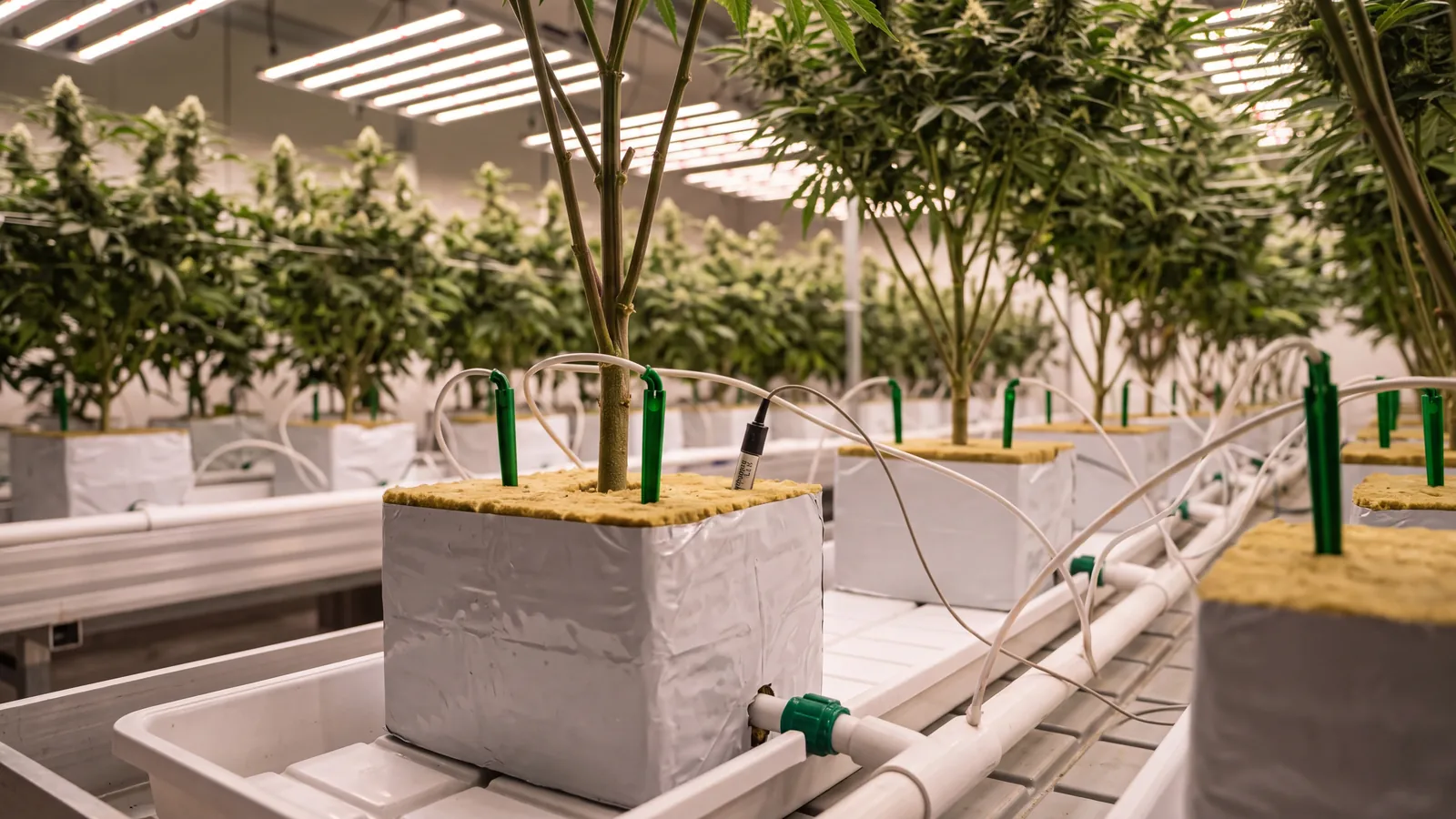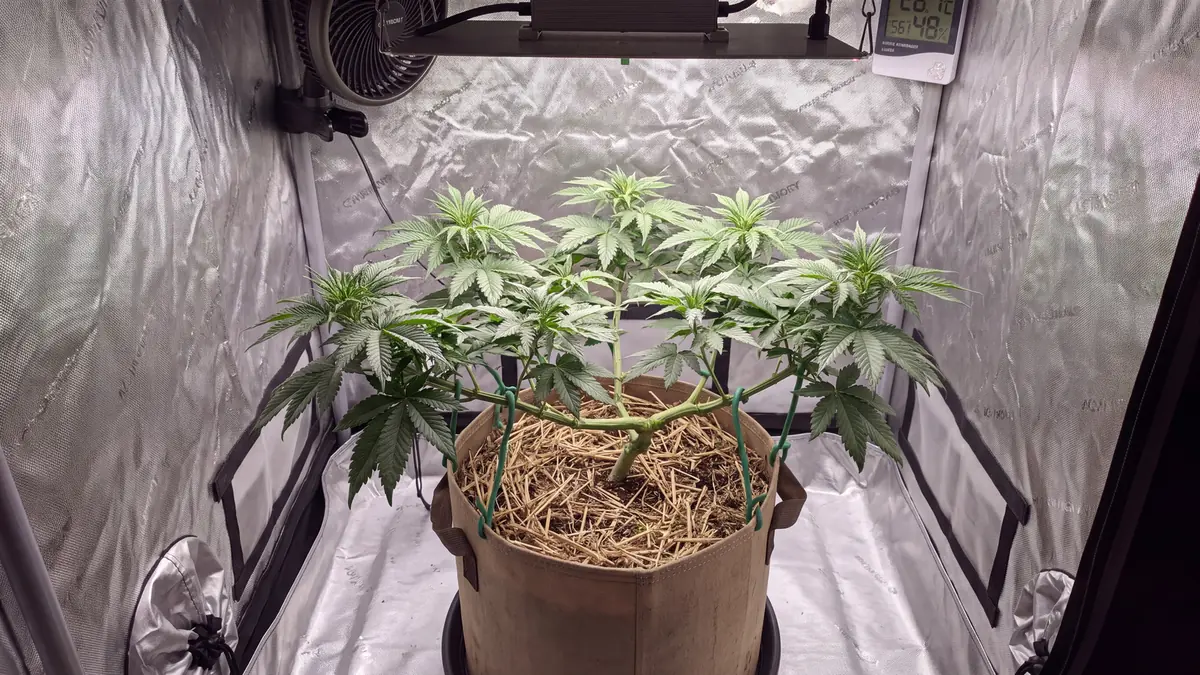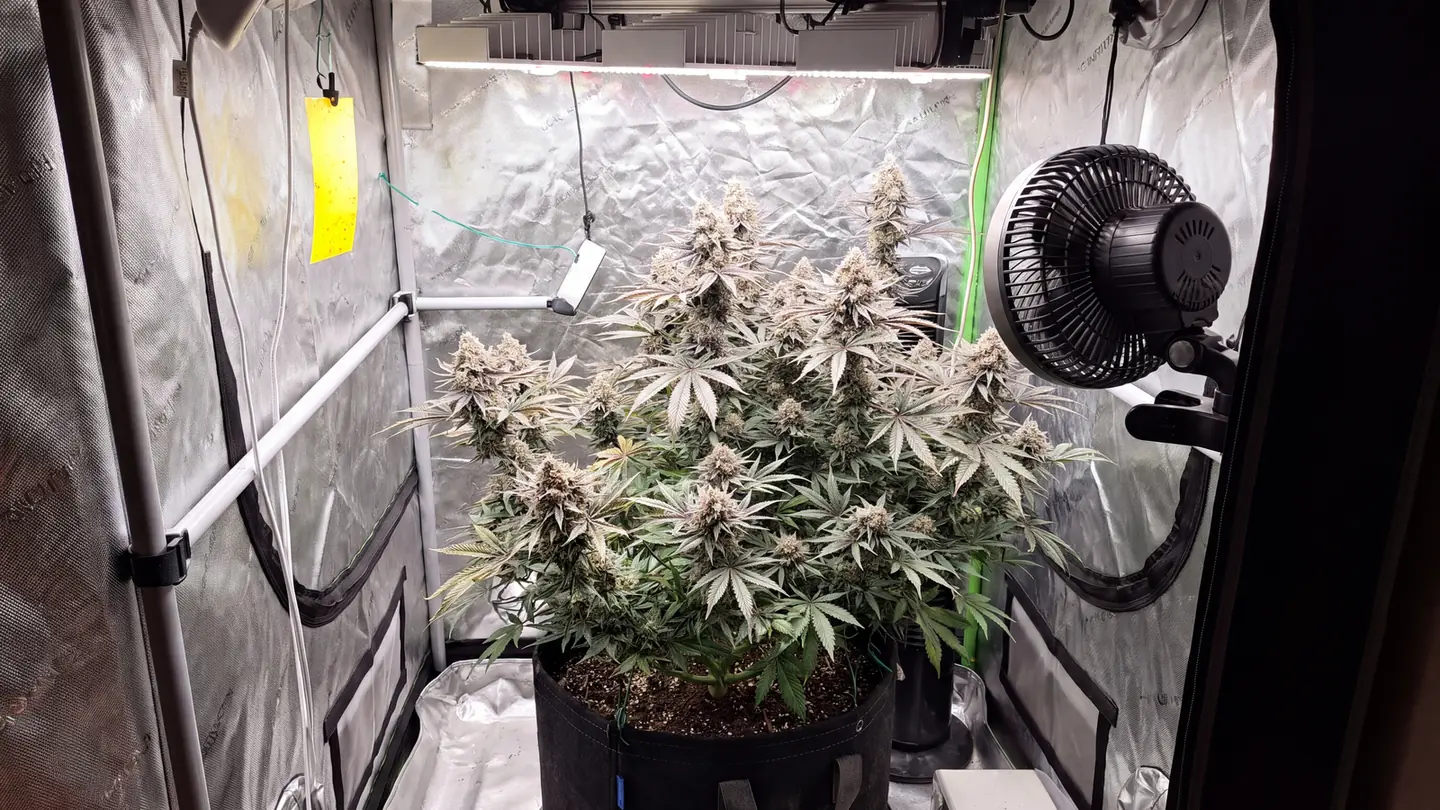
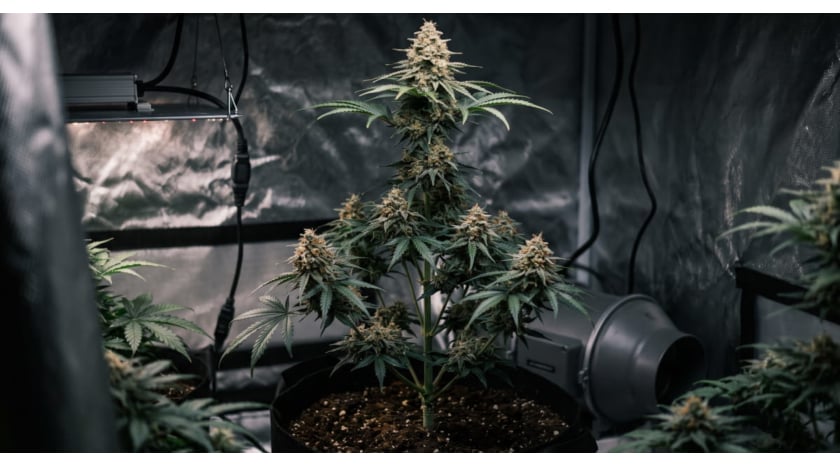
A marijuana plant looks like a green, bushy shrub with deeply cut, finger-like leaves, and at harvest, a healthy female shows off thick, frosted buds, too. Most people know the plant by its iconic leaf shape, but that only tells part of the story. The shape, size, and parts of a weed plant shift so much as it grows that two photos taken at different stages look surprisingly different.
Below, we'll walk through how a cannabis plant's appearance changes from seedling to harvest, name every part you can see from the roots to the cola, explain how to tell females from males, and help you separate cannabis from the plants that look like it.
What a Marijuana Plant Looks Like: The Short Answer
A marijuana plant is an upright, branching annual with large palmate leaves, each made of separate serrated leaflets radiating from one point. A mature female weed plant carries dense, resin-covered flower clusters at the tops, too. Leaves and stems are typically vivid to dark green, though some plants show purple tones, which comes down to genetics and temperature.
Left alone, a cannabis plant grows around a single dominant main stem, with branches getting shorter toward the top. That gives it a broadly conical outline, a bit like a loose Christmas tree, with the biggest flower cluster at the very top and smaller ones below it. Trained plants take on a flatter, more even shape instead.
Height varies too much to help with identification. Mature plants range from knee height to well over head height depending on variety, day length, and the space available. That means two weed plants with the same genetics can have vastly different heights.
How a Marijuana Plant's Appearance Changes as It Grows
A marijuana plant goes through four visibly different looks as it goes through the seedling, vegetative growth, pre-flowering, and flowering stages. A seedling with two round, smooth leaves has almost nothing in common with a flowering plant covered in frosted clusters. Growth patterns can also vary depending on the type of cannabis you're growing, with feminized weed and autoflower weed following different flowering schedules.
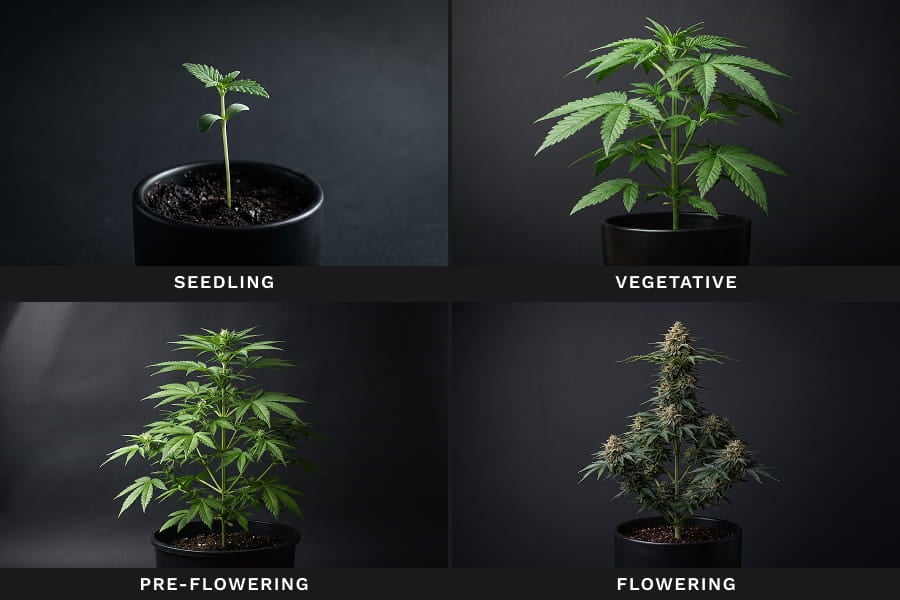
These stages also overlap. A weed plant can still be putting on vegetative growth on its lower branches while the top is already flowering, so one plant can show two stages at once. Treat the sequence below as the order in which features appear, with plenty of overlap between them.
The Seedling: Round Leaves, No Fingers Yet
A marijuana seedling's first leaves are a pair of small, rounded, smooth-edged leaves with no serrations and no fingers. These are the cotyledons, or seed leaves, and they've been folded up inside the seed the whole time, so nothing about them resembles the famous outline.
The first true leaves follow within days, usually as a pair, and each is typically a single toothed blade. The leaflet count builds with each new set of leaves, so don’t expect your young plant to look anything like a cannabis plant at first.
Vegetative Growth: When a Weed Plant Starts Looking Like the Picture
Vegetative growth is when a marijuana plant takes on the shape most photos show. The stem thickens and turns slightly square in cross-section, side branches push out, and the plant gains height quickly. It's all structure and leaf at this point, with nothing at the branch tips yet.
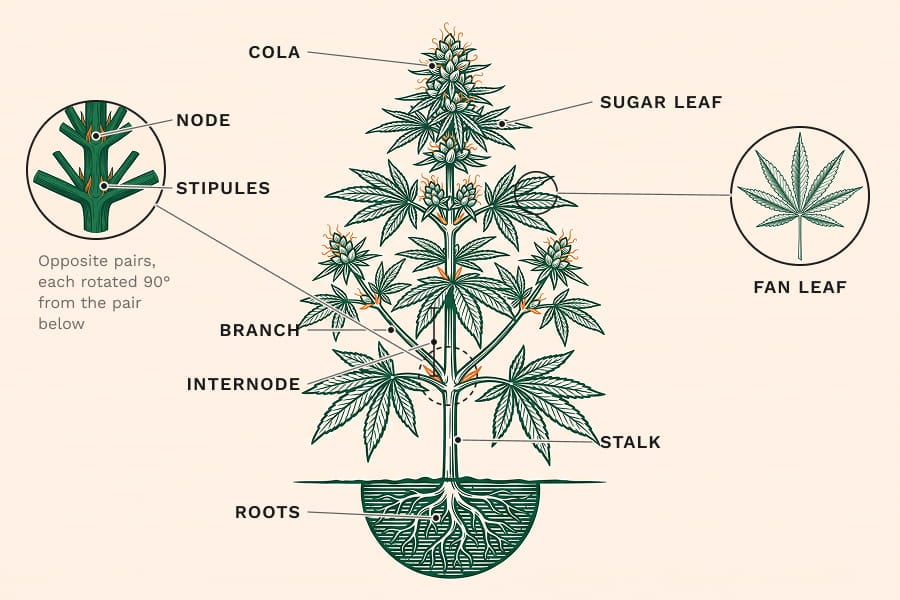
Look closely at the joints. On a young seed-grown plant in veg, leaves and branches grow from the stem in opposite pairs, one on each side at the same height, with every pair rotated roughly 90 degrees from the pair below.
Closer to flowering, that pattern often switches to alternate, with single leaves staggered up the stem. It's a small detail that tells you roughly where the plant is in its life.
At the base of each leaf stalk sit two thin, pointed stipules, and that's exactly where the first visible sign of the plant's sex shows up.
Pre-Flowering: The First Signs at the Nodes
Pre-flowering is when small structures appear at the nodes, tucked in against the stipules, before any flowers open. It's the earliest point you can tell a plant's sex by looking instead of guessing.
Nothing else about the marijuana plant changes dramatically, so this stage is easy to miss unless you check the joints. What those structures look like on females and males is covered in more detail further down.
Flowering: Dense Tops, White Pistils, and Frost
When a female marijuana plant flowers, clusters of small flowers form at the ends of the branches, sprout fine white hairs (pistils), and gradually turn dense and frosty. Early flowering looks thin and gappy, with plenty of space visible through each cluster.
But as flowering advances, the gaps close, the clusters swell sideways as well as upward, and the surface starts to glitter in good light. The pistils are the change most people watch. They darken from white through orange to rusty brown as the weed plant matures, though pistil color alone isn't a precise measure of how far along a plant is.
How Long a Weed Plant Holds Each Look
From seed to harvest, an indoor marijuana plant usually takes roughly 3 to 5 months, and vegetative growth is the stage that varies most. Here's how long each look typically lasts:
| Stage | Typical duration |
| Germination | 1 to 10 days |
| Seedling | 1 to 3 weeks |
| Vegetative growth | 3 to 8+ weeks, the most variable stage of all |
| Pre-flowering | 1 to 2 weeks |
| Mid to late flowering | 6 to 8 weeks, 4 to 6 weeks for faster varieties, and 8 to 10 weeks for slower ones, with some taking up to 12 weeks |
| Total seed to harvest | Roughly 3 to 5 months indoors |
The length of each stage largely depends on strain genetics and growing conditions. Indoors, photoperiod plants stay in veg until the lights switch to 12/12, so growers decide how long that stage lasts. Outdoors, the seasons set the schedule, so an outdoor grow from seed to harvest often takes longer, around 5 to 7 months.
Plants grown from autoflowering marijuana seeds start flowering based on age instead of waiting for a 12/12 light schedule. Their ruderalis genetics shorten veg and flowering length, which usually means a smaller plant at the finish.
The Parts of a Marijuana Plant, From Root to Cola
From the bottom up, a marijuana plant is made of three systems: a support and transport system (roots, stalk, and branches), a light-collecting system (leaves), and a reproductive system (the flower clusters and everything inside them). Most of the terms that trip up newcomers belong to that last group.
Cannabis Roots, Stalks, Branches, and Nodes
The roots, stalk, branches, and nodes make up the cannabis plant’s framework, moving water and nutrients and holding everything else up. Here’s how each part works:
- Roots: These sit hidden in the soil or other growing medium, where they absorb water and nutrients and anchor the plant so the top growth has something to stand on.
- Stalk: The main central stem that carries water, nutrients, and sugars up from the roots and physically supports every branch and flower above it.
- Branches: These grow out from the stalk and do the same job on a smaller scale, carrying the leaves and flowers.
- Nodes: These are the points where a leaf, branch, or flower joins a stem. They’re also where the first pre-flowers appear, so nodes are the place to check when you want to know a plant’s sex.
- Internodes: The bare stretch of stem between two nodes is an internode, and its length sets how far apart the growth points sit.
- Stipules: Every leaf stalk has a pair of these thin, pointed structures at its base. They’re smaller than a grain of rice and appear at every leaf joint from early growth onward, so they’re easy to overlook until you need them.
Fan Leaves and Sugar Leaves
Fan leaves are the large leaves along the stem and a weed plant's main light collectors, while sugar leaves are the small leaves tucked into the buds. Each fan leaf is palmate, with several separate toothed leaflets radiating from a single point, and together they drive photosynthesis and take in CO₂.
The number of fingers on a fan leaf isn't fixed, and it varies within a single plant:
- One leaflet, then three, then five on the earliest growth.
- Commonly seven or nine on the largest fan leaves during full vegetative growth.
- Eleven or thirteen on some plants, usually on the biggest leaves around the middle of the stem.
- Back down to three or even one near the flowering tops, where leaves get smaller and simpler.
That means you can't identify a cannabis variety, age, or species on leaf-finger count alone. It mainly tells you which part of the plant you're looking at more than anything else.
Sugar leaves are often coated in so much resin that they look dusted with sugar, which is where the name comes from. Most come off during trimming after harvest, and that's why dried flower looks much tidier than the living plant.
Inside a Bud: Bracts, Stigmas, Trichomes, and the Cola
A bud is a tight cluster of many small flowers (often dozens or even hundreds) that grow so close together they read as a single mass. Buds form at the nodes along each branch, with the biggest ones at the tips. Here’s what you’re looking at inside a flowering top:
- Bracts (Calyxes): Small, teardrop-shaped, leaf-like structures that form the body of each female flower. They enclose the reproductive parts and carry a heavy load of resin glands. Growers often call them calyxes, using the two terms loosely as synonyms.
- Stigmas (Pistils): The two fine hairs emerging from each flower, which catch pollen. Most people call them pistils, but the stigmas are technically part of the pistil, so a hair on a bud is one structure with two names.
- Trichomes: Tiny glandular structures with a short stalk and a rounded head, concentrated on the bracts and sugar leaves. At arm’s length, trichomes look like glitter or frost. Under a hand lens, they look like a forest of tiny stalked mushrooms.
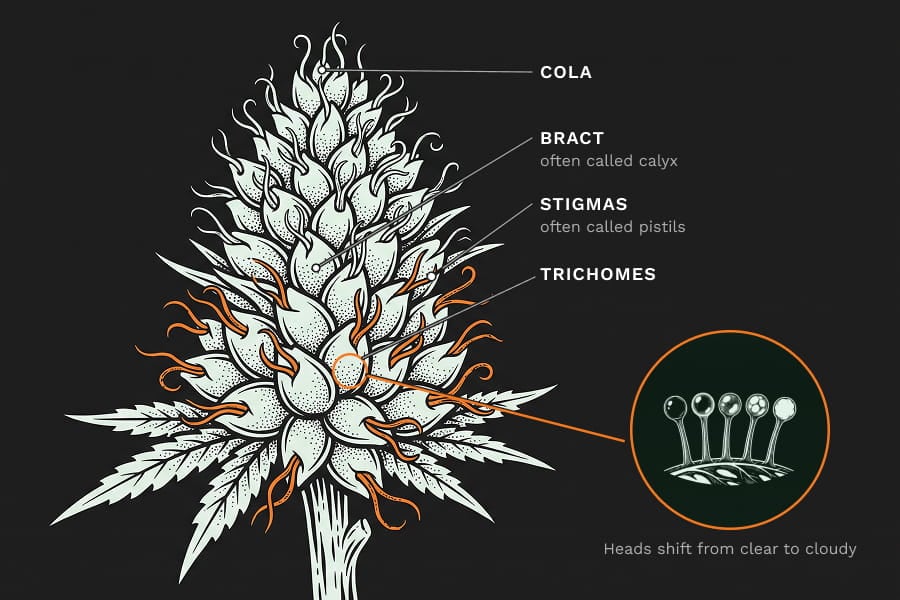
Trichomes produce and store the plant’s cannabinoids and terpenes. They also help defend the plant, deterring pests with their chemistry and trapping smaller ones in their stickiness. As the plant matures, the trichome heads shift from clear to cloudy to amber, a change you can see on the surface of a mature top.
- The Cola: Where many buds merge into one long column at the top of a stem. On an untrained female cannabis plant, the main cola crowns the main stem as the largest flower mass, with smaller side colas on strong branches. Topped or trained plants grow several colas of similar size, which gives them that flat, even canopy.
Female vs Male Marijuana Plants: What to Look For
To tell female and male marijuana plants apart, check the nodes at pre-flowering. A female grows a small teardrop-shaped bract with two fine white hairs, while a male grows small, round pollen sacs with no hairs at all. Cannabis is normally dioecious, meaning male and female reproductive structures grow on separate plants. Here's how the two compare as they develop:
| What to Look For | Female Weed Plant | Male Weed Plant |
| Structure at the node | Small teardrop-shaped bract | Small round, smooth pollen sac |
| Fine hairs | Two, white at first, emerging from the bract | None |
| As it develops | Bracts multiply and pack into clusters | Sacs hang in loose bunches, later opening to shed pollen |
| Mature top | Dense, fuzzy, resin-coated mass | Open and airy, clusters hanging clear of the stem |
| What it produces | Flower clusters | Pollen |
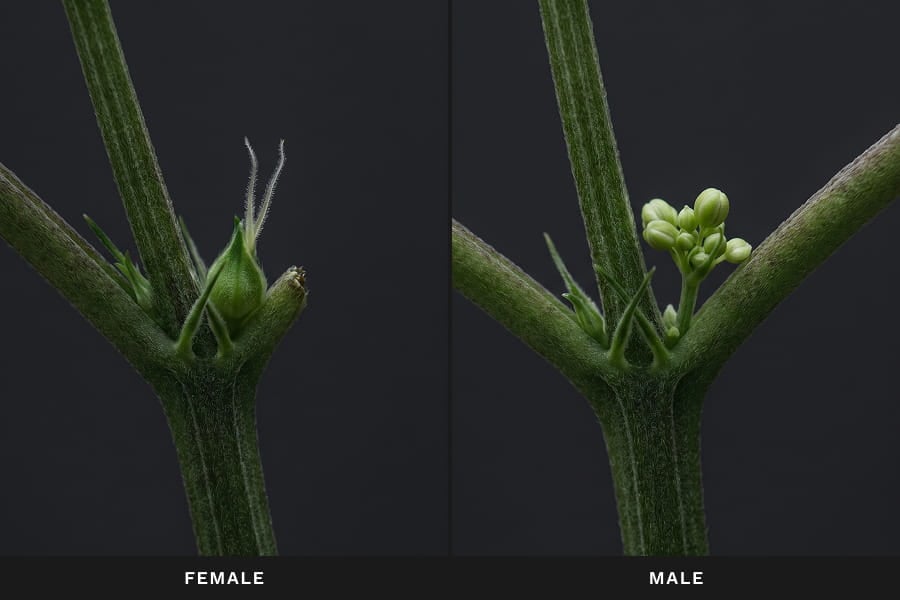
These reproductive structures are less than a quarter inch long, so check the nodes closely. Once plants mature, the difference in the tops is easy to spot from across a room.
Occasionally, one cannabis plant carries both structures at once. This is called a hermaphrodite or “hermie,” and while it’s uncommon, you can spot it the same way — by finding both the hairs and the round pollen sacs on the same plant.
While a female plant bears buds, a male plant does the other half of the reproductive job by producing pollen. Growers generally keep males away from flowering females because pollination fills the buds with seeds and can ruin a harvest.
That’s why feminized weed seeds are the go-to for most — they’re bred to produce females. Males still play a big role in breeding, though.
What Plant Shape Can’t Tell You
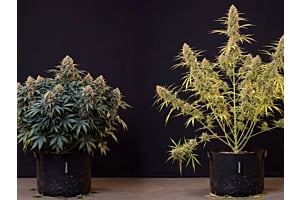
Plant shape can hint at whether a marijuana plant leans indica or sativa, but it can’t confirm it. Most modern strains are hybrids, so many plants show a mix of traits from both sides of their family tree. As a general guide, plants grown from indica seeds tend to be short and bushy with broad leaflets, while sativa plants usually grow taller and more open with longer, narrower leaves.
A weed plant inherits its shape from both its parents, so a cross can lean either way or land somewhere in between. Even cannabis seeds from the same pack can grow into different phenotypes, or phenos, with one plant taking after its indica parent and another favoring its sativa side. Growing conditions add to the variation. Light, space, and training all affect how tall and wide a plant gets, so its shape won’t always match the label on the pack.
Autoflowers add another layer. They get their autoflowering traits from ruderalis, a small, hardy type sometimes named alongside indica and sativa. Because they start flowering based on age, autos often stay smaller and reach their final form sooner than the indica or sativa genetics they’re crossed with would suggest.
Hemp is the hardest case of all. It belongs to the same plant species as cannabis, but each one is bred for different purposes, and a key difference between them is THC content. Since a plant can look very similar either way, appearance alone can’t reliably tell them apart.
How to Tell Cannabis Apart From Lookalike Plants
To tell cannabis from lookalike plants, check the flowering tops (or pollen sacs), stipules, and growth pattern before the leaves. Several ornamental and wild plants have serrated palmate leaves close enough to fool people every summer. Here are the features to look for, ranked from most to least reliable:
- The flowering tops (or pollen sacs): No other plant produces that dense cluster of small flowers with bracts, paired hairs, and a frosty surface you’d find on a female weed plant, so this is as close to conclusive as looking gets. A flowering male is less distinctive, with loose bunches of small, round pollen sacs hanging from the nodes.
- The stipules: The two thin, pointed structures at the base of every leaf stalk, present long before any flowers.
- The arrangement of young growth: Leaves and branches in opposite pairs, each pair rotated about 90 degrees from the one below.
- The leaf outline: Fine for a first glance but nearly useless alone, because it's the one feature cannabis shares with its lookalikes.
Males and plants without flowers are harder to confirm, so that’s when the stipules and growth pattern do the heavy lifting. Check those two first, then let the flowers or pollen sacs settle it once they appear.