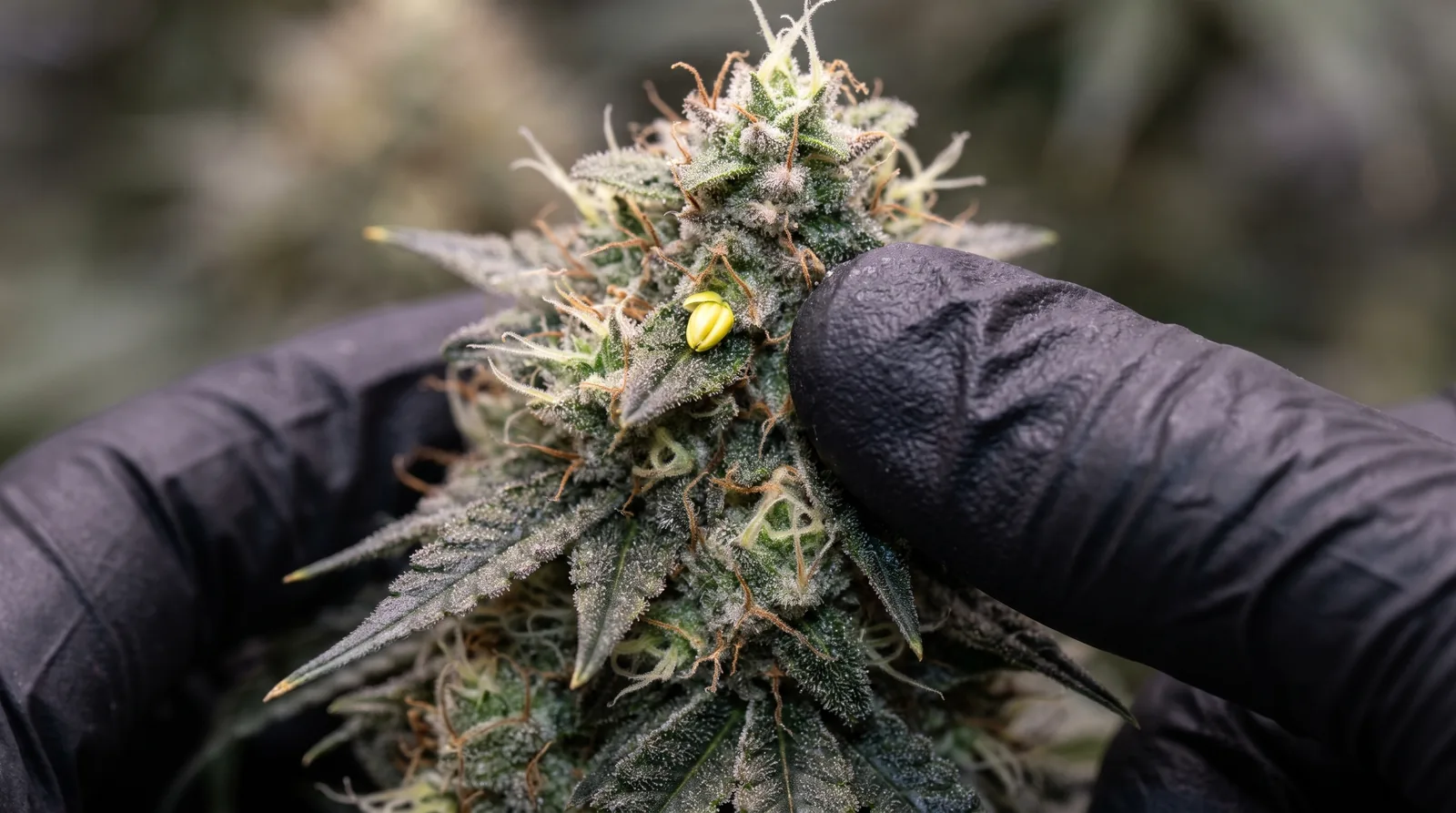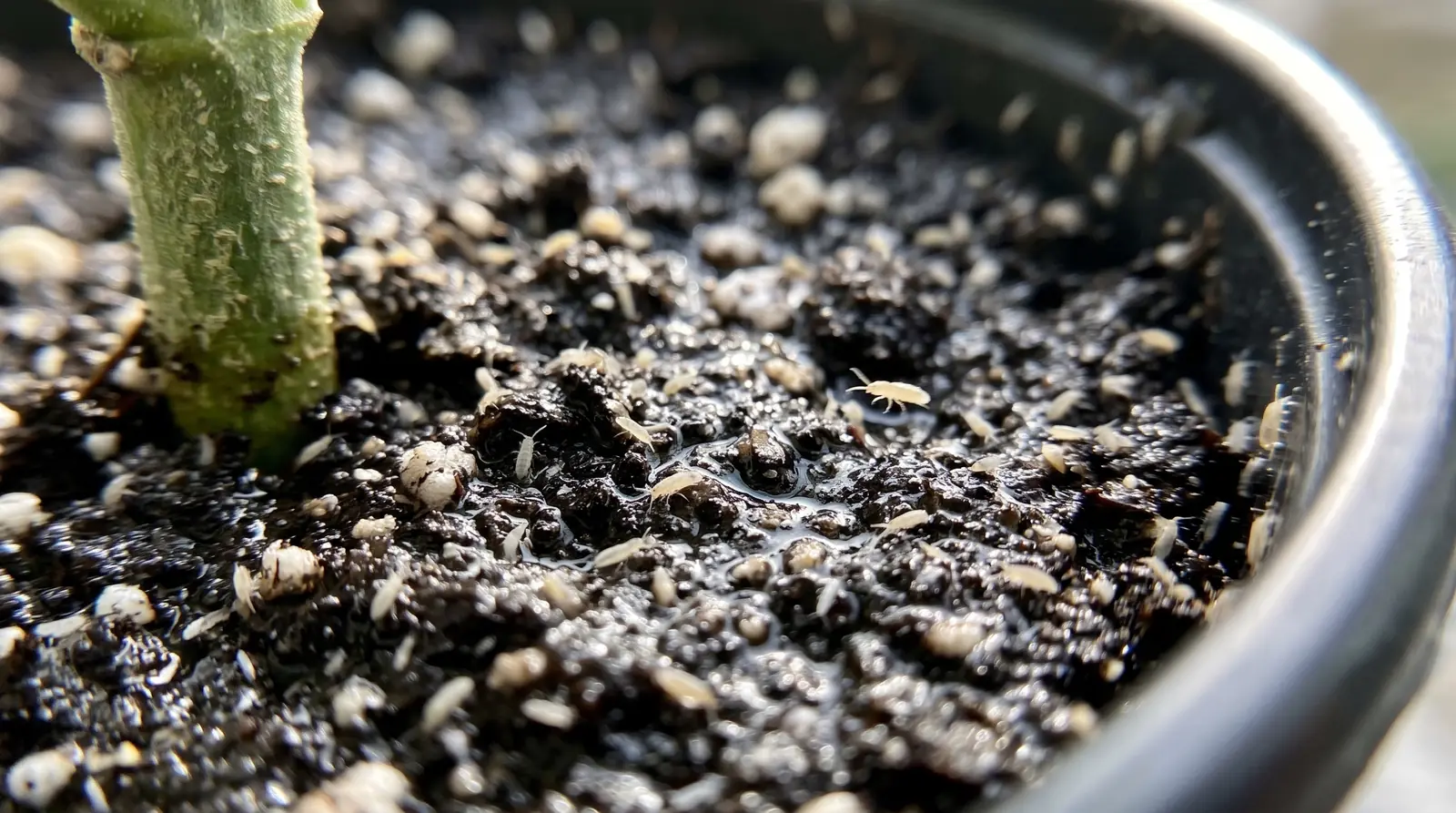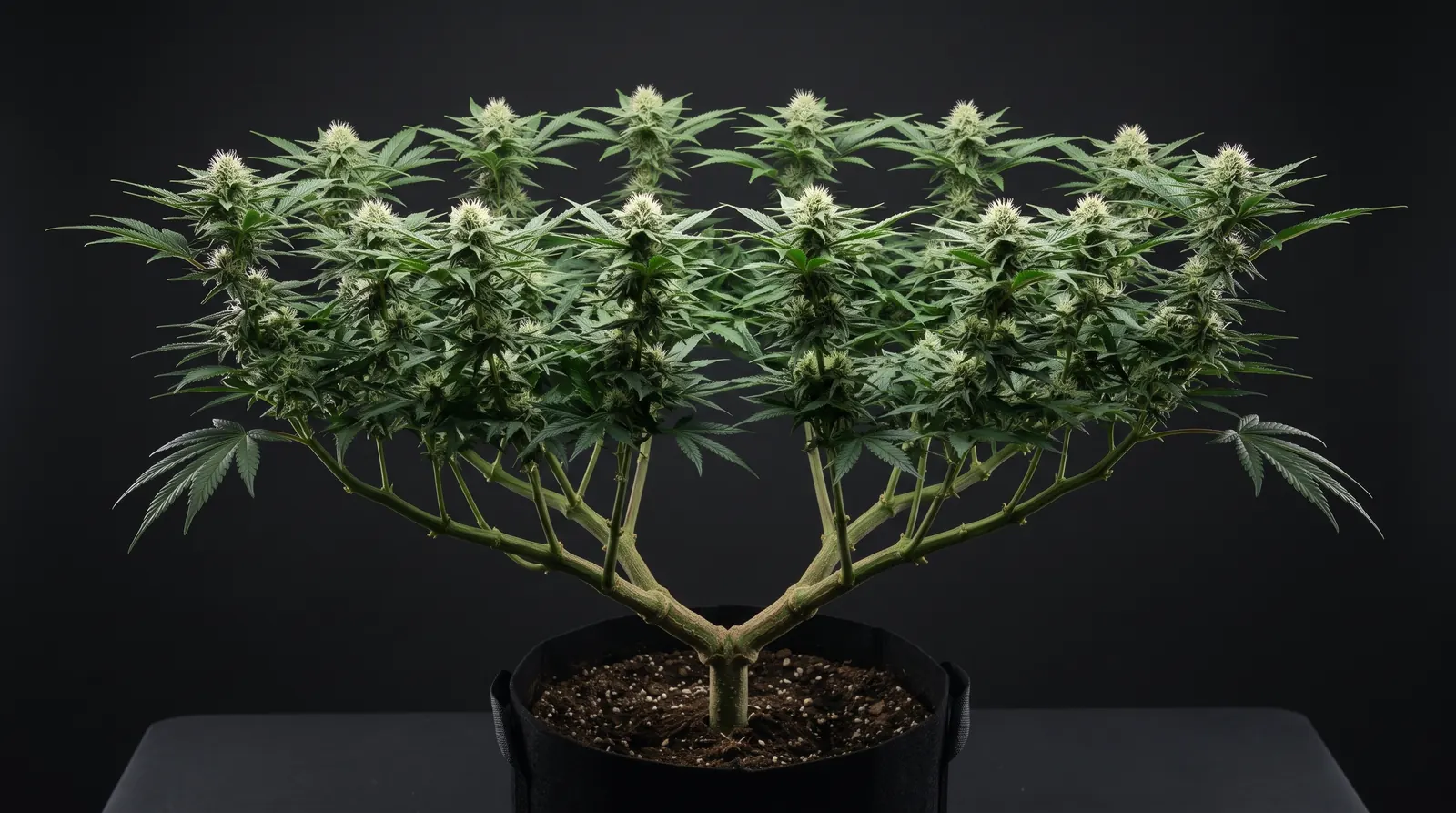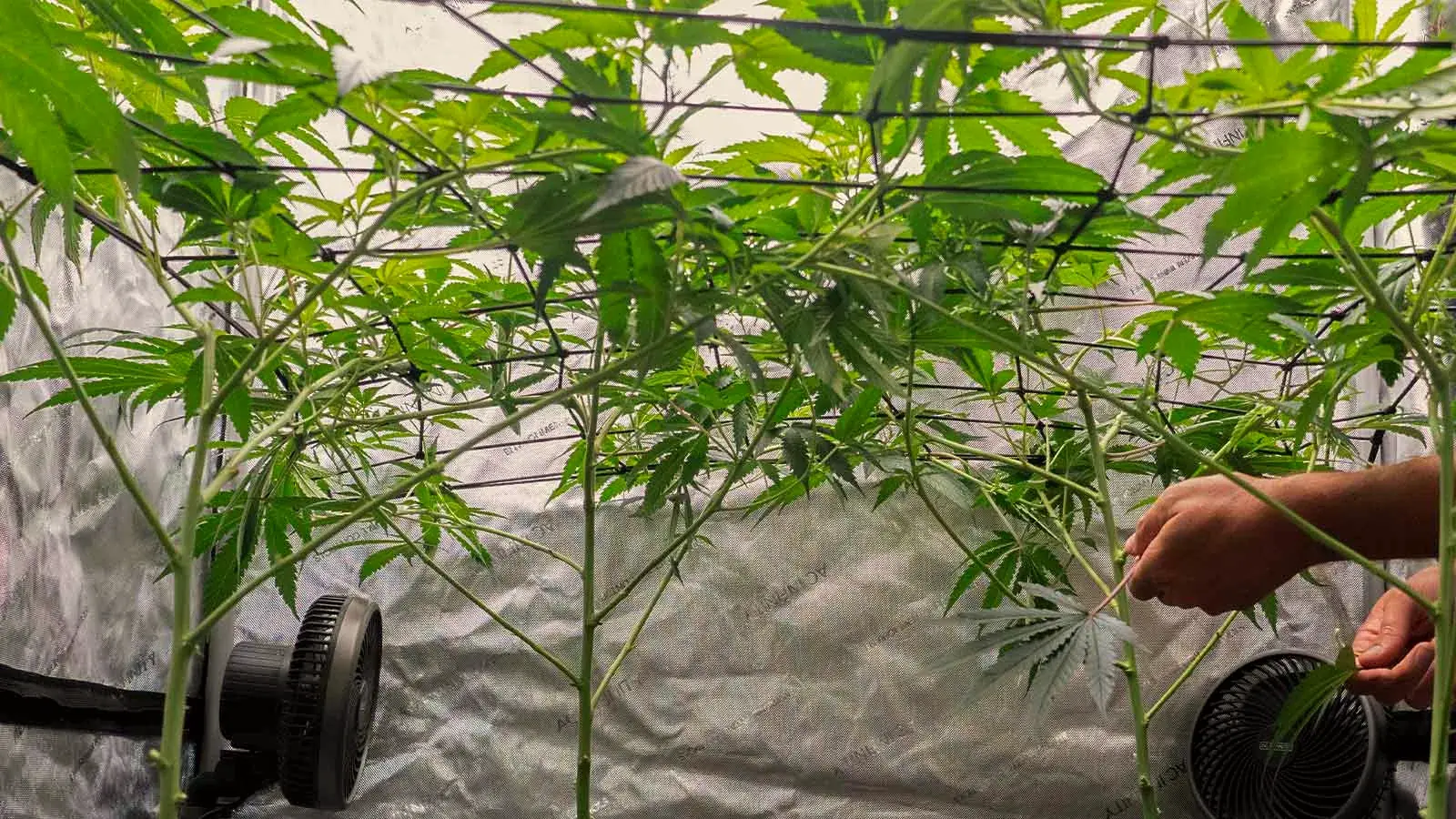
Cannabis crop steering is the practice of adjusting irrigation, nutrient strength (EC), and climate on purpose to push your plants toward leafy, structural growth or toward flower production at the right moment. It’s a strategy layer that sits on top of your feeding schedule: the schedule decides what goes into the plant, and steering decides how and when it gets there.
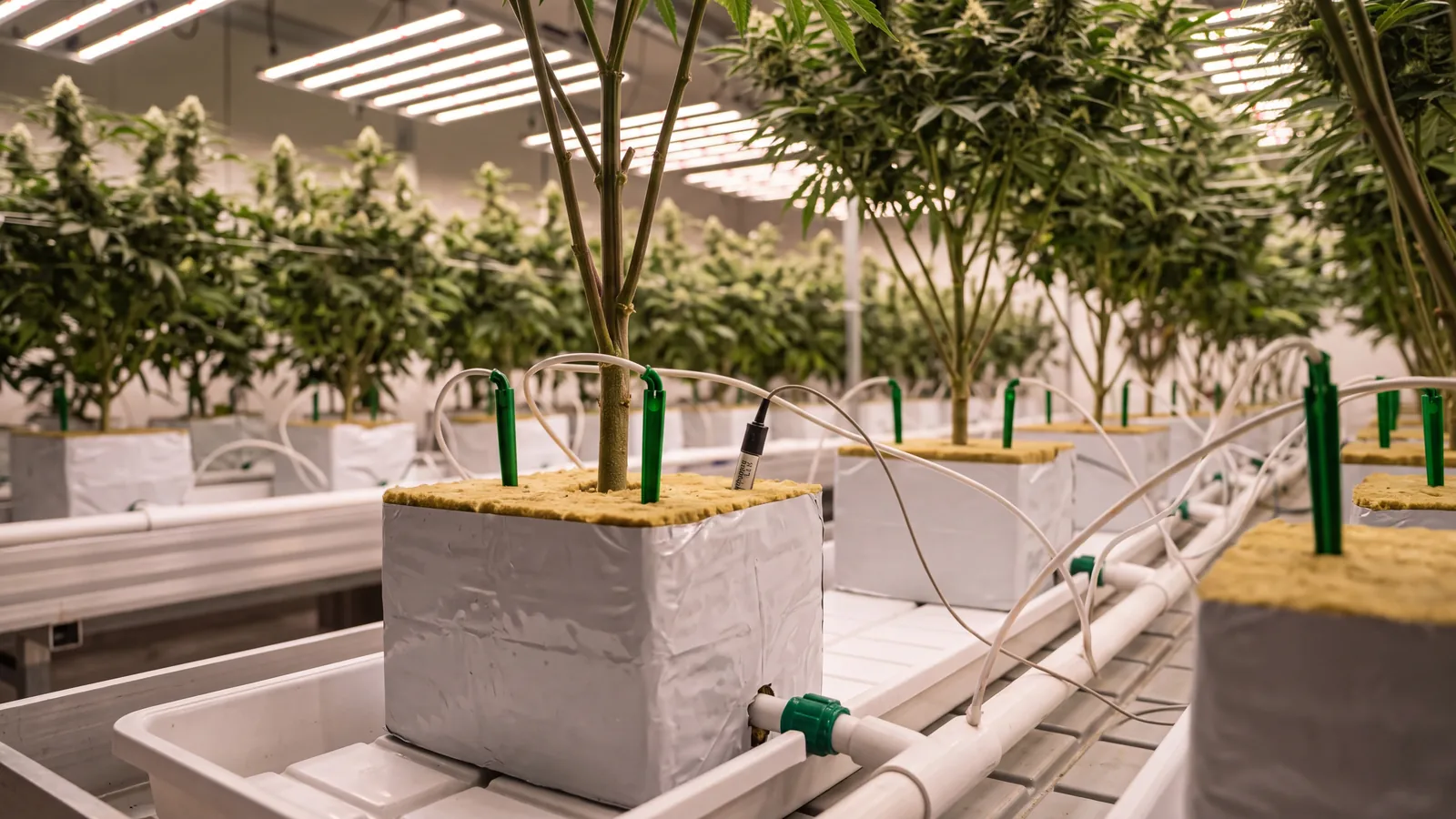
Done well, crop steering gives you real control over your crop. You can rein in stretch, encourage tighter flower sites, help buds bulk up in mid-flower, and get more consistent results from run to run. It works best in controlled rooms, where indoor seeds grow in coco or rockwool with drip irrigation and root-zone sensors.
This guide walks you through the levers that do the steering, the data that shows whether it’s working, a stage-by-stage plan, a simpler version for soil grows, and the mistakes to avoid.
What Is Cannabis Crop Steering?
Cannabis crop steering is an advanced cultivation method that uses irrigation timing, shot size, root-zone EC, temperature, humidity, and light intensity to tilt a crop between vegetative growth and generative (flower-focused) growth. You can steer in either direction at any stage, and the goal is always the right balance for where the crop is in its cycle.
It works through resource allocation. A cannabis plant only has so much sugar to spend and so much root zone to draw on, and its conditions bias how that budget gets split between building structure and building flower. As a rule:
- Adding controlled stress pushes a crop generative
- Easing stress pulls it back toward vegetative.
The idea came from commercial greenhouses, where tomato and pepper growers used it to balance plant growth against fruit set. Cannabis growers borrowed the vocabulary, the sensors, and the assumption that an inert substrate like rockwool or coco releases water predictably.
Steering is a feedback loop, not a recipe. You choose a direction, change an input, measure how the root zone and plant respond, then adjust. That's also what separates it from topping, training, and defoliation. Those are hands-on changes to the plant, while cannabis crop steering works only through inputs and environment, so it depends entirely on measurement.
Vegetative vs Generative Steering: The Two Directions
Vegetative steering favors leaf, stem and root expansion, and generative steering favors flower development and reproductive structure. Neither one is better. The aim is the right lean for the stage, because pushing too far either way costs you something.
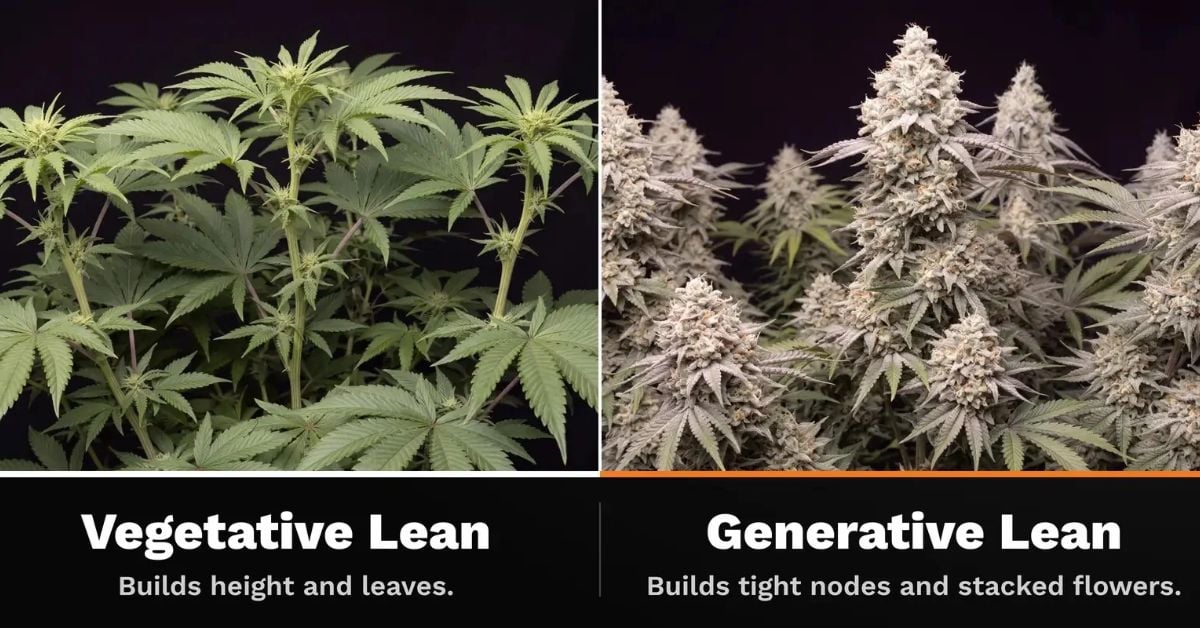
These two directions aren't the same as the veg and flower stages. A plant in early flower can still be steered vegetative, and a plant in late veg can be nudged generative. Here's how each lean usually shows up on a cannabis plant:
| Indicator | Vegetative Lean | Generative Lean |
| Internodes | Longer, with faster growth at the top | Shorter and tighter |
| Leaves | Larger, softer, and thinner | Firmer, darker, and thicker |
| Stems | Thinner relative to overall vigor | Thicker, with stacked growth |
| Flower sites | Slower, looser formation | Denser formation at the nodes |
Read these as a trend, not a snapshot. Internode spacing is usually the first thing growers check, but one plant can show tight internodes and big, soft leaves at the same time because different traits respond at different speeds. Track the same marked plants for several days before deciding whether a change worked.
Cannabis Crop Steering Levers: Irrigation, EC, Climate & Light
Five inputs do the steering work: irrigation frequency and shot size, substrate water content and dryback, root-zone EC, day and night climate, and light intensity.
Here's which way each one pushes:
| Crop Steering Lever | Vegetative Direction | Generative Direction |
| Irrigation | More frequent, smaller shots | Less frequent, larger shots |
| Substrate water content | Higher | Lower |
| Dryback | Smaller | Larger |
| Root-zone EC | Lower | Higher |
| Day/night temperature gap | Narrower | Wider |
| VPD | Lower | Higher, within safe limits |
| Light intensity | Lower | Higher |
The levers work as a set. Pushing one hard won't stand in for another, and two levers pulling in opposite directions cancel out while still carrying the risk of both. Change one lever at a time so you know which one caused the response.
Irrigation Frequency and Shot Size
Shot size is the volume of one irrigation event as a share of substrate volume, and frequency is how often those events happen. Frequent small shots keep the root zone near field capacity, the most water the substrate can hold, and that steady supply keeps plants vegetative. Fewer, larger shots with longer gaps widen the moisture swing and push generative.
Shot size also controls runoff. Once the substrate is near full, every small top-up spills out the bottom, flushing salts and lowering substrate EC. Fewer shots, spaced so the medium dries back between them, get absorbed instead, which cuts runoff and lets substrate EC climb.
When you're raising water content, do it in several small events. Dumping it all at once can cause channeling, where water races down a few paths, drains out the bottom, and leaves dry pockets behind.
Substrate Water Content and Dryback
Dryback is the drop in substrate water content between one irrigation and the next, or overnight. It's the most powerful steering lever because it directly sets how much water the roots can reach. Small drybacks with high water content keep marijuana plants comfortable and vegetative. Larger drybacks to a lower floor apply generative pressure.
Some dryback is always useful, even when you're steering vegetative, because air moves back into the root zone as water leaves. Too little and roots sit wet. Too much and you've crossed from steering into damage. A controlled dryback means you know your peak, you know your target floor, and you water again when you hit it.
Root-Zone EC and Salinity
EC (electrical conductivity) measures how concentrated your nutrient solution is, and in crop steering it doubles as a water lever. Lower EC in the feed and substrate lets roots take up water easily, which supports vegetative growth. Higher EC makes water harder to pull in and adds generative pressure.
Feed EC and substrate EC are separate readings that move independently. You can raise substrate EC by feeding stronger at the dripper or by cutting runoff so salts build up, and those two routes behave differently. That's why steering needs both readings, not just the strength listed in your feeding schedule.
EC and dryback also stack. A drying medium holds its remaining water more tightly, and as it dries, that water gets saltier, so root-zone EC climbs with no change to your feed. Roots feel both as the same problem: water that's harder to pull in.
This combination is one of the strongest generative tools you have and the easiest to overdo.
Day/Night Temperature Difference and VPD
The gap between lights-on and lights-off temperatures, often called DIF, is a steering lever in its own right. Steering frameworks generally treat a narrow gap as a vegetative cue and a wider gap as a generative one.
But there's a catch during the cannabis flowering stretch. Greenhouse research shows a warm day followed by a cooler night tends to lengthen stems, so a wide gap can work against height control. Growers fighting stretch often keep the gap modest or run cooler for the first couple of hours after lights-on — a trick borrowed from ornamental greenhouse production.
VPD (vapor pressure deficit) is the drying power of the air around the leaves. Lower VPD slows transpiration and supports leaf and stem growth. Raising it within safe limits increases transpiration demand and adds generative pressure.
Climate levers act on the whole room, so you can't apply them plant by plant. Change them gradually, too. A sudden temperature drop at lights-off spikes humidity and collapses VPD, which sets up ideal conditions for mold.
Light Intensity vs the 12/12 Flip
Flipping photoperiod plants to 12/12 triggers flowering, but it isn't crop steering. It happens once, it's on or off, and every steering decision still lies ahead of you. Light intensity is the real dial.
Intensity sets how much energy the plant has to spend in whichever direction you're steering. A crop pushed generative under weak light simply has less to allocate. Steering redirects what the plant already has. It can't create the capacity your lighting, genetics, or environment never supplied.
What You Need Before You Start Crop Steering Marijuana
To steer with any precision, you need a substrate that responds predictably, irrigation that delivers small repeatable shots, a way to read the root zone, and enough climate control to hold a day and night pattern. Without these, you're still changing inputs, but you can't tell which change caused which response.
| Crop Steering Requirement | Why You Need It | Without It |
| Inert, low-buffering substrate (rockwool, coco, or peat) | Water release is predictable and changes are reversible | Organic soil buffers and delays the response, so readings get muddy |
| Substrate volume matched to plant size | Small blocks respond fast and large pots respond slowly | You either over-react or can't move the root zone in time |
| Irrigation control (pump, drippers and a timer or controller) | Delivers small, repeatable shots at set intervals | Shot size and frequency aren't available as levers |
| Water content and EC sensors, or a consistent proxy, plus runoff collection | Shows what the root zone is actually doing | You can apply a direction but can't confirm it |
| Day and night temperature and humidity control | Lets you hold a chosen climate pattern | Climate levers are out of your hands |
| Records kept on one timeline | Steering decisions compare days, not moments | You can't tell what worked or repeat it |
Rockwool, coco and peat each release water differently, so one generic formula won't fit all three. Meeting some of these requirements but not others is normal. It just means you'll be steering in a reduced form, which the soil and tent section below covers.
If you're on your first or second grow, get watering, feeding, and climate stable before you try your hand at marijuana crop steering. This technique refines a dialed-in room. It won't rescue an unstable one.
How to Read Crop Steering Data
Every steering decision draws on four data streams: substrate water content, dryback, runoff volume and EC, and plant observations. A steer is only confirmed when the sensor data and the weed plant agree.
| Crop Steering Data Stream | Where to Read It | What It Tells You | What a Problem Looks Like |
| Substrate water content | A sensor in a typical block or pot, where most of the roots are | How wet the root zone is right now | It never gets fully wet after watering, or it never dries down between waterings |
| Dryback | The same sensor: compare the highest reading after watering with the lowest reading before the next one | How hard you’re steering. A bigger drop means more generative pressure | Hardly any drop means you’re not really steering. A very big drop means you’re pushing too hard |
| Runoff volume and EC | The water that drains into the tray or saucer | Whether salts are building up in the medium or washing out | Runoff EC keeps climbing above your feed EC, watering after watering |
| Plant checks (crop registration) | The same marked plants, measured on a set schedule | Whether the plants are actually responding to your changes | The sensor numbers changed, but the plants look the same after several days |
Sensor placement decides whether any of this means anything. Put probes in the root-dense zone, away from the dripper and the container edge. One sensor is a sample, not the whole room.
The Four Daily Irrigation Phases
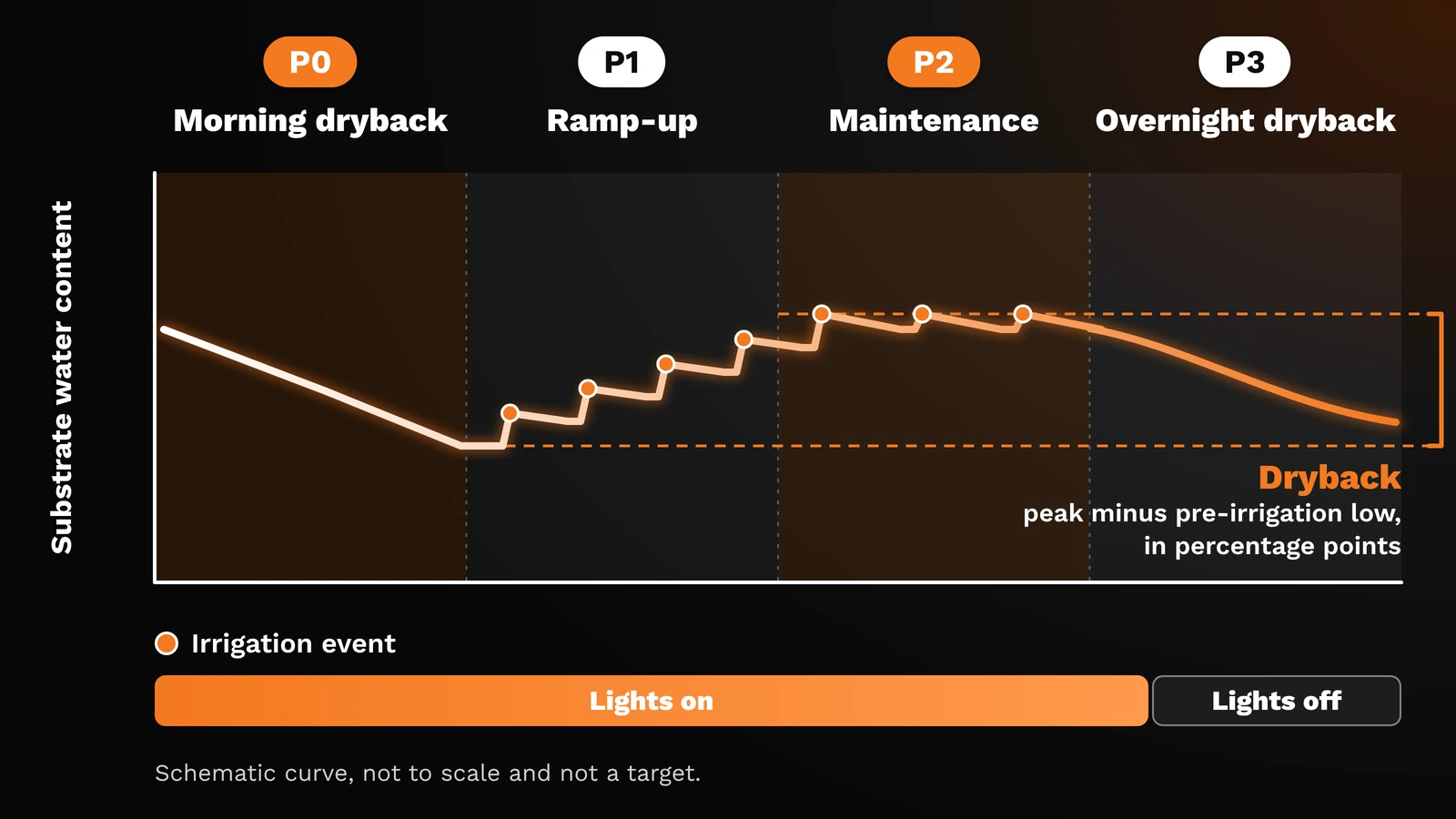
Steering growers split each 24 hours into four phases, usually labeled P0 to P3, and the water content curve shows how they connect:
- P0, morning dryback: from lights-on to the first irrigation, while the plant starts transpiring and water content keeps falling.
- P1, ramp-up: from the first irrigation until the substrate reaches its target peak or field capacity, delivered as several small shots.
- P2, maintenance: from the peak to the last irrigation of the day, where shot size and frequency hold water content and steer substrate EC.
- P3, overnight dryback: from the last irrigation to lights-on, as plants keep transpiring through the night.
Generative steering usually stretches P0 by delaying the first shot of the day and ends P2 earlier, so P3 runs longer. Vegetative steering does the opposite, starting irrigation soon after lights-on and running it later into the day.
Dryback is simple math: peak water content minus the reading just before the next irrigation. A substrate that peaks at 80% and gets watered again at 60% has dried back 20 percentage points. Some apps report that as a share of the peak (25% here), so check which one your tools use before comparing numbers.
Published Dryback and Parameter Ranges
Published targets disagree, mostly because they're measured on different bases. Treat each row as its own reference point, and don't blend rows into one range.
| Measure | Vegetative lean | Generative lean | Basis |
| Daily dryback | About 5–10% | About 15–30% | Stonewool (rockwool) guidance |
| Moisture loss between irrigations | 30–50% overall, set by stage, cultivar and method | Same range | Larger containers watered to container capacity |
| P0 morning dryback | 1–3% | 4–6% | Added on top of the overnight dryback |
| Substrate water content | 60–80% | 40–60% | One cannabis steering framework |
| Root-zone EC | 0.8–1.5 mS/cm | 2.0–4.0+ mS/cm | Same framework |
| VPD | 0.8–1.2 kPa | 1.2–1.8 kPa | Same framework |
| Day/night temperature gap | About 4–7°F | About 14–22°F | Same framework |
| Runoff per irrigation event | 8–16% | 1–7% | One commercial program |
Use these parameters as starting points to test in your own room. Averaging rows from different bases gives you a number that describes nobody's grow.
Shot Size and Runoff
Shot size is expressed as a percentage of substrate volume. One stonewool manufacturer describes extra-small shots at 1–2%, standard shots around 3%, and large shots at 4–6%, with most events landing between 3% and 6%.
Runoff gives you two readings. Volume, as a share of what you applied, shows how hard you're leaching. EC in vs EC out shows whether salts are building, holding steady, or being diluted, and it's the most useful diagnostic you have.
Those steering runoff figures sit far below the roughly 30% drainage most hand-watered grows aim for. That's expected, because a drip system manages salts through the size and timing of many small events, while hand watering relies on one big flush per feed.
Crop Registration
Crop registration is the regular measuring and logging of plant development on a set of marked sample plants, done on a fixed schedule. Common fields include:
- Plant height
- Stem diameter
- Internode spacing
- Leaf and stem color
- Flower circumference
- Overall vigor
Greenhouse tomato growers might register weekly, while cannabis growers often measure every two days. Give each change time to show up. EC changes in particular can take several days to appear in the plants, so a lever you changed this morning hasn't failed by tonight. One reading isn't a trend.
Crop Steering Stage by Stage Through the Cycle
Most cannabis growers steer vegetative through seedlings and veg, go generative through early-flower stretch, swing back toward vegetative for bulking and lean generative again to finish. Each stage has one main goal, and the steer exists to serve it. Week numbers only orient you, because the crop moves on when it's ready.
Seedlings and Early Veg
Steer vegetative and keep conditions stable. The goal is root establishment and sound structure, so focus on even moisture, conservative EC, and roots spreading through the whole block.
One exception is common. After the first full hydration, many growers allow a deeper first dryback to send roots out searching for water. After that, young weed plants tolerate very little pressure, so there's nothing to gain by testing them.
Late Veg and the Transition
Lean vegetative, but start easing off. You're building the frame and setting up a firm steer at the flip, so bring irrigation frequency down a little and settle into consistent irrigation and dryback patterns. If the flip is the first change the crop sees, you'll have no baseline to judge its response against.
Early Flower and Stretch Control
Go generative to contain stretch and encourage flower sites to form at tight nodes. Build the pressure over several days with a combination of levers, not one abrupt change.
This is the riskiest window of the whole cycle. The marijuana plant is still expanding, and an over-aggressive push here costs structure you can't win back. Watch internode spacing and how fast the tops are climbing, and check the substrate data before adding more pressure.
Mid-Flower Bulking
Once the stretch is done, steer back toward vegetative or balanced conditions to build flower mass. That means stable water content, moderate drybacks, and steady EC.
This is the step growers skip most often. A crop held under heavy generative pressure through bulking has less capacity to add weight, so sticking with your early-flower steer just because it worked can quietly cost you yield.
Late Flower and Ripening
Lean generative again to finish, with reduced water supply and nutrition adjusted as the plant's demand drops off. Flushing belongs here, and it's genuinely debated. One widely cited trial compared flushes of 14, 10, 7, and 0 days on one cultivar and found no difference in yield, potency, or terpenes, and taste panelists leaned toward unflushed flower.
Critics point out the trial was narrow, and not detecting a difference isn't proof there is none. Decide for your own medium and nutrient program, and log what you did.
How Seed Type and Cultivar Change Your Steering Plan
Your cannabis genetics decide how firmly you can apply the stage plan, how early you apply it, and whether it works evenly across the room. Stretch tendency, tolerance to pressure, and flowering type all shift the plan.
Stretchy vs Compact Cannabis Strains
Stretch tendency sets your early-flower decision. A strain that stacks quietly needs far less generative pressure at the flip than one that doubles in height, and high-stretch weed plants usually need that pressure applied earlier, not harder.
Tolerance to pressure varies too. Salinity research suggests cannabis handles root-zone salt stress fairly well overall, but responses differ between cultivars. Steer unfamiliar genetics conservatively, log them separately, and don't assume last run's numbers carry over.
Steering Autoflowers
If you’re working with autoflower seeds, your plants need a lighter, earlier steer. They start flowering based on age, without waiting for a switch to 12/12, so there's no photoperiod trigger to plan around. The whole timeline is compressed, changes have to come sooner and gentler, and there's very little time to recover from a push that went too far.
Feminized Seeds and an Even Canopy
A cannabis crop steering plan assumes a room that flowers together. Feminized weed seeds produce nearly all-female plants, so you spend far less time finding and pulling males mid-cycle. That keeps canopy density and irrigation demand per pot stable, and it stops your sensor from ending up in a spot that no longer represents anything.
Mixed Rooms and Phenotype Variation
Marijuana plants won't respond uniformly, even if you’re working with a single strain. Each seed expresses its genetics a little differently, so one plant might stretch hard after the flip while its neighbor stays compact. In a room with several strains, those differences get even bigger.
The fix is to steer to representative plants. Pick a few plants that sit in the middle of the pack for size and vigor, and use them for your sensors and plant checks. Avoid the tallest, smallest, or weakest plants, because they’ll skew your readings and push you into over-steering or under-steering the rest of the room.
Where you can, group similar cannabis plants together. Put stretchy plants on one irrigation line and compact ones on another, so each group gets its own shot sizes and timing.
Crop Steering in Soil and Grow Tents
You can’t steer with precision in a hand-watered soil tent, but several levers still work in simpler form. A tent mainly limits your climate control, while soil mainly slows and blurs your root-zone levers. The habit of changing one thing at a time works everywhere, and that’s what actually teaches you how your weed plants respond.
| Crop Steering Lever | In a Grow Tent | In Soil |
| Day/night temperature gap | Partly, within the range your tent can hold once the lights go off | Same as your tent or room. The medium doesn’t change it |
| Humidity and VPD | Yes, at least during lights-on | Same as your tent or room. The medium doesn’t change it |
| Irrigation timing and volume | Yes, including how long you wait before watering again | Yes, but soil holds water longer, so the response is slower and less clear |
| Feed strength | Yes | Partly. Soil holds onto nutrients, so EC changes show slowly. In organic living soil, it barely works |
| Shot size as a share of substrate volume | Only with drippers on a timer. Not with hand watering | No. Soil buffers small shots too much to read them |
| Precise dryback targets | Only with a substrate sensor | Hard. Use pot weight as a rough guide |
| Per-plant root-zone control in a mixed room | Only with separate drip lines for each group | No |
| Switching to a less-buffered medium | Yes. Coco carries little nutrition of its own and dries faster than soil, so it responds more clearly | This is the switch. Moving from soil to coco is the biggest single upgrade for steering |
Measuring Dryback Without Sensors
Pot weight is your best proxy. Water to container capacity, until about 30% drains out the bottom, wait about 30 minutes, then lift the pot and learn that weight. Lift again each morning to judge how far it has dried back. A handheld substrate probe, a cheap EC meter for runoff, and a written log round out the kit.
A proxy isn't sensor data, so read it as a trend. Know the limits, too. Soil buffering slows and hides the response, big single waterings create swings that are hard to repeat, and a small tent often can't hold a meaningful day and night gap once the lights go off.
Steering also needs a steady baseline underneath it. If you're still working out how often to water in your setup, settle that first, because crop steering an inconsistent routine just adds noise to noise. In a single tent with mixed genetics, consistency will do more for this harvest than an aggressive steer.
Common Cannabis Crop Steering Mistakes
Most cannabis crop steering damage comes from too much pressure at once, or several inputs changed together so the result can't be read. Here's what each common mistake looks like and how to fix it:
| Crop Steering Mistake | What You'll See | How to Fix It |
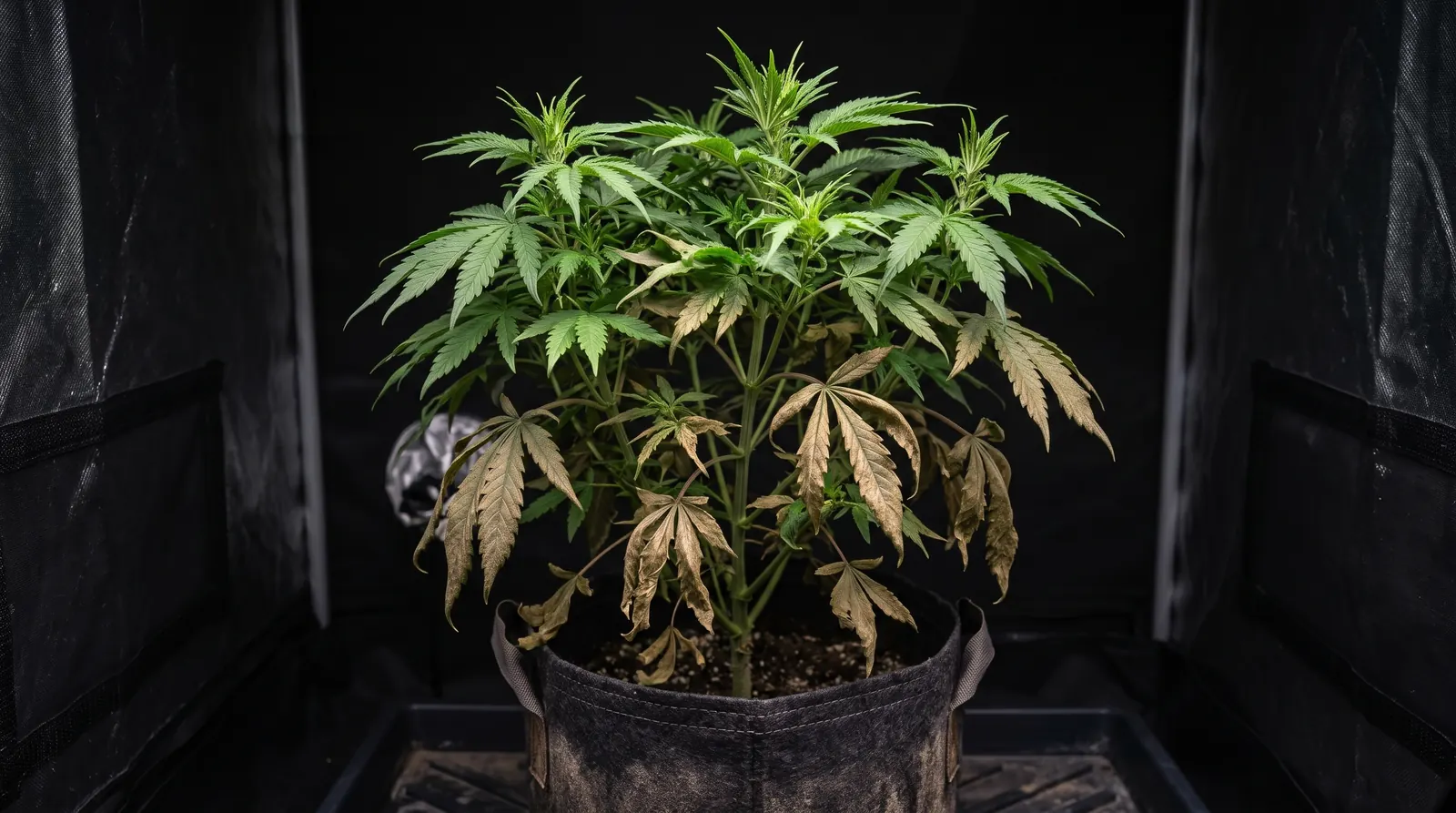
| Over-steering generative (big drybacks plus high EC) | Wilting, stalled growth, leaf tip burn, and lost bulking | Ease both levers and recover gradually (see below) |
| Over-steering vegetative | Excess stretch, loose flowers, and a dense, humid canopy with higher mold risk | Shorten irrigation windows and widen drybacks gradually |
| Changing several levers at once | A response you can't explain | Go back to one change per test |
| Ignoring runoff EC | What looks like a mystery deficiency, caused by salts stacking in the substrate | Track EC in vs EC out on every irrigation day |
| One badly placed sensor | Readings that don't match the plants | Move it to the root-dense zone, away from drippers and edges |
| Copying another room's numbers | Plants that don't respond the way the published targets suggest | Start conservative and build your own baseline |
| Running autos on a photoperiod plan | Stress the plant has no time to grow out of | Steer autos lighter and earlier |
Over-steering generative is the costliest of these. Damage done during bulking is very hard to recover inside the cycle, and one controlled salinity study that cut plant height as intended also cut flower yield, suggesting it's hard to shrink plants this way without losing weight.
How to Recover an Over-Steered Crop
Return to stable, vegetative-leaning conditions first. Then bring substrate EC down gradually with smaller, more frequent shots that create runoff, and wait. EC changes often take several days to show, so resume steering only once the weed plants have settled. Avoid fixing one shock with another. A second hard correction is how a bad week turns into a bad run.
How to Start Cannabis Crop Steering on Your Next Grow
Start narrow. Pick the one lever your setup controls best, steer it in one direction, and hold everything else steady. That single-variable habit is what makes cannabis crop steering pay off:
- Pick one lever. Feed strength or irrigation timing work in almost any setup, so they're the easiest place to begin.
- Change it alone. Keeping climate, light, and the rest of your routine steady is the only way to know what caused the response.
- Log substrate data and plants on one timeline. Give each change several days, because the plants usually answer slower than the sensors.
- Repeat with the same genetics. Running the same cannabis seeds for two or three cycles gives you a log that compares like with like, so your second run starts from your own data.
The published numbers in this guide come from other people's rooms. A log you build over two or three runs with the same cultivar will beat all of them.