Watering weed plants is one of those things that sounds simple until your leaves start drooping and you can't tell whether they've had too much or not enough. It's the most common point of failure for new growers, and it catches experienced ones off guard, too, especially when moving to a different growing medium or container size.
This guide covers how to read your cannabis seeds, seedlings, and plants, when to water, how much to give at each feed, and how to dial in your routine. When you have invested time and money into cannabis seeds, you want to catch problems before they take hold.
Why Watering Weed Correctly Matters More Than Most Growers Think
Cannabis plants are surprisingly sensitive to water stress, and the damage from getting it wrong compounds quickly. Overwatering is the most common mistake, but underwatering causes its own set of problems, and both can stall plant growth at any stage.
The root zone is where everything starts. Roots need water to absorb nutrients, but they also need oxygen, and a waterlogged growing medium cuts off that oxygen supply. This creates the conditions for root rot and other pathogens to take hold.
Healthy plants with well-developed roots are far more resilient, but even hardy plants can deteriorate quickly when the root zone is consistently stressed.
Getting your watering routine right isn't just about keeping cannabis plants alive. It's the foundation that supports nutrient uptake, root development, and ultimately the size and quality of your harvest.
How to Tell When Cannabis Plants Need Water
The clearest sign a potted plant is ready to water is the lift test. Pick up the pot and feel the weight. A dry pot feels noticeably lighter than a freshly watered one. With practice, this becomes one of the most reliable checks you have, regardless of which watering methods you're using.
Beyond weight, there are a few other signals worth watching:
- Finger test: Push a finger about an inch into the soil. If it comes back dry, the plant is ready.
- Leaf appearance: Slight drooping or a matte look to leaves can indicate the plant is thirsty, though this can also point to other issues, so use it alongside other checks.
- Moisture meter: A digital pH meter or dedicated moisture probe gives you a reading directly from the root zone. More accurate than guessing from the surface, and particularly useful for new growers still building intuition. pH measuring drops work for testing water, but a digital pen tends to be more consistent for regular use.
Avoid watering on a fixed calendar schedule. Plants don't drink at the same rate every day. Temperature, humidity, light intensity, and plant size all affect how fast the medium dries out.
The Wet/Dry Cycle: The Core Principle Behind Watering Weed
The wet/dry cycle is the most important concept in cannabis watering. The idea is simple: water thoroughly, then allow the growing medium to partially dry before watering again. Understanding where the wet-dry line sits in your specific setup is what separates growers who get consistent results from those who guess.
How the Wet/Dry Cycle Works
When you water cannabis plants, saturate the medium fully, then allow it to dry to around 30–40% moisture before the next feed. Saturate the medium fully, then allow the top inch or two to dry before the next feed. The goal is partial dryback — enough that air can move back into the root zone, but not so much that roots dry out. This cycle does two things:
- It ensures roots have access to water and dissolved nutrients when they need them.
- As the medium dries, roots grow aggressively through the pot in search of moisture, creating lateral growth that builds out a healthy root system over time.
A robust root system means a stronger, more productive plant, one that can handle more nutrients and environmental variation without showing stress.
What Happens When You Get It Wrong
Cutting the wet/dry cycle short by watering too frequently keeps the medium saturated and prevents lateral root development from happening. The root ball stays shallow and concentrated near the surface rather than expanding through the full volume of the container.
Stretching the cycle too far lets the medium go completely dry, which stresses roots and can cause hydrophobic conditions in fine soil or micro fine soil where water struggles to absorb evenly. Either extreme limits what the plant can achieve at harvest.
A more reliable approach is maintaining a consistent cycle based on container size, medium, and environmental conditions rather than fixed timing. Temperature, airflow, and plant size all shift how quickly moisture is used, so the goal is a stable rhythm that supports steady root expansion without pushing the plant into extremes.
How Much Water to Give Cannabis Plants
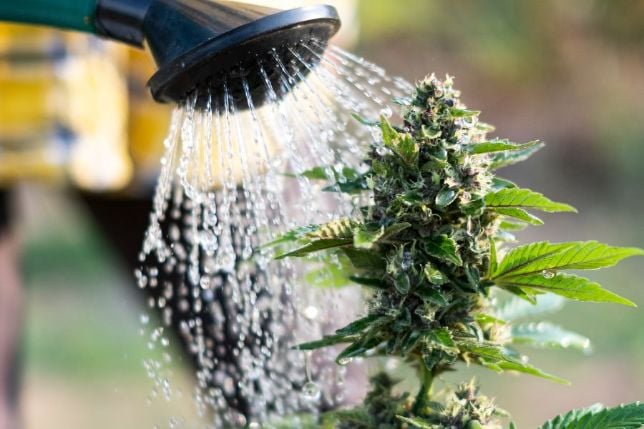
Watering amounts for cannabis vary by plant size, environment, and drainage conditions.
Figuring out exactly how much water to give isn't something most growers nail immediately. A widely used starting point is roughly 10% of the container volume per feed, so a plant in a 5-gallon pot receives around half a gallon per watering session.
This is a baseline, not a rule, and you adjust it based on plant size, medium, and how quickly the pot cycles back.
Aim for Runoff
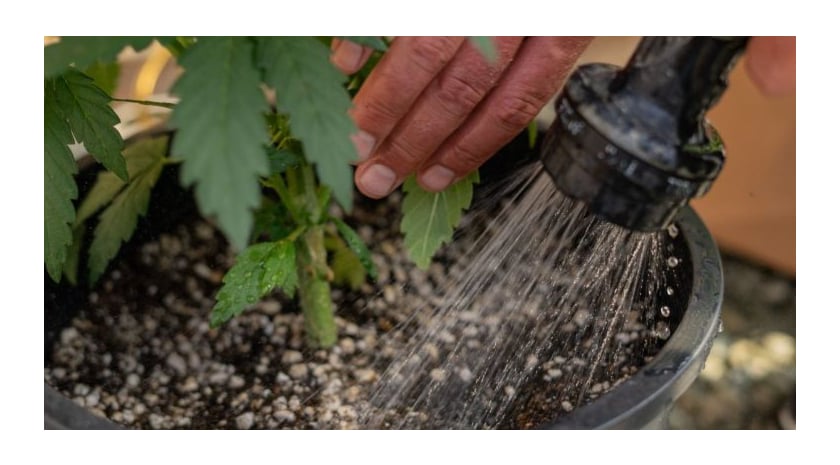
You want to see a small amount of runoff from the drainage holes at the bottom of the potted plant. This confirms the entire root zone has been reached and prevents salt-based synthetic nutrients from accumulating in the lower layers of the medium.
Cannabis plants watered without reaching the bottom of the pot tend to develop shallow root systems, because roots only follow moisture as deep as it goes.
Avoid plants sitting in standing water. Once runoff drains, remove it. Roots sitting in excess water risk suffocation and defeat the purpose of the wet/dry cycle.
Fabric Pots
Fabric pots change the dynamic. Air pruning through the fabric walls promotes a denser, more branched root ball and speeds up drying, which typically means more frequent watering than plastic pots of the same size.
They are good for both feminized and autoflower plants, providing the perfect breathable membrane for your root zone. Consistent watering with fabric pots generally supports faster growth and helps drive a solid root ball forming through the entire container volume.
Water Quality: pH, Temperature, and What to Avoid
pH
pH is the single most important water quality factor for cannabis. The pH of your nutrient-rich water determines whether cannabis plants can actually absorb the nutrients you're feeding them.
Even with correct nutrient levels, the wrong pH causes lockout, where all the nutrients in your solution are present but unavailable at the root level.
- Soil: Target 5.5 to 6.5, with 6.0–6.3 being the sweet spot
- Coco coir and hydro: Target 5.6–6.4, with 5.8–6.2 being ideal for most stages
Test every feed. Nutrients shift pH after mixing, so test your solution after adding nutrients, not before.
Temperature
Water temperature has a direct effect on plant health. Cold water around 50–55°F can shock roots and temporarily stall growth. Very warm water holds less dissolved oxygen and favors pathogens.
Aim for water in the 65–72°F range.
If you're pulling from a cold tap in winter, let it reach room temperature before feeding. Water droplets sitting on leaves at the wrong temperature can also cause spotting under intense lighting, so water at the base rather than over the canopy.
Tap Water and Chlorine
Tap water typically contains chlorine or chloramine, both of which can disrupt the beneficial microbial life in organic soil. For the pure organic gardener, this is particularly important. Letting tap water sit uncovered in a bucket for 12 hours allows chlorine to off-gas.
Chloramine doesn't dissipate the same way, so if your water supply uses chloramine, a carbon filter is the more reliable solution.
Watering Cannabis Across Different Growing Mediums
The growing medium changes almost every aspect of how you water. There's no universal schedule that works across all setups, but understanding these differences allows growers to build a consistent watering routine that matches their plants' needs.
Soil
Soil retains moisture longer than other mediums and buffers pH shifts more naturally, which makes it more forgiving of watering mistakes. Nutrient-rich soil (particularly a quality organic mix) holds nutrients in reserve, meaning plants may benefit from plain water between feeds to avoid overloading the root zone.
This is a concept sometimes called soil exchange: allowing the medium to flush slightly before driving nutrient-rich soil back into the root zone with the next feed.
Fine soil or micro fine soil can compact over time, creating what some growers call micro fine sludge, which is a dense, compacted layer at the bottom of the container that restricts drainage and prevents the soil from sucking air back into the root zone as it dries.
Mixing perlite into your medium from the start prevents this. In most soil types, watering every 2–4 days is typical once plants reach the vegetative stage, but this varies with environment and container size.
Coco Coir
Coco coir drains quickly and holds very little nutrient reserve on its own. Plants grown in coco need more frequent watering, often daily during vegetative growth. Coco also has a slight calcium affinity, so calcium and magnesium supplementation are standard.
The wet/dry cycle still applies in coco, but the dryback period is shorter. Letting the coco go completely dry creates hydrophobic conditions where the medium repels water rather than absorbing it evenly, making recovery slow and root recovery even slower.
Rockwool
Rockwool holds moisture evenly and responds well to light, frequent feedings. It drains freely, making overwatering less of a concern than with soil, though oversaturation is still possible if drainage is blocked.
Rockwool is typically used in hydroponic or semi-hydroponic setups where feeding frequency is higher and solution management is more hands-on.
Hydroponics
In fully recirculating hydroponic systems, a constant circular flow of nutrient-rich water moves through the root zone on a timed cycle, and pH and EC management replace what soil handles passively.
The margin for error is smaller, but so is the lag between a feed adjustment and the plant's response. Monitoring EC and pH daily is standard practice for weed farmers running hydro setups.
Watering Schedule by Growth Stage
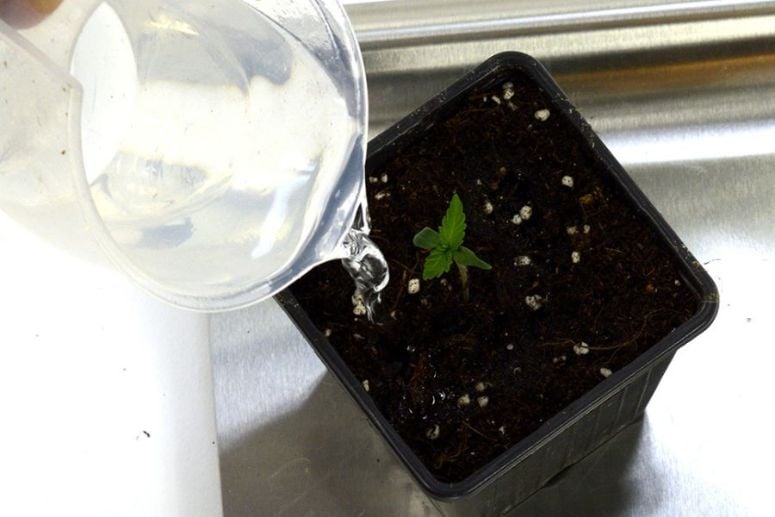
Cannabis seedlings should be watered lightly to maintain moisture without oversaturating the soil.
How often you water weed plants shifts significantly as the plant develops. There's no single answer to watering frequency because it depends on stage, medium, environment, and container size.
Seedling Stage
In the early stages, seedlings have tiny root systems and very low water demand. Overwatering at this stage is easy and damaging. The goal is to keep the medium moist but not saturated, and to avoid flooding the root zone before roots have spread enough to use the water.
A light mist or gentle watering around the base of the seedling, rather than saturating the whole pot, works well at this stage.
If you're starting in a large container, water only the area directly around the seedling until a solid root ball begins forming. Consistent watering with small, careful amounts is far more effective than flooding the pot and hoping for the best.
In terms of frequency, every 2–3 days is a rough starting point, but always check the medium before watering.
Vegetative Stage
As the plant grows and the root system expands, water demand increases significantly. The medium dries faster, and plants can handle deeper, more thorough waterings.
This is the stage where the wet/dry cycle does its most important work. Letting the pot partially dry between feeds drives a strong taproot and extensive lateral root growth through the medium, creating an incredibly robust plant with the infrastructure to support heavy flowering later.
Early in vegetation, watering every 2–3 days is typical. By mid-to-late veg, daily watering is common for larger plants. Container size matters a lot. A small pot with a large plant dries out much faster than a large pot with a young plant.
Flowering Stage
Cannabis plants typically need the most water during flowering. Deep, thorough waterings followed by a proper dryback period work better than shallow, frequent ones.
The dense original root ball built during vegetative growth is doing heavy lifting at this point, and keeping it healthy through consistent watering and maintaining pH is the priority.
Toward the end of flowering, many growers running synthetic programs switch to plain water for the final 1–2 weeks to flush accumulated salts. The practice is debated - some experts argue tapering off fertilizer in the final weeks improves flavor more reliably than a water-only flush, and that the difference between flushed and unflushed bud is small or undetectable in blind tests.
For the pure organic gardener, this is less necessary because organic nutrient forms break down differently and don't accumulate salts in the same way.
Building a Dense Root System Through Watering Practices
A robust root system means the plant has more surface area for nutrient and water uptake, better anchorage, and greater resilience.
When the medium dries to that 30–40% moisture range, roots grow aggressively outward and downward in search of water, creating lateral growth that fills the container. Over several weeks, this builds a dense root ball that occupies the full volume of the pot.
An extremely dense root ball achieved through consistent wet/dry cycling is the foundation of what experienced growers sometimes call an extremely aggressive grower, a plant that pushes hard, drinks fast, and responds visibly to good inputs.
By contrast, plants watered too frequently develop shallow, weak root systems concentrated near the surface of the medium. These plants look fine early on, but run into limitations during flowering when demand peaks and the root zone can't keep up.
Signs of Overwatering and How to Fix It
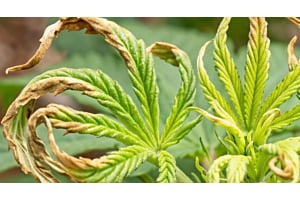
Overwatered cannabis plants show drooping leaves that look swollen and curl downward. The medium stays wet for extended periods, plant growth slows noticeably, and in more advanced cases, root rot sets in: brown or slimy roots and sometimes a foul odor from the container.
To fix overwatering:
- Stop watering and allow the medium to dry out before resuming.
- Improve drainage if the pot doesn't have adequate drainage holes.
- In severe cases, repotting into fresh soil may be necessary to give the roots a clean environment to recover in.
Overwatering is almost always a result of watering on a schedule rather than reading the plant and the pot. Returning to the lift test and the finger test as your primary cues prevents most overwatering problems before they start.
Signs of Underwatering and How to Fix It
Underwatered plants wilt limply rather than drooping with that swollen, overfull look. The pot feels very light, and the medium may have pulled away from the sides of the container. In severe cases, very fine soil or micro soil can become hydrophobic, where water runs straight through the medium without being absorbed.
If the medium has become hydrophobic:
- Water the plant slowly in small amounts.
- Pause watering between additions, allowing the soil to gradually rehydrate.
- Once the medium is fully rehydrated, return to the normal wet/dry cycle.
A happy and productive plant recovers from mild underwatering quickly; repeated severe underwatering damages root structure and slows recovery significantly.
Adjusting for Temperature and Humidity
Both temperature and humidity directly affect how fast the medium dries and how often you'll need to water weed plants.
- Higher temperatures increase evaporation from the medium and transpiration from the plant. In a warmer-than-usual environment, plants may need water more frequently or in larger amounts.
- Lower temperatures slow evaporation and extend the dryback period, so less frequent watering prevents oversaturation.
- High relative humidity means the air is already saturated with moisture, which slows the plant's ability to release water vapor and means the medium stays wet longer.
- Low humidity accelerates transpiration, pulling water through the plant faster and drying the medium more quickly.
A hygrometer and thermometer in the grow space give you the data to anticipate these shifts. If temperatures rise or humidity drops significantly, increase watering frequency before the plant shows stress rather than after.
All the roots depend on a stable environment to function properly, and consistent watering that accounts for environmental variation is what separates steady growers from reactive ones.
Outdoor Watering: Key Differences
Outdoor plants deal with variables indoor growers don't have to manage: rain, wind, direct sunlight, and seasonal shifts all affect how often and how much to water.
During hot, dry periods, large outdoor plants in containers may need daily watering. Mulch applied to the surface of the growing medium helps retain moisture during dry spells and reduces watering frequency.
Rainfall can supplement or replace feeds entirely, though heavy rain followed by plants sitting in standing water creates overwatering conditions if drainage is poor.
For plants growing directly in the ground, native soil structure plays a big role. Well-draining soil in a sunny position dries faster than dense soil in partial shade. Watering based on soil moisture checks rather than a schedule is the most reliable approach for outdoor growing, regardless of experience level.
Water Well, Grow Well
Proper watering comes down to reading your plants and your growing medium rather than following a fixed schedule. Master the wet/dry cycle, check pH on every feed, and adjust for whatever your environment throws at you.
Build a dense root ball through consistent wet/dry cycling, and the plant does the hard work from there. Start with the lift test, trust what the pot tells you, and your root system will take care of the rest.
FAQs
How Often Should You Water Cannabis Plants?
Most plants in containers need watering every 1–4 days, depending on growth stage, container size, and environment. Seedlings dry out slowly; large plants in late flower can need daily feeds. Consistent watering based on plant and medium cues beats any fixed schedule.
What Happens If You Overwater Cannabis Plants?
Overwatered plants develop drooping, swollen-looking leaves that curl downward. Prolonged overwatering starves the root zone of oxygen, which can lead to root rot and significantly slowed growth. Letting the growing medium partially dry between waterings and never leaving plants sitting in standing runoff prevent most overwatering issues.
Can You Water Cannabis Plants With Tap Water?
Yes, though pH needs to be checked and adjusted before each feed. Tap water can contain chlorine, which can disrupt beneficial microbes in organic soil. Letting it sit uncovered for 12 hours allows chlorine to off-gas. Aim for a pH of 5.5–6.5 for soil and 5.8–6.2 for coco or hydroponic setups.
How Do You Know If a Cannabis Plant Is Underwatered?
Underwatered plants droop limply rather than looking swollen or firm. The pot feels very light, the medium pulls away from the pot sides, and in severe cases, the substrate won't absorb water evenly. Slow, gradual rehydration is more effective than flooding the container all at once.
Does Growing Medium Affect How Often to Water Weed Plants?
Significantly. Soil retains moisture longest and generally needs watering every 2–4 days. Coco coir dries faster and often requires daily feeding. Rockwool and hydroponic setups feed on tighter cycles, sometimes multiple times per day. Always calibrate your watering frequency to your specific medium rather than a generic schedule.