The Sea of Green method takes lots of small cannabis plants, flips them to flower after a quick veg, and lets each one finish with a single cola. Most growers call it SOG for short, and it's one of the fastest ways to maximize yields when space is limited.
A SOG grow works by turning each square foot of space into a productive canopy — and fast. Compact, quick-finishing indoor seeds do a lot of the heavy lifting, since veg is only lasts a few weeks.
Below, we'll walk you through the Sea of Green method step by step with details covering the layout, flip timing, pruning, growing mediums, and seed choice so your first SOG grow goes smoothly.
What Is the Sea of Green Method?
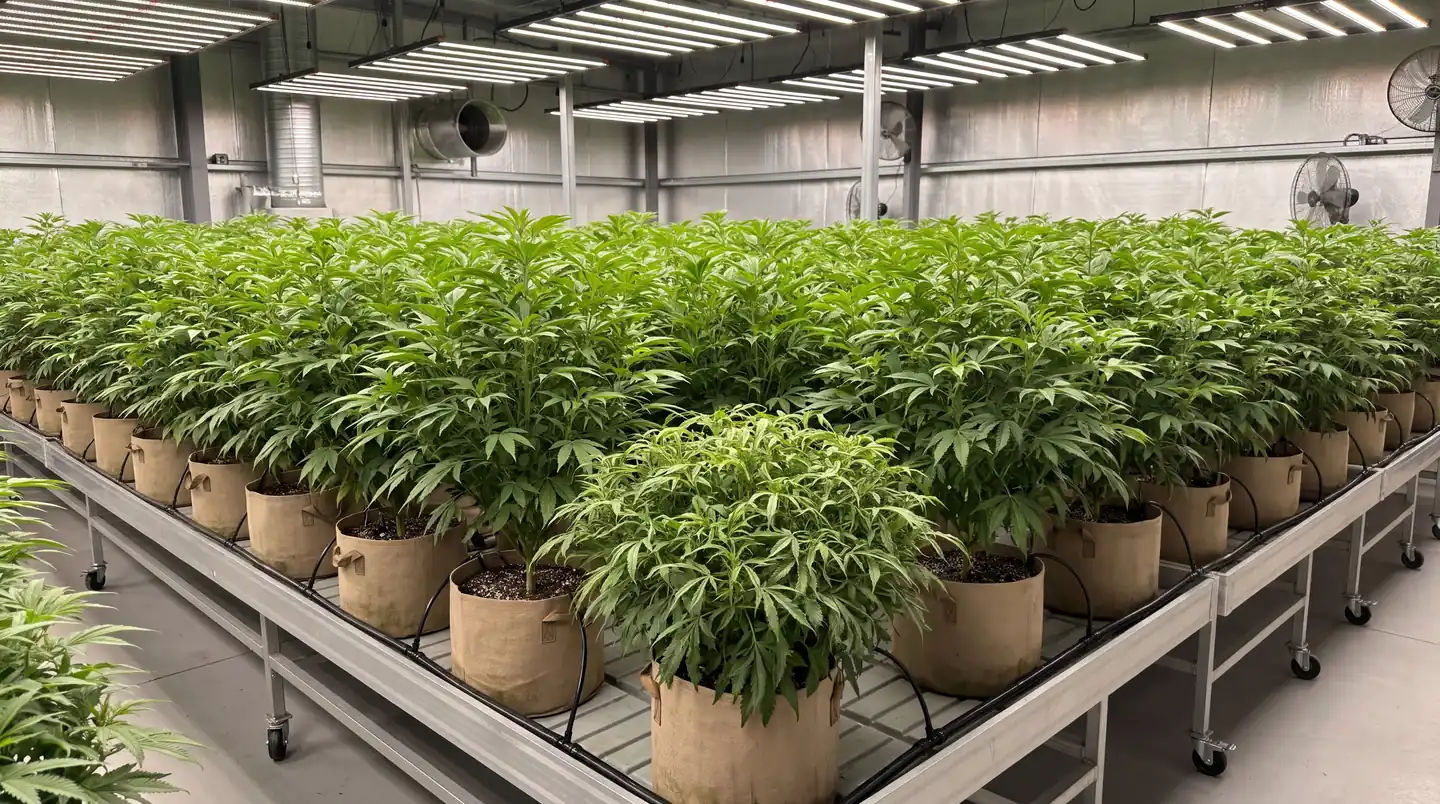
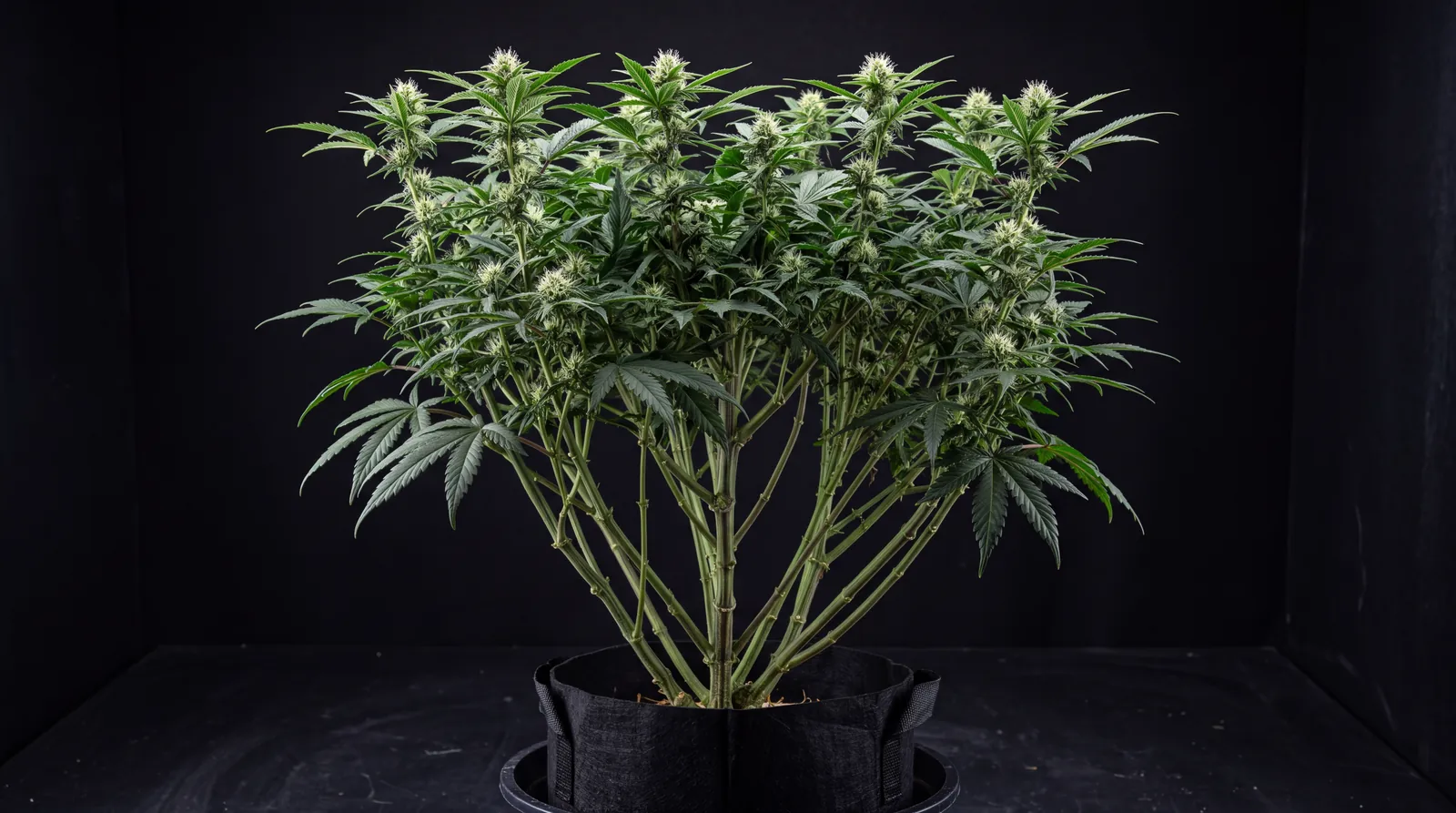
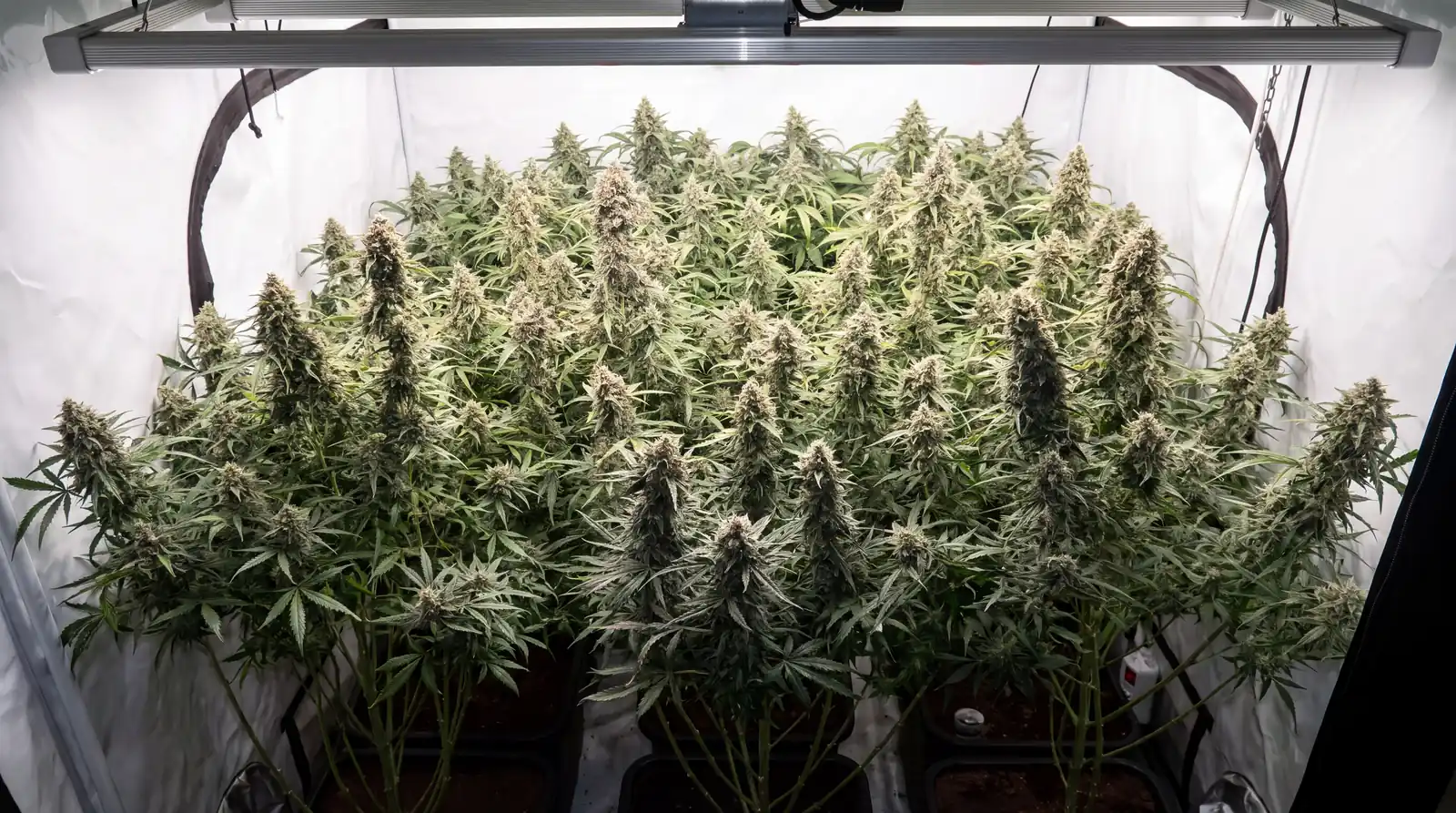
The Sea of Green method is an indoor cultivation technique where you grow many small weed plants uniformly in a limited space with one main cola each, flipping them to flower after a very short veg. Every plant is the same age and about the same height, so the canopy looks like one continuous green surface or a sea of green
Together, that creates a flat, even canopy of tops that all sit in strong light and finish at the same time. Nothing gets bent, tied or woven into place. That's the biggest structural difference from scrogging, where a few plants get spread across a screen. SOG is a whole-cycle strategy, so you plan your genetics, pot size, veg length, and pruning around it from day one.
Why a SOG Grow Gets More From the Same Space
A SOG grow gets more from the same space in two ways. It maximizes every inch of your light’s footprint and it shortens each cycle so you fit in more harvests a year. On a big untrained plant, the lower half gets shaded by its own upper growth. SOG swaps that shaded growth for more single-cola plants, all up in the best light for optimal bud development.
The shorter cycle comes from the veg. A plant vegged for a couple of weeks reaches harvest well ahead of one vegged for a month or so. Over a year, those saved weeks add up to extra runs. Each SOG plant yields less than a big trained plant, but total output can match or beat it.
Is the Sea of Green Method Good for Beginners?
Yes, SOG is beginner-friendly in one key way: there’s no training to learn. The harder part is consistency. You’ll be watering, feeding, and checking many plants on the same schedule, so small slips can show up across the grow. Once your routine is set, though, that same uniformity works for you, with every plant finishing together for one quick and easy harvest.
How to Run a Sea of Green Grow Step by Step
Running a sea of green comes down to five steps in a fixed order. Set your layout, germinate all your seeds together, veg briefly and flip, prune each plant to one cola, then keep the canopy even through flower.
Make every one of those decisions against a single number: the final height you want your plants to reach. It sets how tightly plants can sit, how long they can veg, and how much lower growth comes off.
Step 1: Plan Plant Count & Pot Size According to Tent Size
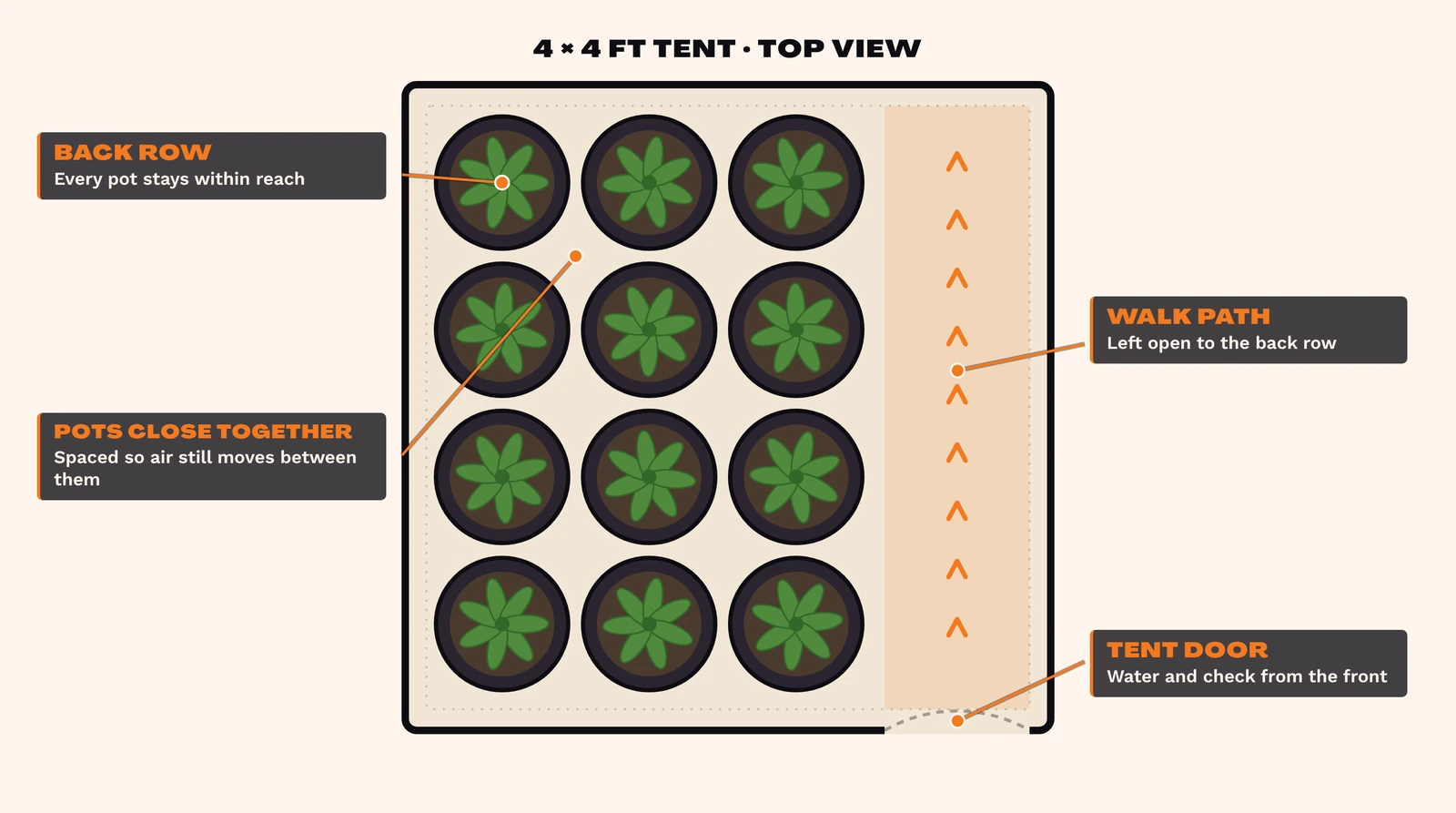
Most indoor SOG grows run about 1 cannabis plant per square foot, on average. Dense setups using very small pots or hydro trays can push that to a maximum of around 4 plants per square foot. Your final number depends on pot size, veg length, how much access you need for watering, and your local plant limit.
SOG pots are small, usually 1–3 gallons, and hydro setups often go smaller still. Pot size and plant count are really one decision. Smaller pots hold smaller plants and fit more per square foot, while larger pots grow bigger plants that need more room each.
Here’s roughly how many round pots fit in common tent sizes when they sit close together:
| Grow Tent Size | 3-Gal Pots | 2-Gal Pots | 1-Gal Pots |
| 2 x 2 ft | 4 | 4 | 9 |
| 2 x 4 ft | 8 | 10 | 18 to 21 |
| 3 x 3 ft | 9 | 16 | 25 |
| 4 x 4 ft | 16 | 25 | 36 to 49 |
These counts assume standard nursery pots about 7–12 inches wide, sitting close together. Fabric pots and other brands can run wider, so measure yours before you plan. Then aim a little under the max to keep a path to every plant. A back row you can’t reach is a back row you’ll stop checking.
Step 2: Start Every Seed on the Same Day
SOG depends on every plant staying on the same timeline, so germinate all your marijuana seeds together. Pop a few more than you need so you can replace any that don’t sprout.
Once a seed cracks and shows its taproot, plant it straight into its final pot. Skipping a transplant removes one more chance for a few plants to stall and fall behind the rest. This matters most with autos, which have little time to recover from setbacks.
Put seedlings on an 18/6 light schedule from the start and water lightly around the stem until the roots spread. Hold off on nutrients at first, since many potting soils carry enough food for the first few weeks. In coco or hydro, which supply no food on their own, start with a light, diluted feed instead.
Rooted cuttings skip this step because they’re genetically identical and already on the same timeline as the mother plant.
Step 3: Veg Briefly and Flip to 12/12
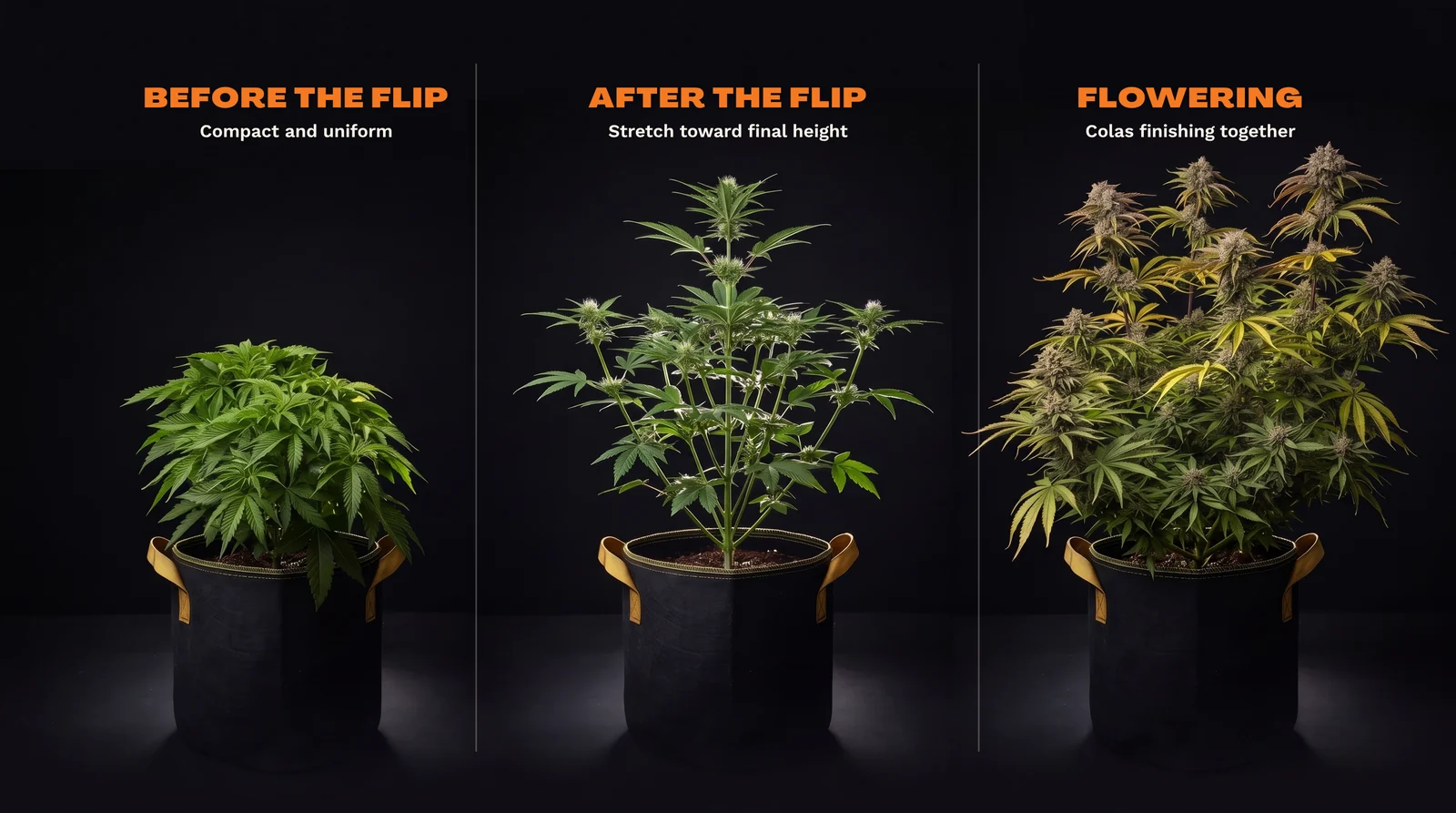
Give your cannabis plants just 1–3 weeks of true veg after the seedling stage, then flip to 12/12, usually 4–6 weeks after sprouting. Time the flip for when they reach a third to half of your target height. Plants can double or triple in height after the flip (depending on genetics), so the stretch carries them the rest of the way.
Denser setups need even less veg, since more plants fill the space faster. Rooted cuttings can flip sooner still because they skip the seedling stage. Until you know how much your strain stretches, leave extra headroom on your first run.
Timing mistakes cost you either way. Flip late and plants outgrow their spacing and shade each other. Flip too early and they never fill the footprint, so light falls on the floor between pots.
Autoflowers skip this step. They start flowering based on age rather than a light change, so strain choice and pot size do most of the work on final size. Plan your spacing around that from the start.
Step 4: Prune Each Plant to a Single Main Cola
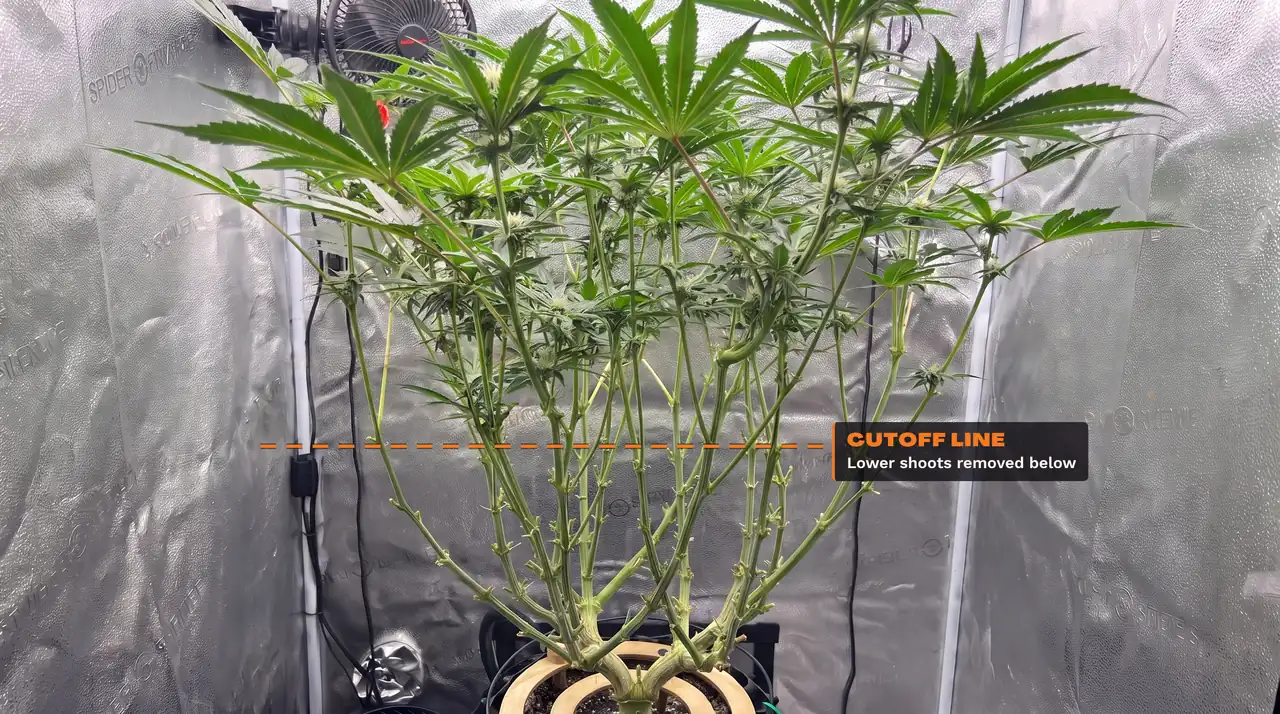
Around the flip and through early stretch, remove the lower shoots that’ll stay shaded, and leave the main growing tip alone. The intact tip keeps apical dominance, so the plant puts its energy into one big cola. Left in place, lower growth only turns into small larfy buds that draw resources and sit where humidity runs highest.
To prune each plant in your Sea of Green grow:
- Mark the cutoff line on each plant. Since plants stretch after the flip, most of their current lower growth will end up under the final canopy. In most SOG plants, that means the bottom third to half of the stem.
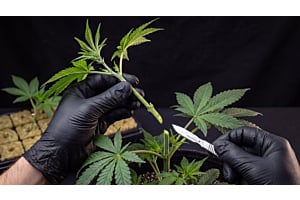
- Snip everything below that line flush with the main stem. That includes small side shoots and any bud sites forming there. Use clean, sharp scissors, since a clean cut heals faster than a torn one and leaves less room for disease.
- Keep the fan leaves on the top half of the plant. They catch the most light and feed the main cola as it bulks up. Large lower fan leaves sitting fully in shade can go too, but don’t strip the plant bare.
Finish within that early flowering window. Heavy pruning later in flower adds stress for very little return. Skip topping, FIMming, and mainlining too, since they break apical dominance to create multiple tops (which is the opposite of what you want with a SOG setup).
Step 5: Keep the Canopy Even Through Flowering
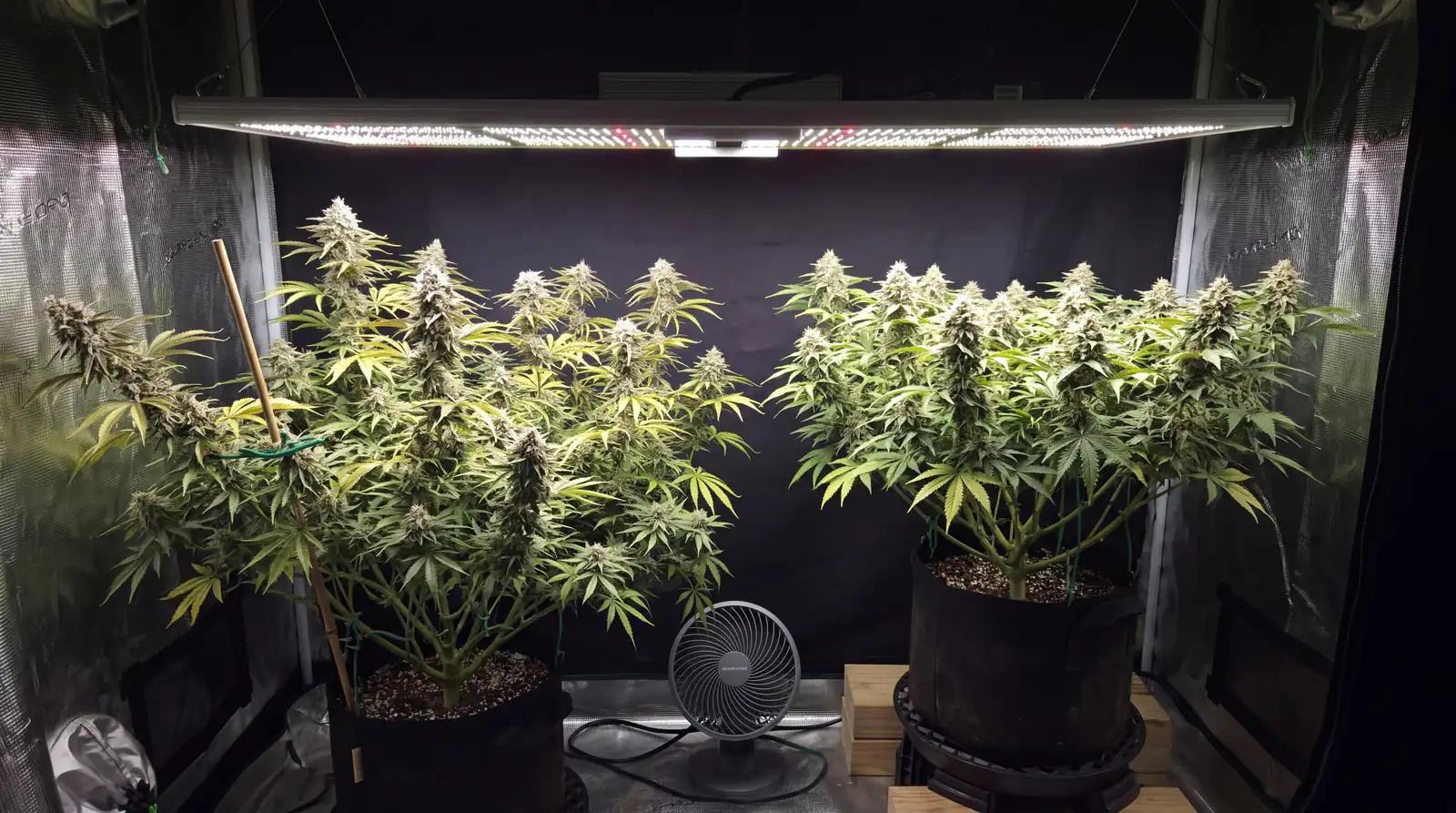
Keep the tops at one height by moving and raising pots as your plants stretch. Lift shorter plants on blocks or upturned pots, and move the tallest to the edges so they don’t shade the rest. Keep air moving under the canopy too, since a packed tray traps humidity.
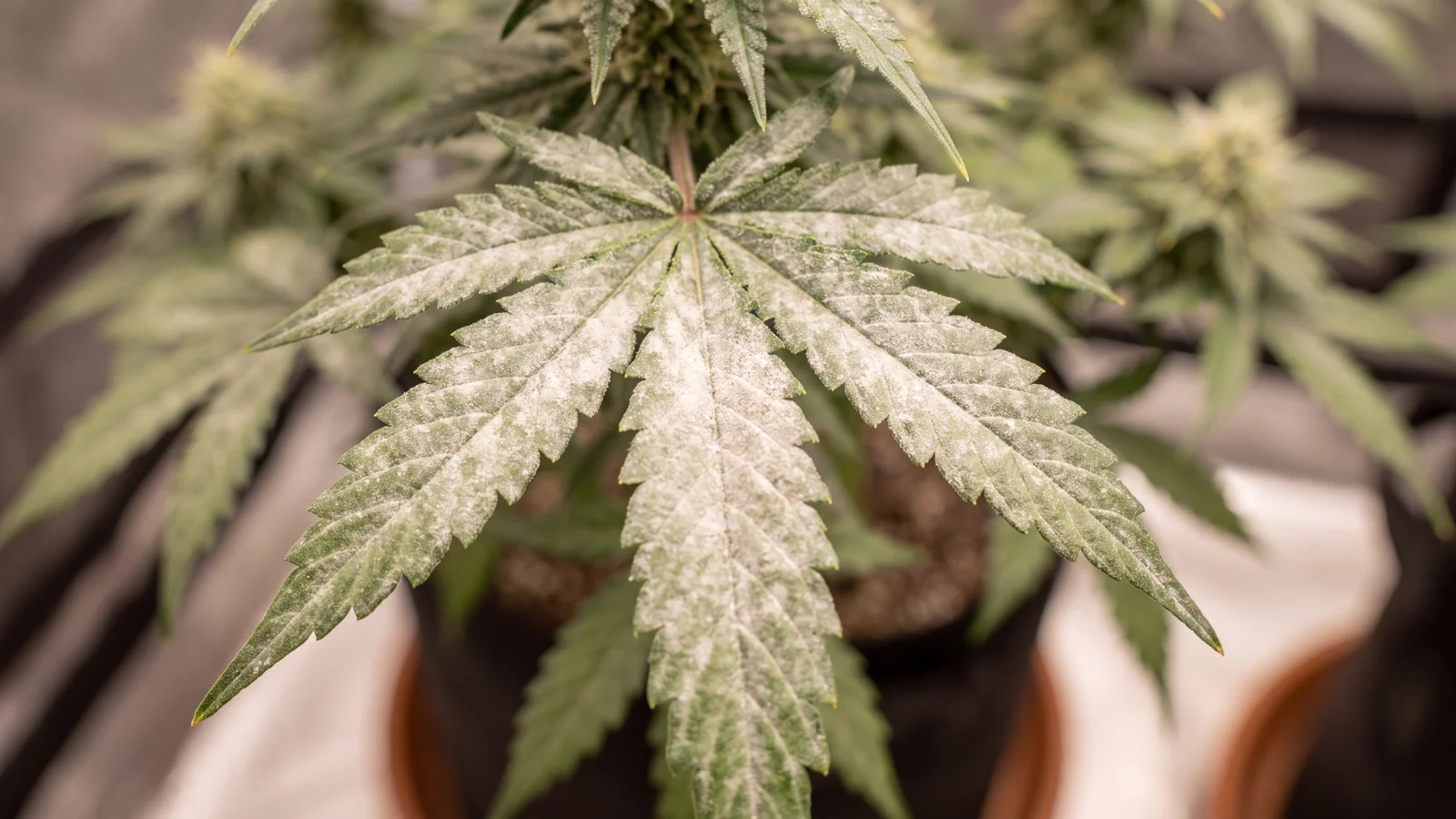
Run at least one fan below the canopy as well as one above it. The lower fan pushes air through the stems you cleared in Step 4, where still, damp air invites mold and mildew. Keeping humidity around 40–50% in flower helps too.
Each week:
- Re-level the tops. Swap pot positions, add or remove blocks under shorter plants, and rotate any pot that’s growing faster on one side.
- Stake leaning colas. A bamboo stake or plant yoyo keeps heavy tops upright, especially around the edges where plants tend to lean outward.
- Check under leaves and inside the densest colas. Look for pests on leaf undersides and gray or brown patches inside buds for signs of bud rot. Touching plants pass problems along fast, so pull any affected pot out of the tent right away.
Stick with these weekly checks until the end of flower. When the tops stay level and healthy, the colas ripen on roughly the same schedule, which is what makes a quick, single-session SOG harvest possible.
Sea of Green in Hydroponics, Coco and Soil
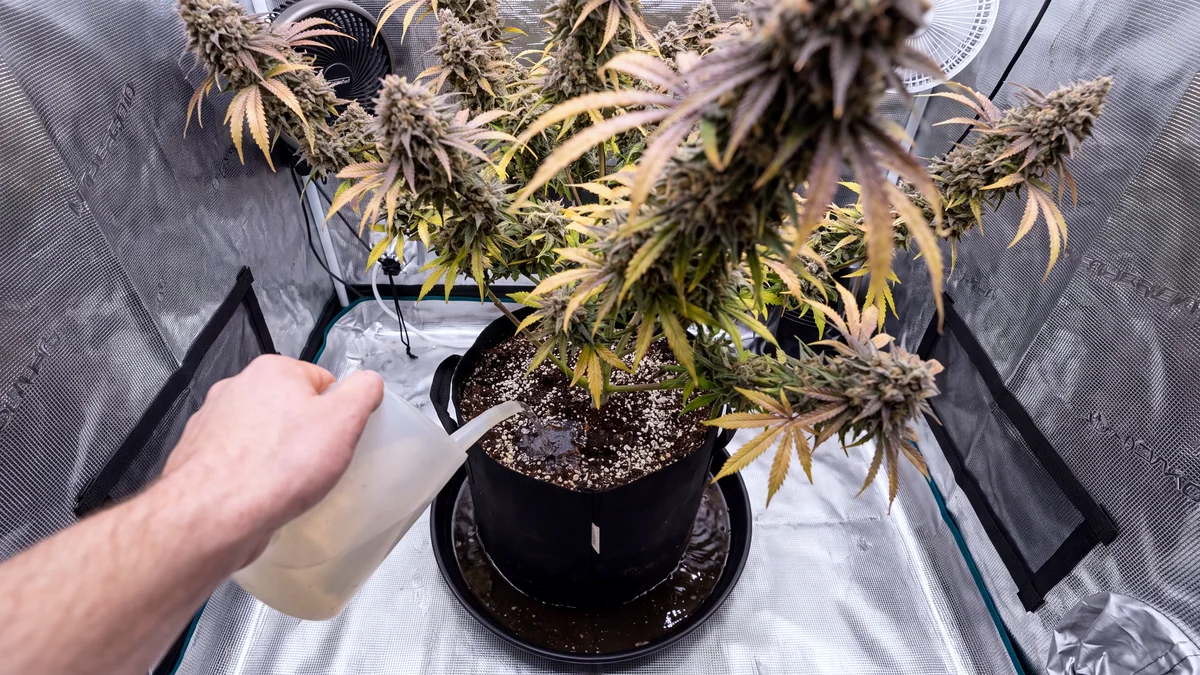
SOG works in hydro, coco and soil. Hydro and coco suit dense tents best, since drip or flood-and-drain systems can water every pot automatically. Soil is more forgiving of feeding mistakes but usually means hand-watering, so it fits smaller plant counts.
Sea of Green in Hydroponics
Hydro is the easiest way to run a large SOG grow, because one reservoir can feed every plant through a drip or flood-and-drain system. That automation absorbs the extra watering a high plant count creates. The catch is shared risk. One pH or feeding mistake in the reservoir reaches every plant at once, so check your reservoir’s pH and EC often.
Sea of Green in Coco Coir
Coco gives you most of hydro’s automation while each plant keeps its own pot of medium. It drains fast, so small coco pots often need watering more than once a day by mid flower. Most growers add drip emitters as plant counts climb. Since the pots don’t share water, a root problem in one pot stays there instead of spreading through the system.
Sea of Green in Soil
Soil is the most forgiving option while you learn SOG, since it buffers pH and nutrients better than coco or hydro. An off feeding is less likely to hit the whole grow as hard. The cost is time. Hand-watering twenty or more small pots can become a daily job in flower, so many soil growers stay at the lower end of the plant count range.
Sea of Green vs ScrOG: Which Should You Run?
Run SOG if you want a faster turnover and can grow plenty of uniform weed plants. Run ScrOG if you're capped at a few plants or your genetics stretch hard. SOG fills the space with many single-cola plants, while ScrOG spreads a few multi-cola plants across a screen so each one grows many colas.
| Aspect | SOG | ScrOG |
| Plant count | Many | Few |
| Plant size | Smaller | Larger |
| Veg length | Minimal, so a shorter cycle | Longer, until the screen fills |
| Suitable genetics | Compact & fast-finishing | Taller, stretchier genetics |
| Labor pattern | Many root zones & frequent watering | Fewer root zones & regular hands-on training |
| Time to harvest | Shorter | Longer |
Some growers blend the two at small scale by laying netting over a dense SOG purely for support. It's a handy variation, though a classic SOG runs without a screen.
Common Sea of Green Mistakes & How to Avoid Them
The mistakes that hurt most in a SOG are the ones that spread. Every plant is the same age and touching its neighbors, so a problem with one plant rarely stays with one plant. Here’s what to avoid with the Sea of Green weed-growing method:
- Ignoring your legal plant count. Many places cap how many plants you can grow at home, so check your local limit before you plan the layout. With a low cap, grow fewer, slightly larger plants on the same short veg, top each plant once for two main colas, or switch to scrogging.
- Letting the canopy crowd itself. High density restricts airflow and raises humidity inside the canopy, which increases mold risk and helps pests jump between touching plants. If crowding has already happened, pulling a few whole plants usually works better than trying to prune a full tray back into shape.
- Mixing plants of different sizes. An uneven canopy undoes the SOG method. You can partly rescue it by raising shorter plants, moving the tallest to the edges and cutting back the highest tops, but sorting plants by height at setup is far easier.
- Ignoring light leaks. Light leaking into the dark period can stress feminized photoperiods into growing pollen sacs. In a packed tray, one missed sac can pollinate its neighbors, so seal your tent and check plants closely from the third week of flower.
- Underestimating watering. Small pots at density dry out fast and forgive very little. Work out how often your pots actually need water before you scale up the plant count, or automate it.
Choosing the Best Seeds for a Sea of Green Grow
The best weed seeds for a Sea of Green grow come from compact, fast-flowering strains with moderate stretch and one strong central stem. Autoflowers are the simplest option from seed, while feminized and fast version photoperiods give you more control over size:
- Feminized seeds: Nearly every plant grows female, around 99%, so you don’t have to spend pre-flower sexing every plant in a packed tray. These photoperiod seeds are the classic SOG pick, and the time saved grows with your plant count.
- Fast version seeds: These feminized photoperiods are bred to finish flowering sooner, which shortens each SOG cycle even further.
- Autoflower seeds: Autos are feminized too, so you get the same female-focused grow. They start flowering based on age rather than a light change, so there’s no flip to time. They also stay compact and go from seed to harvest quickly, which suits SOG’s short cycles.
- Indica seeds are available as the feminized, fast version, or autoflowering seed types listed above but these genetics tend to grow shorter and denser. That’s a tendency rather than a rule, so check seed strain genetics for specifics.