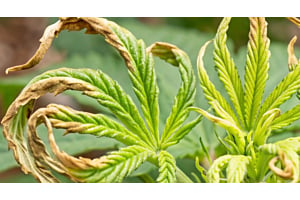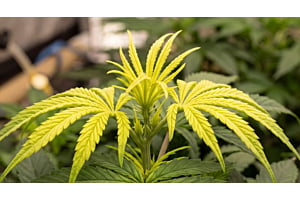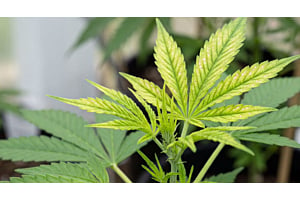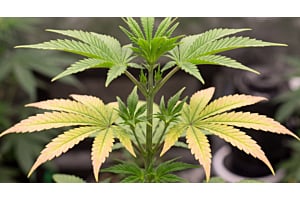
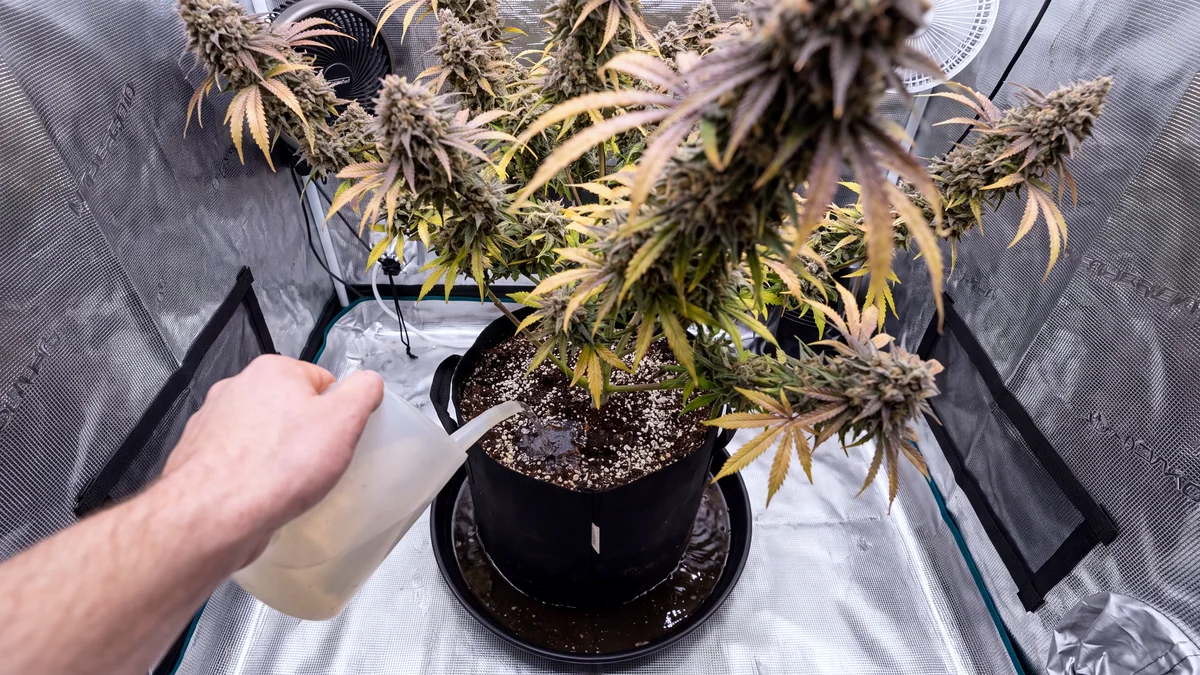
Flushing cannabis is about switching to plain, pH-adjusted water in late flower instead of nutrient solution. Count back from your expected harvest date so the flush wraps up as the trichomes turn mostly cloudy. Budget 7 to 14 days in most potting soils, 3 to 7 days in coco, and 2 to 3 days in hydro.
Water slowly until about 30% drains out, water again once the top inch or two starts to dry, and stop when your runoff reads close to your source water.
The pre-harvest flush is popular but debated, with little scientific evidence it improves the smoke. That’s why many growers taper nutrients instead. Flushing still has a clear mid-grow job, though: clearing salt buildup that’s locking out nutrients.
This guide covers whether to flush, when and how long by medium, a step-by-step method, common mistakes, and the lockout fix.
What Does Flushing Cannabis Actually Mean?
Flushing cannabis means running plain, nutrient-free, pH-adjusted water through the root zone in late flower to dilute excess mineral salts and wash them out of the growing medium. So if you’re growing feminized weed seeds, nothing gets rinsed, cleaned, or pulled out of the buds themselves.
Salts build up because each feed delivers more minerals than the plant takes up in that watering. The extra stays behind on soil particles, on coco fiber, or in the hydroponic reservoir, and it stacks up over weeks of flower. Heavy feeding and watering with little runoff push that load higher.
The name is what fools people. The word “flush” makes it sound like you’re rinsing the buds, but the water only ever touches the roots and the growing medium. The leaves that yellow in late flower aren’t being cleaned out either. That fade is the plant using up its own stored nutrients, and it happens whether you flush or not. A flush just speeds it up.
Growers also flush mid-grow, for a different reason: to clear salt buildup that’s locking out nutrients. That’s a legitimate fix, and it’s covered below.
To Flush or Not to Flush: Does Flushing Weed Work?
No, flushing weed doesn’t actually work for improving potency, flavor, or smoothness, based on the controlled research so far. Its real benefit is in the root zone. Where salts have built up, a flush dilutes them, which eases water uptake and lowers the risk of tip burn or lockout before harvest.
An Rx Green Technologies cannabis flushing trial ran 14, 10, 7, and 0-day flushes side by side on weed plants grown in coco and found no significant difference in yield, THC, or terpenes. A blind expert panel found no difference in flavor, smoothness, or ash color either, and what preference it showed leaned toward no flush at all.
Two other studies point the same way. A 2017 University of Guelph thesis found that flushing didn't change nutrient levels in the harvested flowers, and a 2024 peer-reviewed study across five cultivars found no consistent effect on terpenes or cannabinoids.
Each trial covered a limited set of cultivars and setups, so the results may not carry over to every medium, feed program, or genetic line. More recent trials have also found that flushes stretching toward three weeks can cut yield.
Plenty of experienced growers still swear by flushing, and the harsh, crackling smoke they've had from some unflushed weed is real. But the more likely causes are a rushed dry and cure or a plant that was overfed all through flower. A last-minute flush fixes neither. The first comes down to a slower dry and cure, the second to a lighter hand with nutrients all through flower.
Should I Flush My Cannabis Plants?
Whether to flush your cannabis plant depends on how you feed. A pre-harvest flush only helps when there’s a buildup of mineral salts in the root zone to clear, so the answer changes with your feed program:
- Heavy synthetic feeders: A flush is worth doing, especially if you’ve been overfeeding or watering with little or no runoff. That’s when salts pile up fastest.
- Light or moderate feeders: It’s optional. Many growers taper their feed over the last week or two instead. A short flush won’t hurt, but don’t expect either one to make a better smoke.
- Organic and living soil growers: You can usually skip it. Your plants get their nutrition through soil life rather than bottled salts, so there’s little to wash out. Heavy plain-water flushing can also disrupt the microbes doing that work.
One exception applies to everyone. If you’re seeing signs of salt buildup or lockout at any stage, a flush is the right tool, whatever you feed.
When to Flush Cannabis
If you’re choosing to flush your weed plants, start a set number of days before harvest. How many days depends on your medium, and the table further down covers that. For example, if you plan to flush soil for 10 days, start 10 days before you expect to harvest.
So the real job is working out your harvest date. Don’t rely on the strain’s listed flowering time, because an 8-week strain can take anywhere from 8 to 10 weeks. Check the trichomes instead. Look at them under a loupe or scope as the plant gets close. Most growers harvest when they’re mostly cloudy with a few turning amber.
Give your last nutrient feed the day before your flush starts. Check your feeding schedule to see whether that feed should be full or reduced strength.
If you’re not sure of the date, start the flush later rather than earlier. A few days late does no harm. Two weeks early leaves the plant on plain water while its buds are still growing.
When to Flush Autoflowers
Autoflowers use the same medium windows as photoperiod plants, and you time the flush the same way, by counting back from a projected harvest date. Because autos start flowering by age rather than after a switch to 12/12, breeders list them by total seed-to-harvest time instead of weeks of flower. Use that figure to know roughly when to start checking trichomes.
How Long to Flush Cannabis in Soil, Coco and Hydro
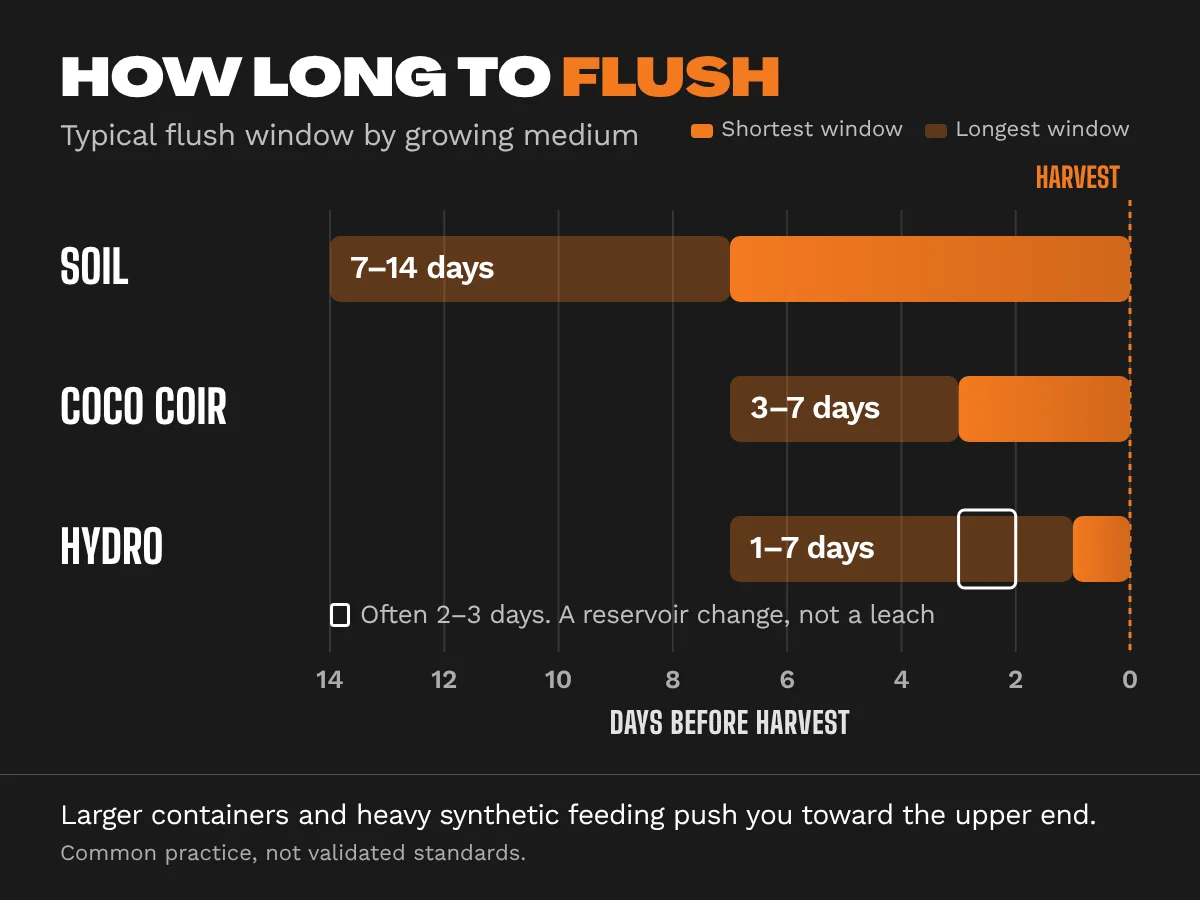
The medium sets the flush length: soil holds onto salts longest, coco clears faster, and hydro clears fastest because you can simply swap out the reservoir.
| Medium | Typical flush length | Why |
| Soil | 7 to 14 days | Soil holds minerals on its particles and releases them slowly, so it takes several waterings to dilute them. |
| Coco coir | 3 to 7 days | Salts cling to the fiber, but coco drains fast and gets watered often, so the load clears quickly. |
| Hydro (DWC, RDWC, NFT) | 2 to 3 days | Nutrients are dissolved in the reservoir, so you drain and refill it. There's no medium to leach. |
Two things push you toward the long end of your range. Bigger containers hold more medium and more salt, so a 5-gallon soil pot takes longer to bring down than a 2-gallon one. Heavy feeding through flower does the same.
Treat these ranges as common practice, not tested standards. Going past the top of your range won't improve the result.
How to Flush Cannabis Plants Step by Step
To flush cannabis plants, test and pH your water, stop all nutrients, water slowly until about 30% drains out, hold off on the next watering until the top inch or two has lost some moisture, and keep the rest of your setup unchanged. Repeat that cycle until your runoff reads close to your source water or your flush window closes.
Step 1: Test and pH Your Water
Start with the water because its reading is the baseline for the whole flush. Tap and well water carry their own dissolved minerals, so take an EC or PPM reading of your source water before you begin. Filtered water starts lower, and RO water reads at or close to zero.
For soil, bring the pH to 6.0 to 6.3 (anything from 5.5 to 6.5 is workable). Coco and hydro sit a touch lower, ideally 5.8 to 6.2, with 5.6 to 6.4 as the outer limits. Running organic or living soil? Skip this part, because the soil biology keeps the root zone in range on its own.
Cold water straight from the tap can shock a root zone sitting at room temperature, so aim for roughly 68 to 72°F in coco and hydro, or up to 75°F in soil.
Step 2: Stop All Nutrients and Additives
With your water ready, keep everything else out of it. That means no base nutrients, bloom boosters, silica, teas, or other additives from the first flush day onward. pH Up and pH Down are the one exception. They correct the water and add only small amounts of minerals such as potassium or phosphorus.
Step 3: Water Slowly Until About 30% Drains Out
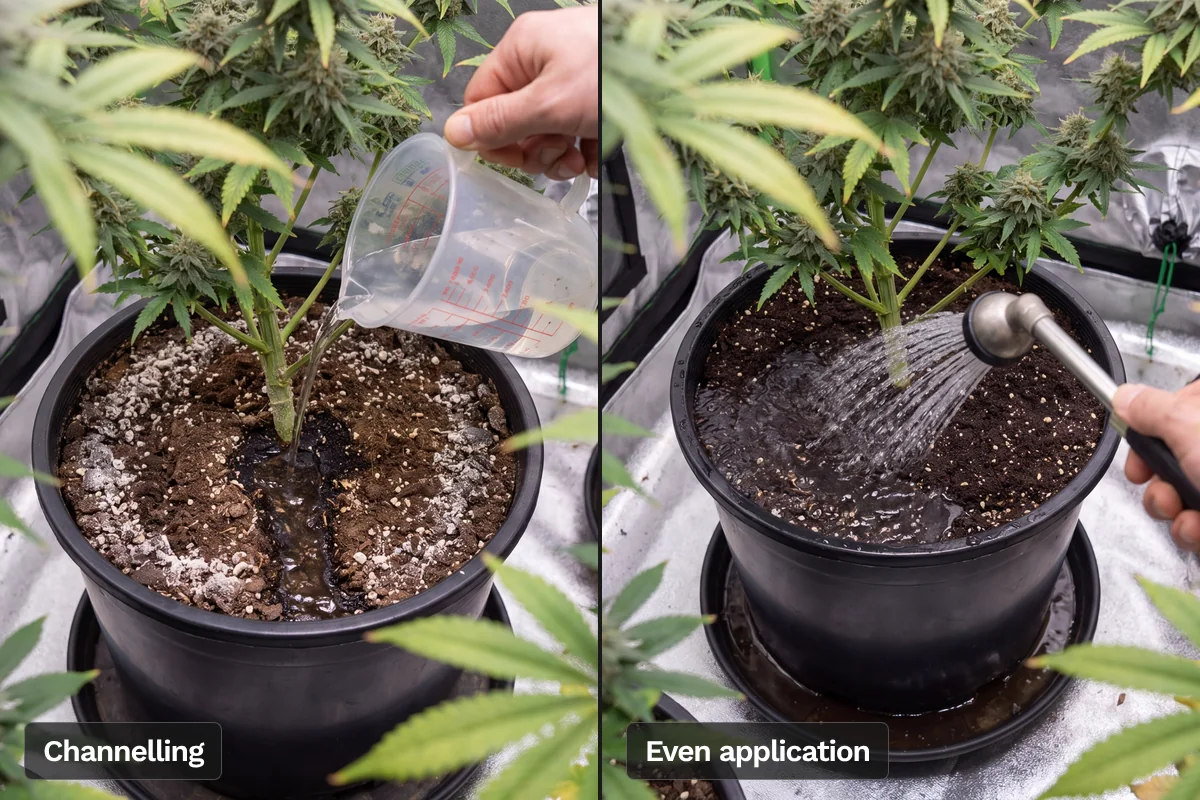
Next, move clean water through the whole root zone. Water at your normal volume until about 30% drains out the bottom, and repeat that at each watering across the flush. If you usually run coco without runoff, you'll need water to runoff for the flush to do anything.
Some growers run 2 to 3 times the pot's volume through in one session. It brings readings down fast but leaves the roots waterlogged in late flower, so most tent growers are better off with repeated normal waterings.
Pour slowly across the whole surface, not into one spot. Fast pouring channels straight down to the drainage holes and leaves dry pockets full of salt. In hydro, this step is a reservoir change instead, so drain the system, refill with plain pH-adjusted water and top up as needed.
Step 4: Water Again Once the Top Inch or Two Dries
Once the water has run through, hold off until the top inch or two of the medium has lost some of its moisture. Flushing doesn't mean watering daily or keeping the pot soaked, but don't let it dry out completely either. Water at that point and collect runoff again.
Step 5: Keep Your Environment Steady
While the flush runs, leave lights, temperature, humidity, and airflow exactly as they were. A flush is a root-zone job, and changing the room at the same time makes it hard to tell what's affecting the plant. From here on, take a runoff reading at every watering so you know when to stop.
How to Tell When Your Cannabis Flush Is Done
Your cannabis flush is done when the runoff EC or PPM drops close to the reading of the water going in, or when your planned window closes, whichever comes first. The closer those two readings get, the less available salt is left in the medium.
For an accurate reading, let the first trickle go, as it's mostly water that was sitting in the bottom of the pot. Collect from the steady flow that follows and measure the same way every time. Published targets vary a lot between sources, so watch the gap between your two readings, not a specific number.
Signals worth reading:
- Runoff EC or PPM: It's falling toward your source-water reading.
- Reservoir EC in hydro: It holds steady near your fill reading with no rebound between changes.
- Plant condition: Leaves stay firm and buds stay intact, with no collapse.
- Days elapsed: You've reached the planned window for your medium.
Leaf fade isn't on that list for a reason. Fan leaves often pale during a flush, but unflushed plants fade too, just more slowly. In the Rx Green trial, the longer flushes left leaves visibly yellower without any measurable change in the flowers.
No EC pen? Go by the elapsed window and plant condition. It's workable, and it still beats treating leaf color as proof. Whichever way you check, don't stretch the flush to chase a number.
When to Harvest After Flushing Weed
Finishing a flush is not a sign that your weed plant is ready to cut, so knowing when to harvest after a flush still comes down to the trichomes. Check them on a few buds under a loupe or scope before you cut.
The end of your flush and the right harvest day often won’t line up, and that’s fine. If the plant needs another 2 to 3 days, keep giving it plain water and let it finish. Cutting early just to stick to a schedule is a bigger mistake than a few extra days on water.
Common Mistakes When Flushing Cannabis Plants
Knowing how to flush weed is only half of it. Most mistakes come from starting too soon or doing too much. Here's what each one costs and how to fix it.
| Mistake | What happens | How to fix it |
| Starting too early | Leaves drop and photosynthesis slows while buds are still filling out, which can cost weight and density. | Recheck the trichomes. If harvest is clearly weeks away, go back to a light feed. |
| Keeping the pot soaked | Roots run short on oxygen, the plant droops like it's deficient, and root disease risk climbs. | Water again only once the top inch or two has started to dry. |
| Skipping pH | A pH problem can lock out nutrients in the final two weeks, with no time left to recover. | Check and adjust pH on every flush watering in coco, hydro, and synthetic-fed soil. |
| Chasing leaf fade | The flush drags on to force yellowing, which strips the canopy for a look that proves nothing. | Stop when your runoff reads close to your source water or your window closes. |
| Flushing with no salt buildup | You take on the risks of a long water-only stretch with nothing to gain. | Light feeders and organic growers can skip the flush. |
| Flushing in a hot, humid room | Extra moisture around dense late-flower colas raises bud rot risk. | Sort out airflow and humidity before adding more water. |
How to Flush a Cannabis Plant to Fix Nutrient Lockout
To fix nutrient lockout mid-grow, flush with slow, even, pH-corrected water until about 30% drains out, let the top inch or two dry, correct your feed pH (or amend the soil if you grow organic), then resume feeding at half strength. It's the same tool as a pre-harvest flush used for a different job. It can happen at any stage, and feeding resumes afterward.
Before you work out how to flush a weed plant for lockout, confirm the problem first, because flushing plants with a true deficiency makes things worse. These signs point to salt buildup or lockout:
- Leaf-tip burn or clawing that showed up after heavier feeding.
- Runoff EC clearly higher than your feed.
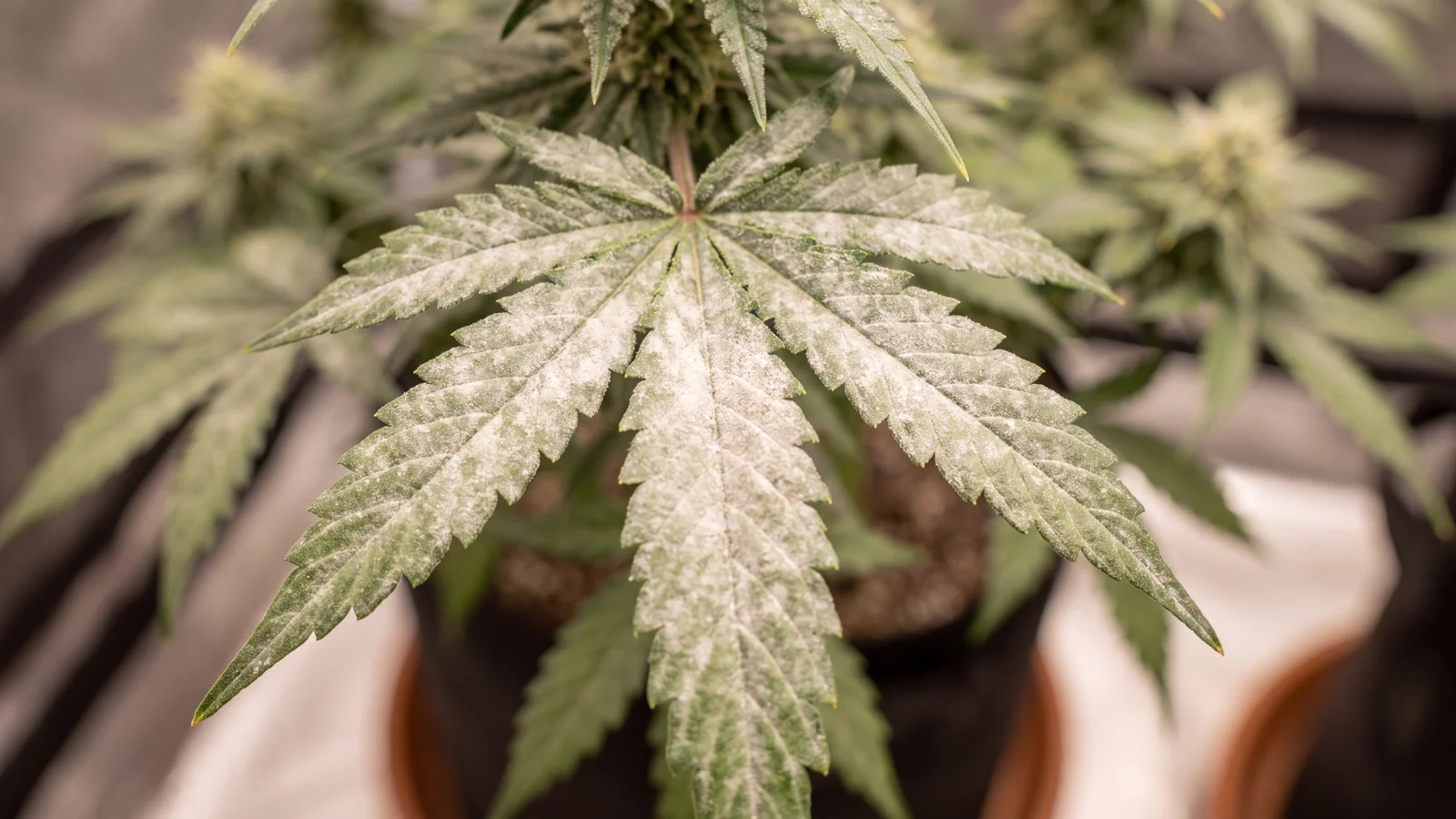
- White crust or salt deposits on the medium surface.
- Deficiency symptoms spreading even though the feed should be enough, which is the classic pH lockout pattern.
After the flush, let the medium dry back properly before feeding again, which usually takes a day or two. Then build back up from half strength over the next few feeds.
Burnt leaf tissue won't recover, so judge the fix by new growth coming in clean. Growers who judge by old damage, or jump straight back to full strength, often end up flushing the same plant again.
Is Water Deprivation Before Harvest the Same as Flushing?
No, water deprivation and flushing are opposites. Flushing adds water to wash salts out of the medium, while water deprivation before harvest holds water back for about 1 to 2 days to stress the plant. The idea is that mild drought stress pushes the plant to make more cannabinoids and terpenes, and that a drier plant is easier to handle and starts drying sooner.
The first part has some research behind it: controlled drought late in flower has raised THCA and CBDA levels in cannabis trials. Those trials used a longer, carefully measured dry-down, though, so the short pre-harvest version is still mostly grower practice.
The handling benefit is real but small. The risk is bigger. Wilting in the last days weakens the plant right when you want it at its best. The line between a mild dry-back and real drought damage is thin, especially in small pots and warm rooms, and there's no time left to recover.
If you try it, it comes after the flush, never in place of it. Keep it mild enough that the plant never wilts. If you're running small pots in a warm room, skipping it is the safer call.
What to Do Instead of Flushing Weed for Smooth, Flavorful Bud
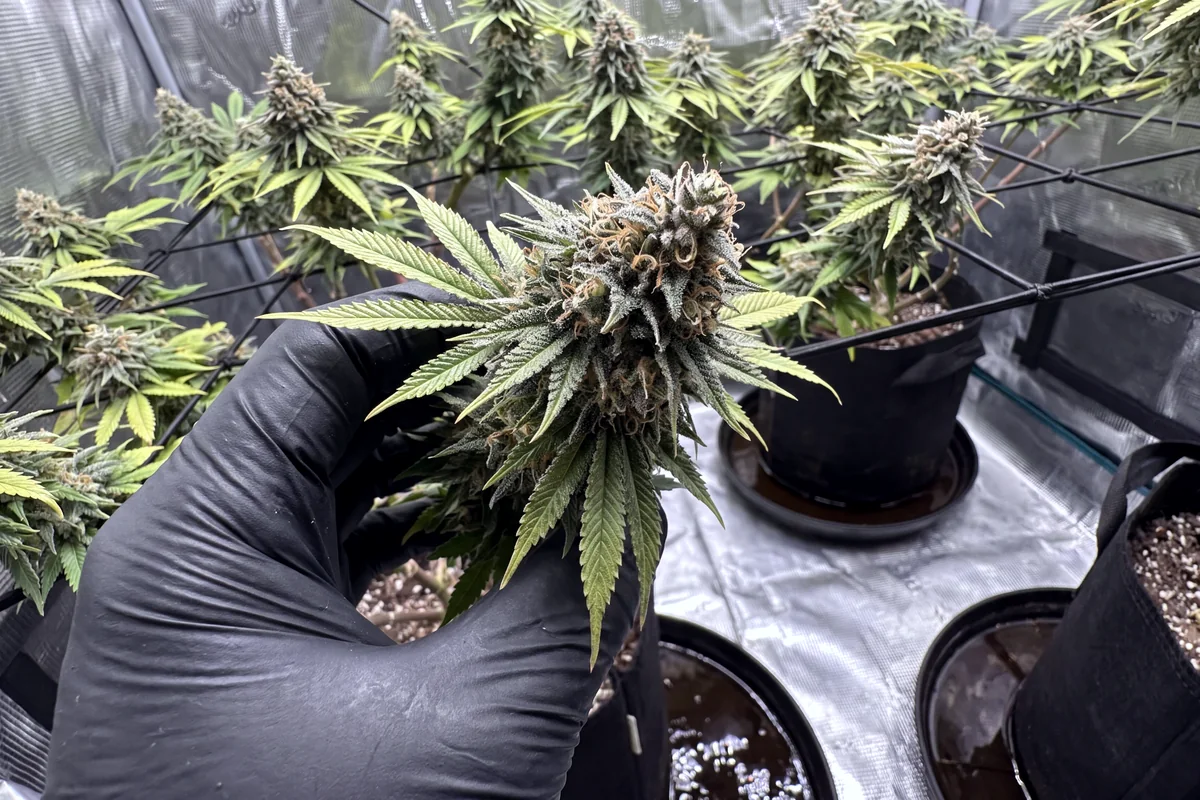
Smooth, flavorful bud comes mostly from how you feed through flower and how you dry and cure, not from a last-minute flush. In the final weeks, most growers taper their feed instead, lowering the strength gradually in the last stretch instead of flushing. A few simple habits through flower also keep salts from building up, so there’s nothing to flush out at the end:
- Taper your feed. Over the final 1 to 2 weeks, step your nutrients down a little at each feed rather than switching straight to plain water. The plant keeps a steady supply while it finishes its buds, and it naturally starts drawing on its own stored nutrients as the feed gets weaker.
- Water to runoff all through flower. Let about 10 to 20% of your water drain out at every feeding. That carries away extra salts as you go, so they never pile up in the medium. This matters most in coco and soilless mixes.
- Check your runoff EC. Take a quick reading every week or so. If it creeps well above the EC of what you’re feeding, salts are building up, and you can ease off the feed before it turns into a problem.
- Don’t overfeed. Start at the low end of your nutrient brand’s recommended strength and only increase it if the plant shows it needs more. Most salt buildup comes from feeding too strong for too long.
- After the chop, don't rush how you dry and cure your buds. That stage shapes smoothness, aroma, and burn quality far more than anything you do in the last two weeks of flower.
Keep notes as you go, including your runoff EC readings, how you tapered your feed, and how the finished bud smoked. That way you can fine-tune your finish on the next batch of cannabis seeds you pop.