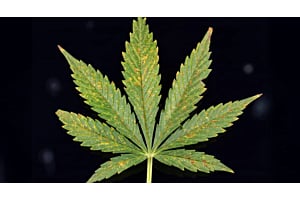
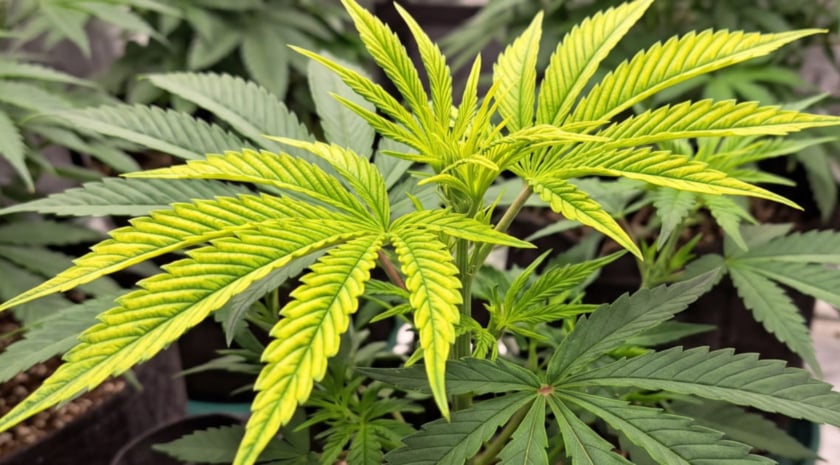
Few things worry a grower like a plant that suddenly starts yellowing up top. Cannabis iron deficiency is a frequent culprit, though it tends to look worse than it really is. The fix is usually simple -once you read the signs right. In this guide, you’ll learn how to spot an iron deficiency in your weed plants, identify the causes, treat the issue, and rule out lookalike problems.
TL;DR: A cannabis iron deficiency shows up as bright yellowing on newer leaves (with green veins) at the top of the canopy. A root-zone pH that's too high is the usual cause since it locks out iron. Bring the pH back into its ideal window (6.0-6.3 in soil, 5.8 -6.2 in coco or hydro), then foliar feed a chelated iron mix with zinc and manganese. New growth greens back up within 3-5 days.
What Does a Cannabis Iron Deficiency Look Like?
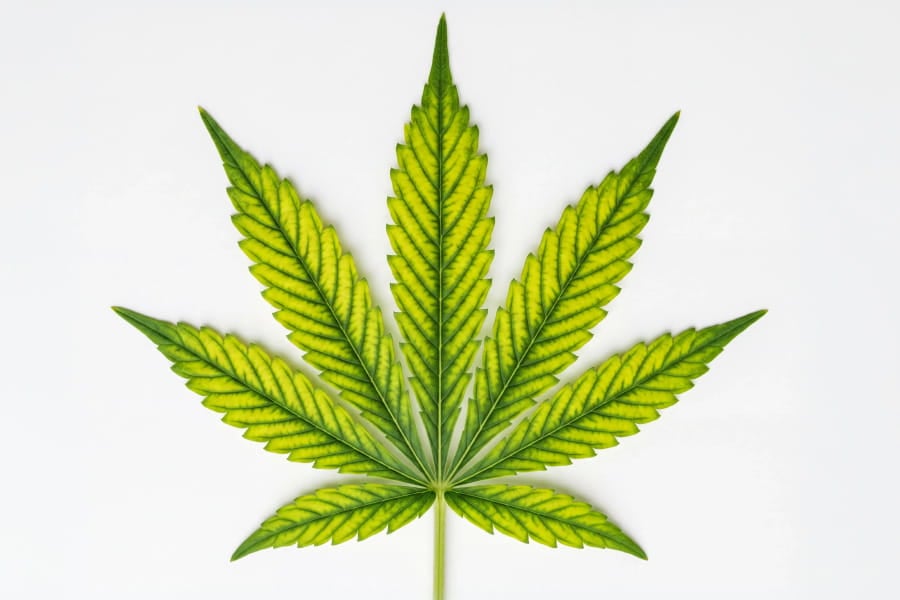
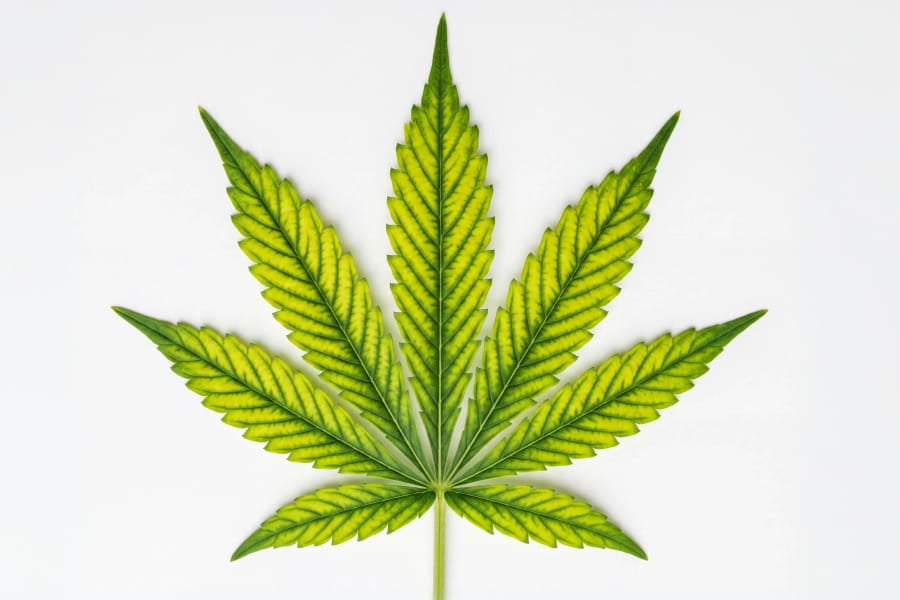
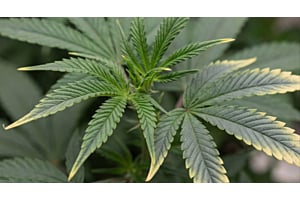
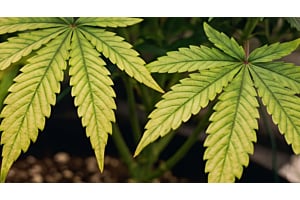
Close-up of cannabis leaf showing iron deficiency.
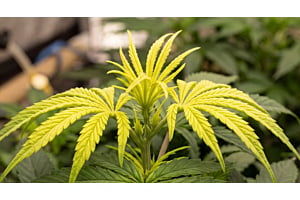
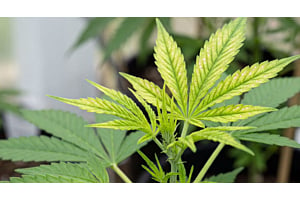
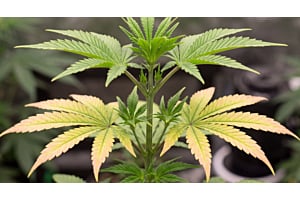
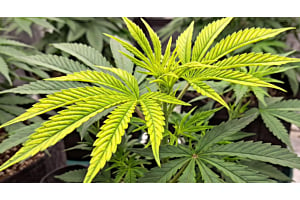
A cannabis iron deficiency turns new upper and inner leaves bright yellow while the veins stay green. The yellowing sits between the veins, a pattern called interveinal chlorosis. Because iron moves slowly through the plant, the newest growth shows it first, while older lower leaves usually stay green.
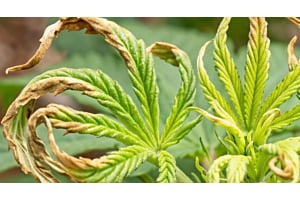
Early on, expect faint interveinal yellowing with no widespread necrosis. You may also see a light brown mottling near the base of each leaflet as the yellowing sets in, giving the middle of the leaf a faintly marked look.
Left uncorrected, the yellowing deepens and spreads across the whole leaf. Growth slows, and in severe cases, the leaf bleaches to near-white with browning tips. Badly damaged leaves won't recover, but new growth greens up once the cause is fixed.
One caveat worth knowing: iron deficiency is uncommon late in the flowering cycle, since there's little new growth left to show it on. But if root-zone pH spikes during this stage, iron deficiency can still appear as bright yellow leaves around the buds - a symptom nitrogen deficiency produces too. Check pH before assuming it's one or the other.
Iron Deficiency vs Other Cannabis Plant Problems
An iron deficiency can look like several other cannabis deficiencies and, in some cases, like pH lockout, an excess, or light burn. Leaf position is the first filter: it separates iron from the deficiencies that show up on old growth, like nitrogen and magnesium.
But iron shares the new-growth pattern with zinc, manganese, copper, and sulfur, so within that group you need a second clue - spotting, twisting, or whether the yellowing is strictly between the veins - to tell them apart.
Light burn has its own tell: canopy position relative to the light. Excesses and lockout are the trickiest, since neither shows a distinct look of its own, so those call for a check of feed history or overall plant condition instead.
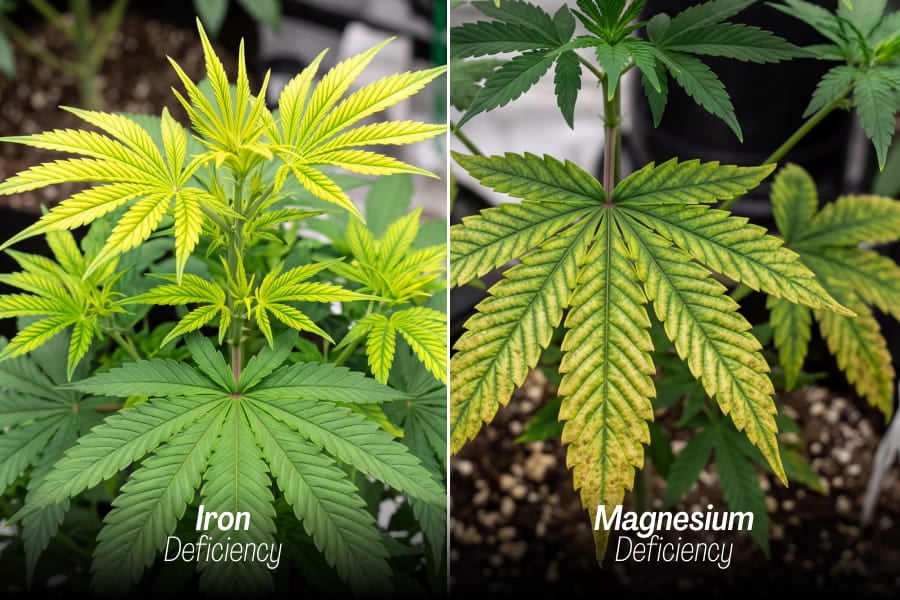
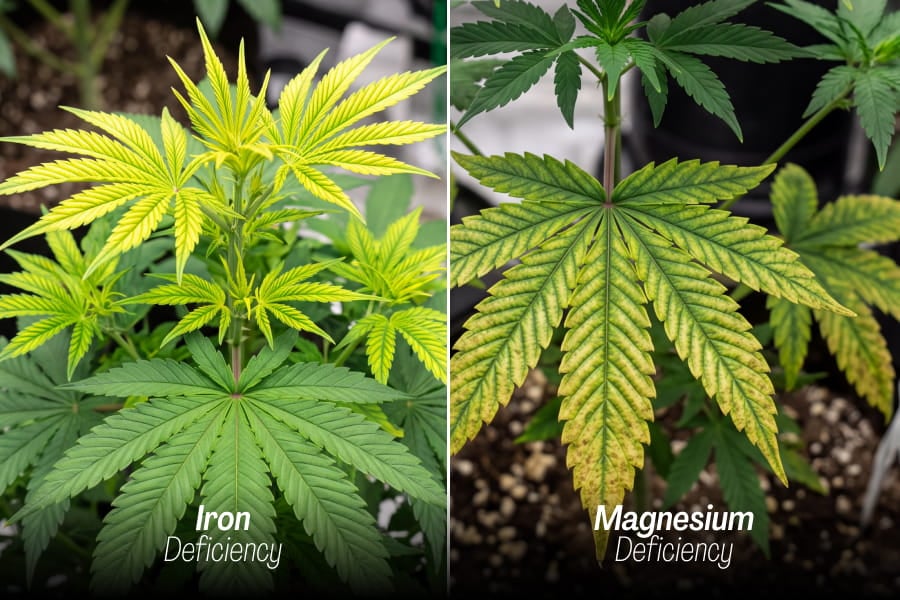
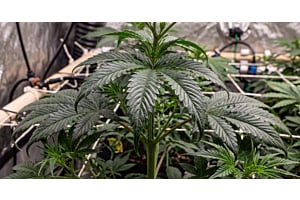
Iron deficiency on new cannabis growth compared to magnesium deficiency.
|
Cannabis plant problem |
Where it shows first |
Leaf symptoms |
How it differs from iron deficiency |
|
Older lower leaves |
Interveinal yellowing, green veins |
Starts bottom-up, not top-down |
|
|
Older lower leaves, near buds in flower |
Pale yellowing, dying leaf-tip inward |
Stems and petioles turn red-purple |
|
|
New growth |
Interveinal yellowing, necrotic spotting |
Radically twisted leaf blades |
|
|
New growth |
Necrotic spotting, green veins |
Dark green ring along leaf margins |
|
|
New growth or whole plant |
Interveinal yellowing, necrosis, curling leaves |
Metallic bluish sheen at tips and margins |
|
|
Middle leaves to new growth |
Yellowing, twisted new leaves |
Curling red tips, pale fringed scorched texture |
|
|
New growth |
Whole-leaf yellowing from the back edge in |
Brittle, narrower leaves, orange or red tints |
|
|
Light burn |
Top of canopy, nearest the light |
Bleaching or scorching |
Tied to light distance, not leaf age |
|
Nutrient/pH lockout |
Old and new leaves at once |
Multiple symptoms overlapping |
Shows up on both old and new growth together |
Is It An Excess Or An Iron Deficiency?
Manganese, copper, and molybdenum excess sit in a different category altogether. Rather than mimicking iron deficiency, one of them actually triggers it, and the other two produce a look close enough that the leaf itself won't settle it. Feed history and how the rest of the plant is holding up are the more reliable read here.
|
Nutrient excess |
What's actually happening |
|
Manganese excess |
Directly induces true iron deficiency, so the leaves will look like straightforward iron deficiency because it is one |
|
Copper toxicity |
Leaves yellow like iron in the final stages, but roots decay and the whole plant declines, not just the leaves |
|
Molybdenum excess |
Visually mimics iron or copper deficiency, confirm with a soil or feed check rather than the leaves alone |
What Causes Iron Deficiency in Cannabis Plants?
Cannabis iron deficiency comes down to four things: a root-zone pH that's too high, water that starts low on iron, competing micronutrients, or roots that can't take up what's available. In most cases the iron is already in your medium, the plant just can't reach it (which is why adding more iron on its own doesn’t usually help). The specific causes:
- Salt buildup from heavy feeding. Excess salts sitting in the root zone from repeated full-strength feeding or too much feeding compete with iron for the same uptake.
- High root-zone pH. The most common cause. Iron becomes out of reach once pH climbs even moderately high, so it's present in the medium but unavailable to the roots.
- Low-iron water. Heavily filtered or reverse osmosis water starts with almost no iron in it to begin with, so there's less to draw on even before pH becomes a factor.
- Excess manganese. This isn't just competition for uptake, too much manganese in the soil directly triggers true iron deficiency. It's a distinct cause from pH, not a variation of it
- Root stress. Overwatering or root damage slows iron uptake even when pH and water quality both check out fine, since damaged roots simply can't move nutrients as efficiently.
- Excess manganese, zinc, copper, calcium or phosphorus. This isn't just competition for uptake; an oversupply of any of these directly triggers true iron deficiency by crowding it out at the root. Manganese is the most directly documented single mechanism, but the others are confirmed too. It's a distinct cause from pH, not a variation of it.
How Do You Fix a Cannabis Iron Deficiency?
You fix a cannabis iron deficiency by correcting root-zone pH first, then feeding a chelated iron source the plant can absorb. Work through these steps in order:
- Check and correct pH: the fix that clears most cases on its own.
- Rule out water and root health: closes off the causes pH correction won't touch.
- Foliar feed chelated iron: the fastest way to green up new leaves.
- Treat the root zone: refills the medium and reaches the whole plant.
- Watch new growth: your signal that the correction worked.
1. Check and Correct Your Root-Zone pH First
Correcting root-zone pH fixes most cannabis iron deficiencies on its own, since iron simply isn't available to the roots once pH drifts too high.
Start by testing. In soil or coco, read the runoff using the PourThru method. Water the pot fully, let it drain and sit for about an hour, then pour a small amount of plain water over the top and test what collects underneath. Treat your pH reading as a sign something's drifted, not a target to keep re-dosing toward (or you’ll overcorrect). In hydro, test the reservoir directly.
While you're at it, check EC or TDS too. If the reading comes back high, salt buildup is blocking uptake. A plain, pH-balanced water flush (aim for about 30% runoff) clears the excess. If the reading is fine, skip the flush and move onto correcting pH. How you do this depends on what you're growing in.
Organic or living soil typically buffers itself through microbial activity, so pH drift is atypical. If it's genuinely out of range, use organic amendments (pH’ing the water won't do much). Garden or dolomite lime raises pH, while wettable or elemental sulfur lowers it. Both work over days rather than instantly. Aim for 6.0- 6.3 (6.5 being the ceiling).
Feeding synthetic nutrients in soil changes that, since it disrupts the buffering. In this case, correct the root-zone pH the same way you would using coco or hydro: Dissolve your nutrients into the water first, then use pH Up or pH Down to adjust that solution into range before feeding.
Both coco and hydro hold around 5.8-6.2 (though 5.6-6.4 still works). Check coco pH weekly. With hydro, it’s best to check pH daily, since that's the exact number reaching the roots.
2. Rule Out Water and Root Health
If pH and EC both check out and the iron deficiency persists, look at what's going into the pot and what's happening at the roots. Heavily filtered or reverse osmosis water starts with almost no iron in it. If that's your source, a Cal-Mag-Fe supplement or switching to a less-stripped water source closes that gap.
Separately, check the roots themselves. Overwatering or physical root damage slows iron uptake even with everything else in range. Let the medium dry back between waterings and inspect for root rot if drainage has been poor.
3. Use a Foliar Feed With Chelated Iron
Spraying iron directly onto the leaves gets it working faster than waiting on the root zone alone. Reach for a chelated blend that carries zinc and manganese alongside the iron (these three tend to run low as a set, so treating just one often leaves the other two unaddressed).
Mix to the label's rate and coat the underside of the affected leaves, where the plant takes it up best. Do this with the lights off or in low light (direct light on wet leaves causes burn), and check back every couple of days until the new growth comes in green.
4. Treat the Root Zone as Well
Feeding chelated iron into the root zone backs up the foliar spray and refills what the medium lost. Water in a chelated iron dose at the corrected pH so the roots can take it up. Root feeding reaches the whole plant, while a foliar spray only greens the leaves you hit.
5. Watch New Growth for Signs of Recovery
New growth tells you whether the iron correction worked. Fresh leaves should come in green within 3-5 days once iron reaches the plant. The leaves that were already bleached won't turn back, so don't judge the fix by them. If new growth still yellows after a week, recheck your pH and rule out a zinc or manganese excess.
Fastest-Acting Iron Sources for Cannabis
Chelated iron and iron sulfate move into cannabis fastest, while compost and iron oxides feed the medium more slowly. Here’s what you need to know about each one:
- Chelated iron (EDDHA or EDTA) stays available across a wider pH range than other forms, so it's the safest bet if you haven't fully corrected the lockout yet. EDDHA holds up especially well at higher pH. EDTA is the more common and cheaper option for routine use.
- Iron sulfate dissolves and acts fast, but it's more pH-sensitive than chelated forms. It can quickly convert back to an unavailable form if the root zone drifts high again, so pair it with a pH that's already corrected rather than using it to fix pH.
- Compost and worm castings feed iron back in gradually as they break down. This is a reasonable ongoing amendment for future grows, but too slow to pull a currently yellowing plant back from a deficiency.
- Iron oxides are the same slow-release logic. They’re useful for working into a soil mix ahead of planting, not something to reach for mid-deficiency.
- Rusty water supplies a small, unmeasured dose - fine as a minor top-up if nothing else is on hand, but not something to rely on for a real correction since you can't control the concentration.
Can Cannabis Plants Get Iron Toxicity?
Yes, but iron toxicity in cannabis is rare and usually points to over-feeding or a very low pH. Most growers never see it. When it shows up, older leaves bronze or burn at the margins, not the bright yellow of a shortage. Too much iron can also block manganese, zinc, copper, calcium and phosphate, which brings on a second round of problems.
The fix is simple. Flush the medium with clean, pH-balanced water to wash out the excess. Then bring the pH back into range and ease off iron-heavy feeds.
How to Prevent Iron Deficiency in Cannabis
Preventing cannabis iron deficiency comes down to steady pH, clean water and a Cal-Mag-Fe supplement in your feed. Check your pH at every feed so it never drifts into lockout territory. A Cal-Mag supplement that includes iron covers three shortages that tend to appear together. Healthy roots and sensible watering keep iron moving the way it should.
Strong genetics handle nutrient stress better than weak stock, so a healthy grow starts with high-quality cannabis seeds from a trusted seed bank - available to eligible adult buyers where local law permits.