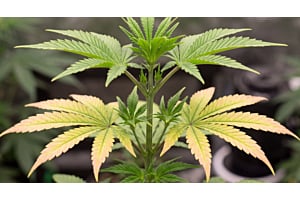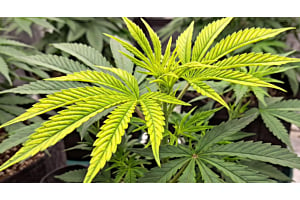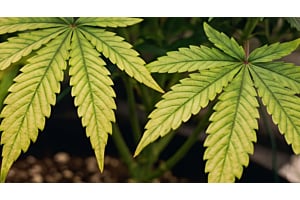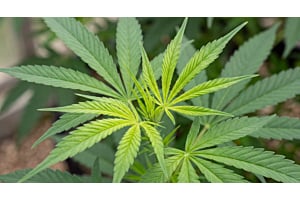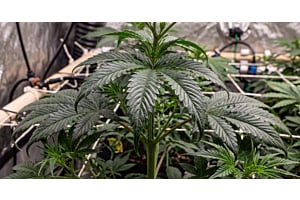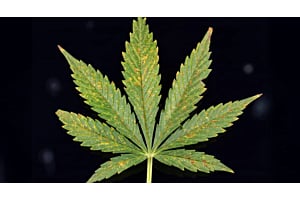
Yellow leaves on your cannabis plant don't always mean nitrogen trouble. A sulfur deficiency in cannabis causes the same pale color, but starts near the leaflet base. It's rare, but worth ruling out if your plant looks off. This guide covers the visual signs, the lookalikes that get confused with sulfur deficiency, what causes it, and how to fix it.
TL;DR: Sulfur deficiency shows up as pale yellowing near the base of a leaflet on younger growth, plus brittle, narrower leaves. While uncommon, it usually traces back to thin or sandy soil or an incomplete feeding routine. Fix it by checking your pH, adding sulfur through Epsom salts or another source, and resuming a complete feeding schedule.
What is a Cannabis Sulfur Deficiency?
A sulfur deficiency means your plant isn't getting enough of this secondary nutrient to keep chlorophyll production and protein synthesis on track. On the cannabis plant, that typically shows up as yellowing near the base of a leaflet - not at the leaf tips like other deficiencies.
Why Sulfur Deficiency is Rare in Cannabis
You won't run into sulfur deficiency often. Most complete fertilizers already supply sulfate through ammonium sulfate, magnesium sulfate or potassium sulfate. If you use quality compost or potting mix, you'll also get incidental sulfur as organic matter breaks down. An isolated sulfur shortage with no other symptoms is unusual.
What Happens If You Ignore a Sulfur Deficiency?
Rare doesn't mean harmless. Left unaddressed, a sulfur shortage reduces bud weight during flowering. In one study, controlled testing found a sulfur deficiency cut yield by roughly one third. Catching it early protects that yield, since sulfur helps your plant build healthy flowers in the first place.
What Does a Sulfur Deficiency Look Like in Cannabis?
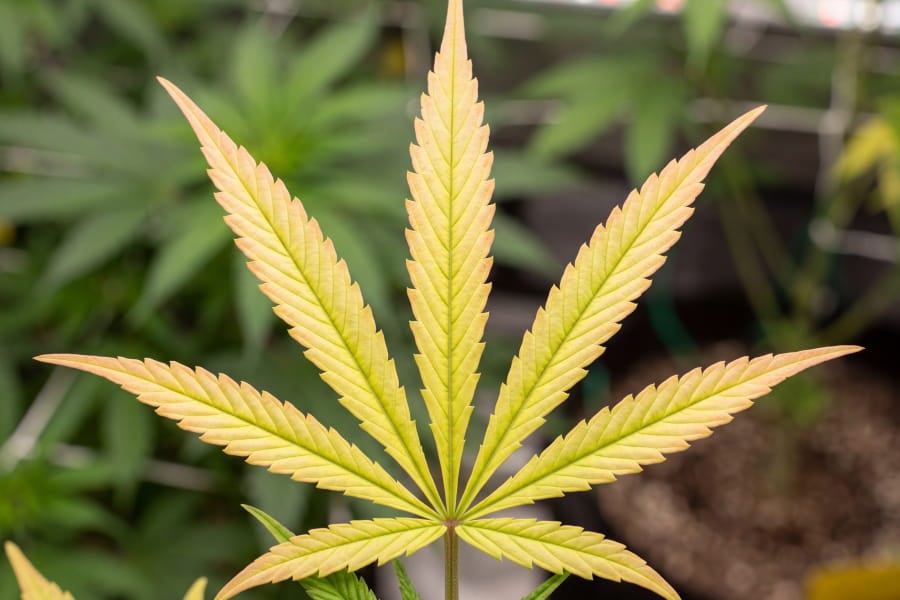
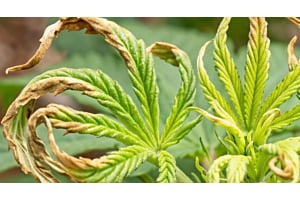
Sulfur deficiency in cannabis, showing brittle leaves with dry, orange-tinged edges.
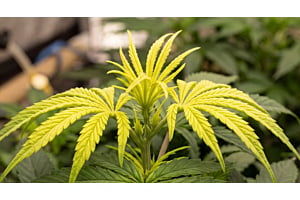
On a sulfur-deficient cannabis plant, the leaves turn a pale lime green before yellowing, usually on younger leaves rather than older fan leaves. Leaf veins tend to stay green early on, though they can yellow too once the deficiency turns severe.
As the shortage continues, the leaf tissue grows narrower and more brittle, sometimes with an orange or red tint developing along the margins.
Some growers report pink, red, or orange undersides on affected leaves too, though that detail comes from grower experience rather than confirmed research. In severe cases, buds at the tops of flowering plants die back and stems turn thin and woody.
Here's how the signs of a sulfur deficiency typically progress from early to advanced:
| Stage | Leaf color | Key symptoms |
| Early signs | Pale lime green fading toward yellow | Yellowing at the base of the leaflet on younger leaves |
| Advanced signs | Orange or red tint along the margins | Thin, woody stems on flowering plants and bud dieback |
Catching the early signs gives you the best shot at a quick recovery.
Is It Sulfur Deficiency or a Different Cannabis Plant Problem?
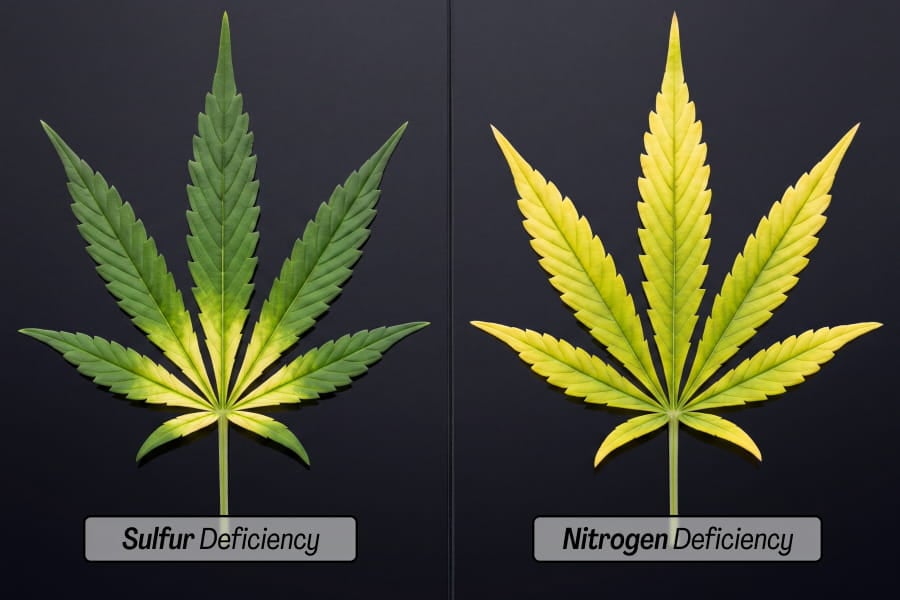
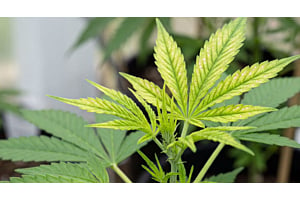
Side-by-side cannabis leaves showing how sulfur deficiency differs from nitrogen deficiency through distinct yellowing patterns.
Since a sulfur deficiency is uncommon, it's easy to mistake for one of a few lookalike cannabis deficiencies or problems. Nitrogen deficiency tops the list, with magnesium, iron, and molybdenum close behind. Nutrient burn, lockout, and light burn can look similar too.
Use the table below to diagnose your plant and find the real culprit:
| Cannabis plant problem | Where it shows up first | Key visual signs | How it differs from sulfur deficiency |
| Nitrogen deficiency | Lower, older leaves | Yellowing, wilting leaves | Starts from the bottom up |
| Magnesium deficiency | Lower, middle leaves | Yellowing leaves, curling tips, green veins | Purple stems and petioles |
| Iron deficiency | New growth | Yellowing faded leaves, green veins | Veins stay green |
| Molybdenum deficiency | Middle leaves, then up to new growth | Yellowing leaves, twisted new growth with a pale, fringed, scorched look | Twisting leaves and red tips on older leaves |
| Nutrient burn | Newer leaf tips/edges | Yellow-brown and crisp, curling leaf tips | Browning from the leaf tip inward |
| Light burn | Top of the canopy | Multicolored, blotchy burns on buds/leaves | Affects buds and leaves nearest the grow light |
| Nutrient lockout | New and old leaves | Overlapping symptoms | Old and new leaves show several problems simultaneously |
Checking leaf location and leaf age against this table narrows your diagnosis quickly. If old and new growth are both showing problems at once, test your pH before treating any nutrient as deficient.
What Causes a Sulfur Deficiency in Cannabis Plants?
Since sulfur deficiency is rare to begin with, it usually takes a specific growing condition to trigger it. The causes below either limit how much sulfate reaches the roots or how easily the cannabis plant absorbs it
- Sandy soil or soil low in organic matter. Sulfate leaches easily out of light, low-organic-matter mixes, since organic matter serves as the main natural sulfur reservoir.
- Poor drainage or overwatering. Excess water pushes sulfate below the root zone, especially in light soils and young plants with shallow roots.
- Cold soil temperatures. Cold soil slows the microbial activity that turns organic sulfur into plant-available sulfate.
- Warm soil temperatures. Warm soil can also make sulfur harder for your plant to absorb, a different mechanism than cold soil limiting supply.
- pH lockout. Sulfur doesn't lock out at a high pH the way some other micronutrients do, so this is a much smaller factor but still worth keeping an eye on.
- Reduced atmospheric sulfur deposition. Outdoor crops once picked up sulfur from rainfall and air, and cleaner air has reduced this source over time.
- Distilled or reverse osmosis water without supplementation. Low-TDS water causes the same shortfall pattern you'd see with magnesium and calcium deficiency.
- Incomplete feeding schedule. Most commercial fertilizers already carry sulfate as a byproduct of other nutrients, so skipping feedings or running an incomplete formula for too long can leave sulfur out along with everything else.
How Do You Fix a Sulfur Deficiency in Cannabis?
Most cases trace back to one of the conditions mentioned above. Work through these steps in order, and you'll clear up the large majority of sulfur deficiencies within a cycle.
- Step 1: Check and correct your ph.
- Step 2: Address soil, drainage, and temperature.
- Step 3: Add sulfur.
- Step 4: Resume a full feeding routine.
Step 1: Check and Correct Your pH
Your pH is still worth ruling out as part of a full diagnosis, though for sulfur specifically it's a less common cause than a naturally low-sulfur medium, so don't expect this step alone to solve most cases.
Read the root zone with a calibrated meter. In soil or coco, take a PourThru sample (water fully, let it drain about an hour, then pour a measured amount of plain water through and test what collects). In hydro, read the reservoir.
Either way the number is a warning light for drift, not an exact number to work from. Aim for 6.0-6.3 in soil (6.5 is the absolute ceiling) and 5.8-6.2 in coco and hydro (5.6-6.4 still works).
How you correct the pH depends on the medium. Living, organic soil buffers its own pH through microbes, so genuine pH drift is uncommon. If it does happen, use organic amendments (dolomite or garden lime to raise pH, wettable or elemental sulfur to lower it), both working gradually over weeks.
In coco, hydro, or soil on synthetic nutrients, pH the feed rather than the plain water. Mix your nutrients in first, then adjust that solution before it goes in. (A pH-up or pH-down product works well). Correcting pH alone resolves most cases before you add anything.
Step 2: Address Soil, Drainage, and Temperature
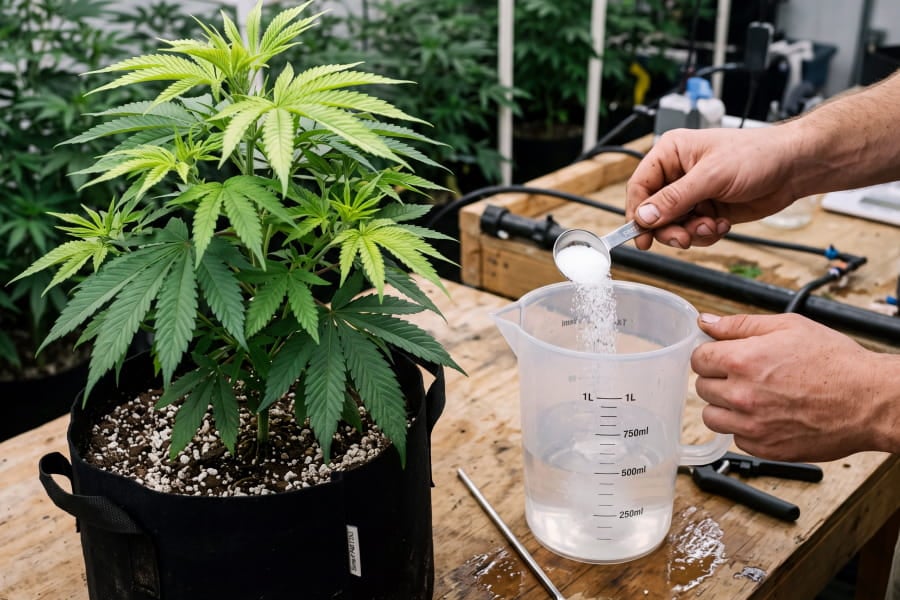
Applying an Epsom salt solution to help restore sulfur levels and support healthier cannabis growth.
If pH tests fine, look at the growing conditions next:
- Low organic matter or sandy soil. Work in compost or a richer organic amendment. Organic matter is the main thing sulfate binds to. Without it, sulfate leaches straight through.
- Overwatering or fast drainage. Cut back watering frequency and let the top inch of soil or medium dry between waterings. Excess water pushes sulfate below the root zone before your plant can use it.
- Cold root zone. Keep the root zone in the 68-78°F (20-26°C) range. Water temperature matters here too: use water at 68-72°F (20-22°C) for hydro reservoirs, and up to 75°F (24°C) for soil. A seedling heat mat or a heating cable holds the medium's temperature through cold rooms or seasons.
- Overly warm root zone. The same range applies on the high end. Root zones running hot (from grow lights, warm floors, or un-chilled reservoirs) can make sulfur harder to absorb even when it's present. A reservoir chiller or simply moving containers off a warm floor helps.
- Distilled or reverse osmosis water with no supplementation. Add a mineral source back in. This is the same fix that resolves magnesium and calcium shortfalls from low-TDS water.
Step 3: Add Sulfur
If your marijuana plant is still experiencing a genuine sulfur deficiency, Epsom salts (magnesium sulfate) are the fastest fix. Use 1 teaspoon per gallon of water (about 5 mL per 3.8 liters), applied through soil or your reservoir until you see improvement.
Elemental sulfur, potassium sulfate, and gypsum are useful alternatives if you're already feeding a complete schedule (and don't want to add more magnesium). Keep gypsum out of any mix below pH 5.5 because it can mobilize soil aluminum into a form that damages roots.
If you’re dosing Epsom salts repeatedly, watch your magnesium levels. Excess magnesium competes with potassium for uptake, and heavy-handed dosing of any single nutrient can crowd out others.
Step 4: Resume a Full Feeding Routine
Nearly every commercial N-P-K fertilizer already carries sulfate as part of its formula, so a complete, label-strength feeding routine clears up most mild cases within one cycle. Mix at the recommended strength to avoid triggering nutrient burn, and stay consistent going forward to keep the sulfur deficiency from returning.
What is Cannabis Sulfur Toxicity?
Sulfur toxicity happens when your plant takes up more sulfur than it can use. It presents as stunted growth with leaf tips that brown and dry out - closely resembling general salt damage rather than a distinct sulfur-specific symptom.
It's far rarer than a sulfur deficiency, though.The usual fix is to flush the medium with plain pH'd water until about 30% drains to clear the excess, then hold off on further sulfur until the plant recovers.
Does Excess Sulfur Cause Other Deficiencies?
Yes, mainly through one mechanism: Excess sulfate can tie up calcium in your nutrient solution. That’s why you should never premix calcium-based fertilizers with phosphate or sulfate fertilizers.
High sulfate levels can also modestly suppress molybdenum uptake through the same shared pathway, though this effect stays minor. In fact, general salt stress from any nutrient in excess (sulfate included) can suppress uptake broadly through osmotic pressure.