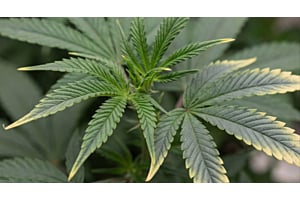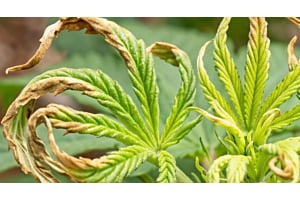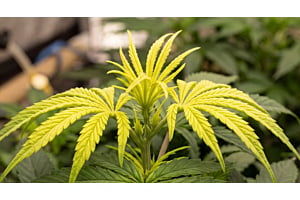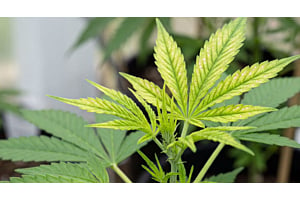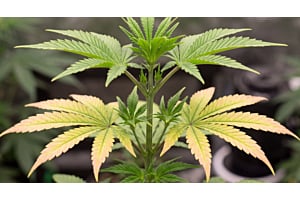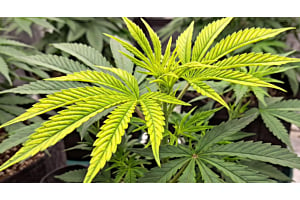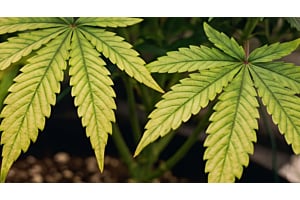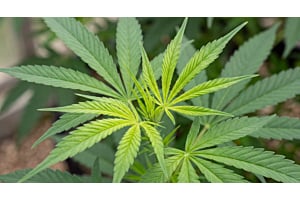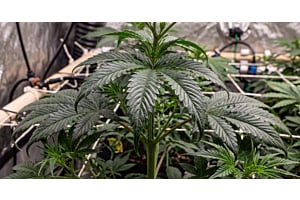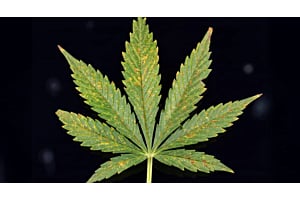
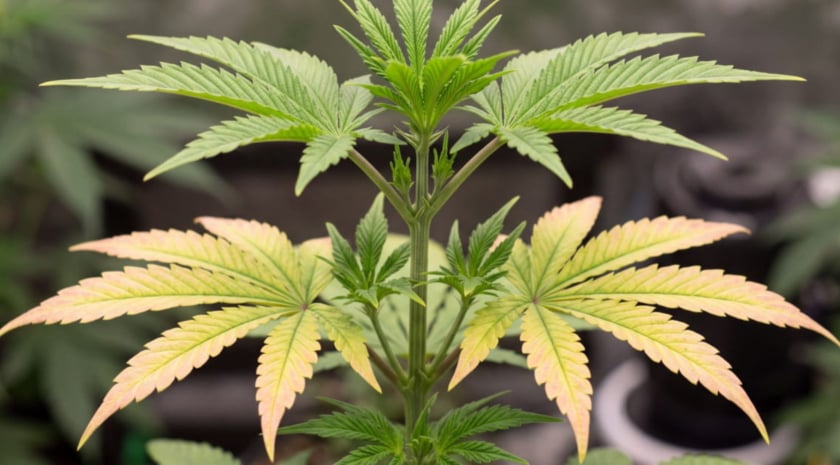
Yellowing on the middle of the plant with strange red, pink or orange edges is the classic tell of a molybdenum deficiency in cannabis. It looks a lot like a nitrogen problem at first glance, which is exactly why growers reach for the wrong fix. This guide shows you how to spot it, tell it apart, and correct it the right way for your setup.
The short version: if the mid-plant leaves are yellowing and the edges turn red, pink or orange, suspect molybdenum, not nitrogen. The cause is nearly always root-zone pH drifting too acidic, which locks out the molybdenum already in your medium. Correct the pH for your grow medium and only add nutrients if a real shortage remains.
What Is a Cannabis Molybdenum Deficiency?
A cannabis molybdenum deficiency occurs when the plant cannot access enough molybdenum, a trace nutrient, to metabolize nitrogen properly.
Plants need only a tiny amount of molybdenum, but that small amount does a big job. It powers the enzymes that let cannabis turn nitrogen into the proteins it needs to grow. When molybdenum runs short, the plant can take up nitrogen but struggles to use it. That link is the reason the symptoms mimic a nitrogen deficiency so closely.
The giveaway is location: nitrogen starts at the very bottom of the plant, while molybdenum starts in the middle. In most grows the nutrient is physically present in the medium, so the problem is access, not supply.
What Does a Molybdenum Deficiency Look Like in Cannabis?
Beyond that headline yellowing-and-red-edge combination, a molybdenum deficiency reveals itself through a few distinct stages. It tends to start mid-plant and work up toward the new growth if left unchecked, where the newest leaves can come in distorted or twisted.
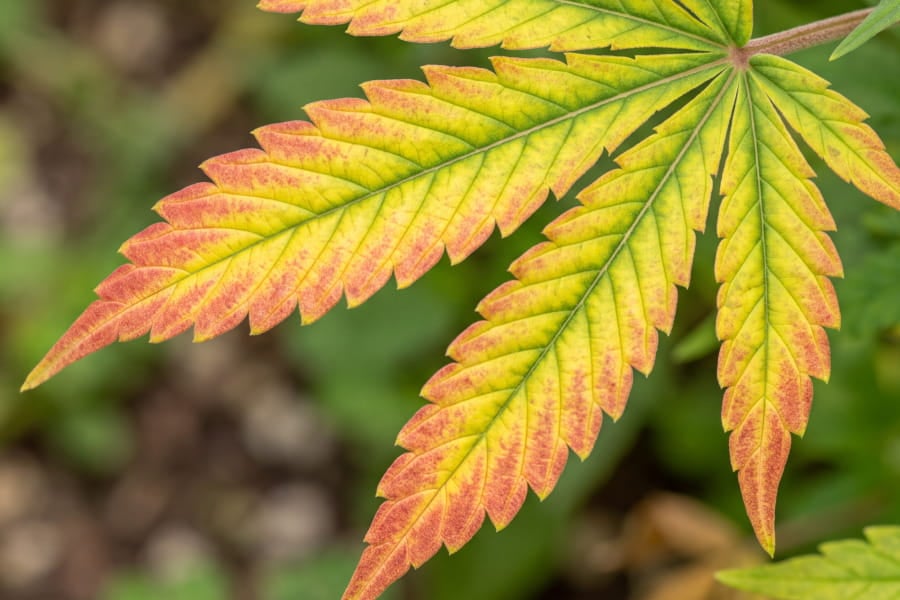
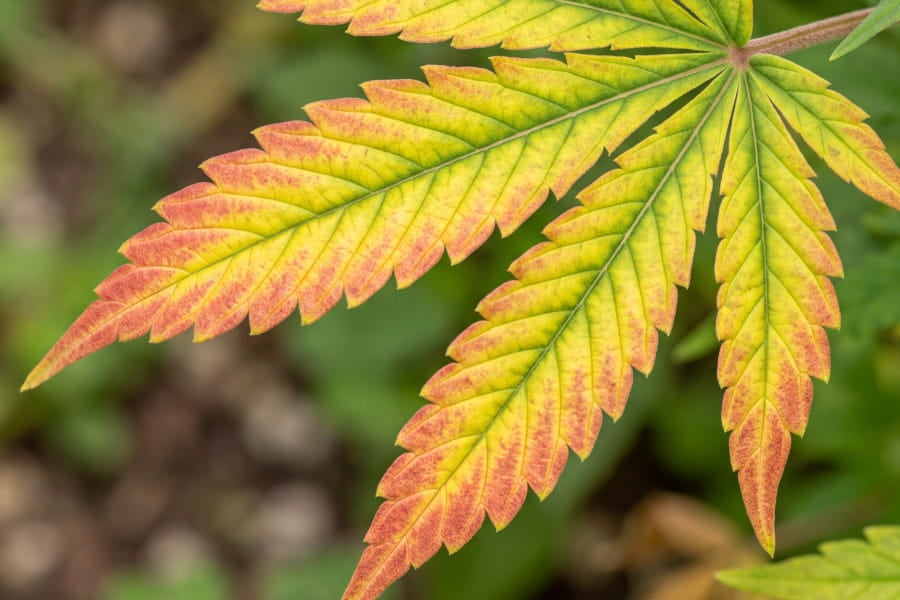
Red, pink or orange leaf edges over yellowing - the signature sign that points to molybdenum, not nitrogen.
Knowing what each stage looks like helps you catch it early and act with confidence.
- Yellowing and pale leaves - the first, easily missed stage that looks like several other problems.
- Red, pink or orange leaf edges - the signature sign that points specifically to molybdenum.
- Spots, curling and stunted growth - the later stage that tells you the deficiency is advancing.
Yellowing and Pale Leaves
Yellowing appears first on the middle leaves, between the veins and along the edges. At this early stage it's easy to mistake for a routine nitrogen shortage, since both open with the same soft, washed-out fade. Plant height is what splits them: nitrogen bites at the very bottom, and molybdenum sets in around the middle.
Red, Pink or Orange Leaf Edges
Red, pink or orange coloring around the leaf edges is what separates a molybdenum deficiency from a plain nitrogen shortage. The color usually starts at the margins and works its way toward the center, and it sometimes appears in the middle of the leaf instead.
When you see that unusual edge tint layered over yellowing leaves, molybdenum moves to the top of your suspect list.
Spots, Curling and Stunted Growth
Dark spots and curling leaf margins signal an advancing deficiency that starts to limit photosynthesis. As the affected tissue dies back, the leaf loses surface area for making sugars, and overall growth slows. Left long enough, the plant looks visibly less vigorous than its healthy neighbors.
Molybdenum Deficiency vs Nitrogen Deficiency: How to Tell Them Apart
A molybdenum deficiency and a nitrogen deficiency both wash the color out of leaves, but they split on where the yellowing starts, the red-edge signature and the underlying cause. A nitrogen deficiency is an actual shortage of nitrogen in the feed, fixed by feeding. A molybdenum deficiency is usually a pH lockout, fixed by correcting pH, not by piling on nutrients.
Getting this right matters, because treating a molybdenum lockout with extra nitrogen just adds stress without solving anything.
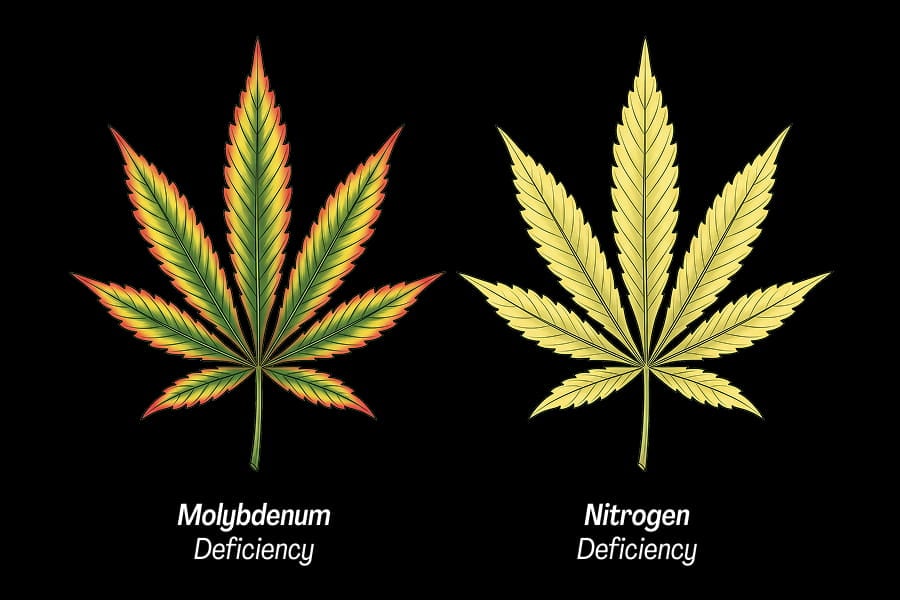
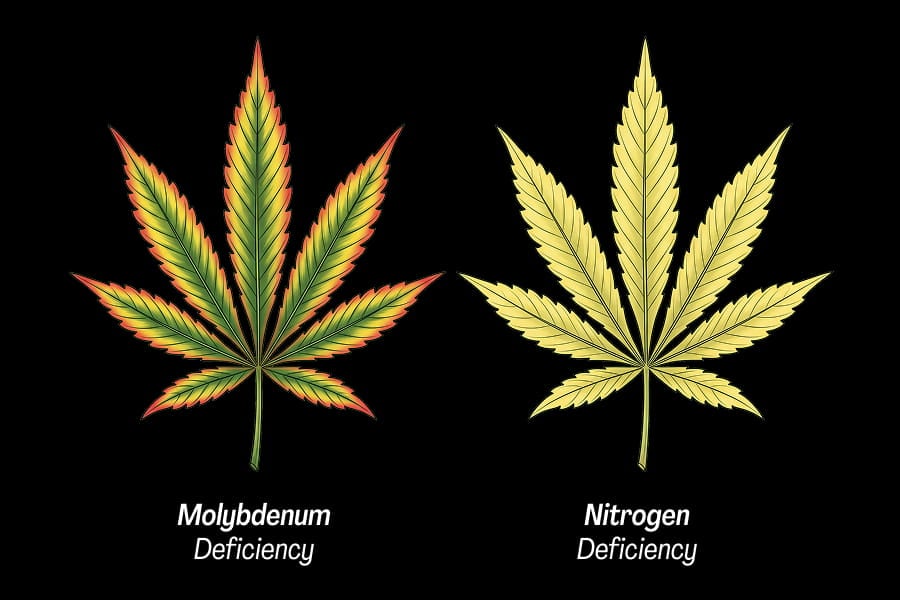
Molybdenum vs nitrogen deficiency: the red edge and mid-plant location set molybdenum apart.
|
Diagnostic trait |
Molybdenum deficiency |
Nitrogen deficiency |
Reliability |
|
Red, pink or orange leaf edges |
Present — the hallmark sign |
Absent |
High |
|
Yellowing location |
Middle of the plant, moving up |
Older, lower leaves |
Medium |
|
Yellowing pattern |
Between veins and along edges |
Even, whole-leaf fade |
Medium |
|
Primary cause |
Acidic pH locking out the nutrient |
A real nitrogen shortage in the feed |
High |
|
Dark spots as it advances |
Common |
Rare |
Medium |
|
The right fix |
Correct pH first |
Add nitrogen |
High |
The red edge is what sets molybdenum apart, but a couple of other trace-nutrient problems muddy the picture. Manganese deficiency brings its own spotting and yellowing, and copper deficiency shows up as discolored leaf tips, so color and pattern tell them apart.
What Causes Molybdenum Deficiency in Cannabis?
Molybdenum deficiency develops when root-zone conditions block uptake, most often when pH drifts too acidic. The nutrient is usually right there in the medium; the plant just can't pull it in.
Three factors account for nearly every case.
- Low or acidic pH - the dominant cause by a wide margin.
- Heavy sulfate feeding - the real competitor for uptake.
- Cold roots and compacted soil - conditions that slow uptake across the board.
Low or Acidic pH
Molybdenum is one of the few nutrients that becomes harder to absorb as conditions turn acidic, so a downward pH drift hits it first. That's why a root zone can hold plenty of molybdenum while the plant still starves for it.
In most grows, correcting pH is the first thing to check and the only thing you'll need to fix.
Heavy Sulfate Feeding
Sulfate and molybdenum travel the same route into the root, so a heavy hand with Epsom salts or gypsum can suppress molybdenum uptake with your pH sitting exactly where you want it. Check your feed log before you go hunting for anything more exotic.
You'll see iron blamed for this a lot, and it's the wrong culprit. Iron and aluminum oxides do tie molybdenum up, but only in acidic media, where they bind it to soil particles and put it out of reach. That's the pH problem again wearing a different hat, and correcting pH releases it.
Iron only earns its own soil test if symptoms are still there well after a genuine pH correction has had time to work, at which point it's worth ruling out an iron deficiency.
Cold Roots and Compacted Soil
A cold or compacted root zone slows the root activity that molybdenum uptake depends on. When roots sit below about 59°F (15°C) for long stretches, they take up water and nutrients far more slowly, and compacted soil chokes root growth the same way.
Healthy, warm, well-aerated roots are the quiet foundation that keeps trace nutrients like molybdenum flowing.
How Do You Fix a Molybdenum Deficiency in Cannabis?
You fix a molybdenum deficiency by correcting root-zone pH the right way for your medium, and only feeding if a genuine shortage remains.
Because the nutrient is rarely the thing that's actually missing, the fix is mostly about restoring access. Work through it in order and change one thing at a time so you can see what worked.
- Check and correct your pH - the step that resolves the vast majority of cases.
- Flush only if salts have built up - a separate action for a separate problem.
- Apply a micronutrient foliar spray - a fast, optional top-up while the roots recover.
Check and Correct Your pH
Correcting pH looks different depending on what you grow in, so match the method to your medium. This is the highest-value step in the whole process.
- Organic or living soil: the root-zone microbes buffer pH for you, so you don't pH your water or use pH Up/Down. Correct genuine drift slowly with amendments — lime to raise, elemental sulfur to lower.
- Coco, hydro or synthetic-fed soil: pH the feed, since salt nutrients shift it. Mix nutrients into the water first, then adjust that solution. Aim for 5.8–6.2 in coco and hydro (5.6–6.4 works), 6.0–6.3 in soil (5.5–6.5 works).
- Runoff: treat it as a warning light for drift, not a dial to chase up and down.
Flush Only If Salts Have Built Up
Flushing clears salt buildup, which is a different problem from a pH drift, so keep the two steps separate. Confirm buildup first with an EC or TDS meter, rather than assuming it: a reading well above your input water means salts have accumulated.
To flush, run plain, pH-corrected water with no nutrients mixed in through the medium until about 30% drains out the bottom.
A flush is not a way to correct pH and it's not a cure for the deficiency on its own. When both salt buildup and pH drift apply, flush first, then correct pH, then feed only if a true shortage remains. Treat flushing as a reset for the root zone, after which your pH correction can actually hold.
Apply a Micronutrient Foliar Spray
A molybdenum foliar spray delivers the nutrient straight through the leaves, bypassing the root zone for a faster response while you sort out pH below. Mix a micronutrient product that includes molybdenum according to the label and mist the affected foliage.
It's an optional accelerator, not a replacement for fixing the root cause; if pH stays wrong, the problem comes back.
One honest note on recovery: leaves already damaged by a molybdenum deficiency usually won't turn green again. Watch your new growth instead, which should come in clean within about a week once you correct the cause.
How to Prevent Molybdenum Deficiency in Cannabis
Preventing molybdenum deficiency comes down to steady pH management and a balanced medium that keeps the nutrient available. Since the cause is almost always pH drift rather than a real shortage, prevention mostly means not letting pH wander. Keep an eye on a few things and this problem rarely shows up at all.
Check pH at the cadence your medium calls for — weekly for coco, daily for true hydro, and mainly through occasional runoff checks in living soil that's otherwise left to buffer itself. Start with a quality medium and, in organic grows, a well-amended soil that holds a stable pH on its own.
If you've fought molybdenum lockout before, a balanced micronutrient blend in your feed keeps a steady supply on hand, and keeping the root zone warm and aerated does the rest.
Healthy Cannabis Seeds and a Stable Start
A stable, well-buffered medium and strong genetics give a new grow the resilience to shrug off nutrient swings like a molybdenum lockout. Problems like this are far easier to avoid when a plant starts healthy and roots into a balanced root zone from day one.
Where growing cannabis is legal for you, browsing quality feminized cannabis seeds is a straightforward way to set that foundation, and autoflowering seeds offer a fast, forgiving option for growers who want a shorter, simpler run. Either way, starting with quality cannabis seeds is your best insurance against trace-nutrient trouble down the line.