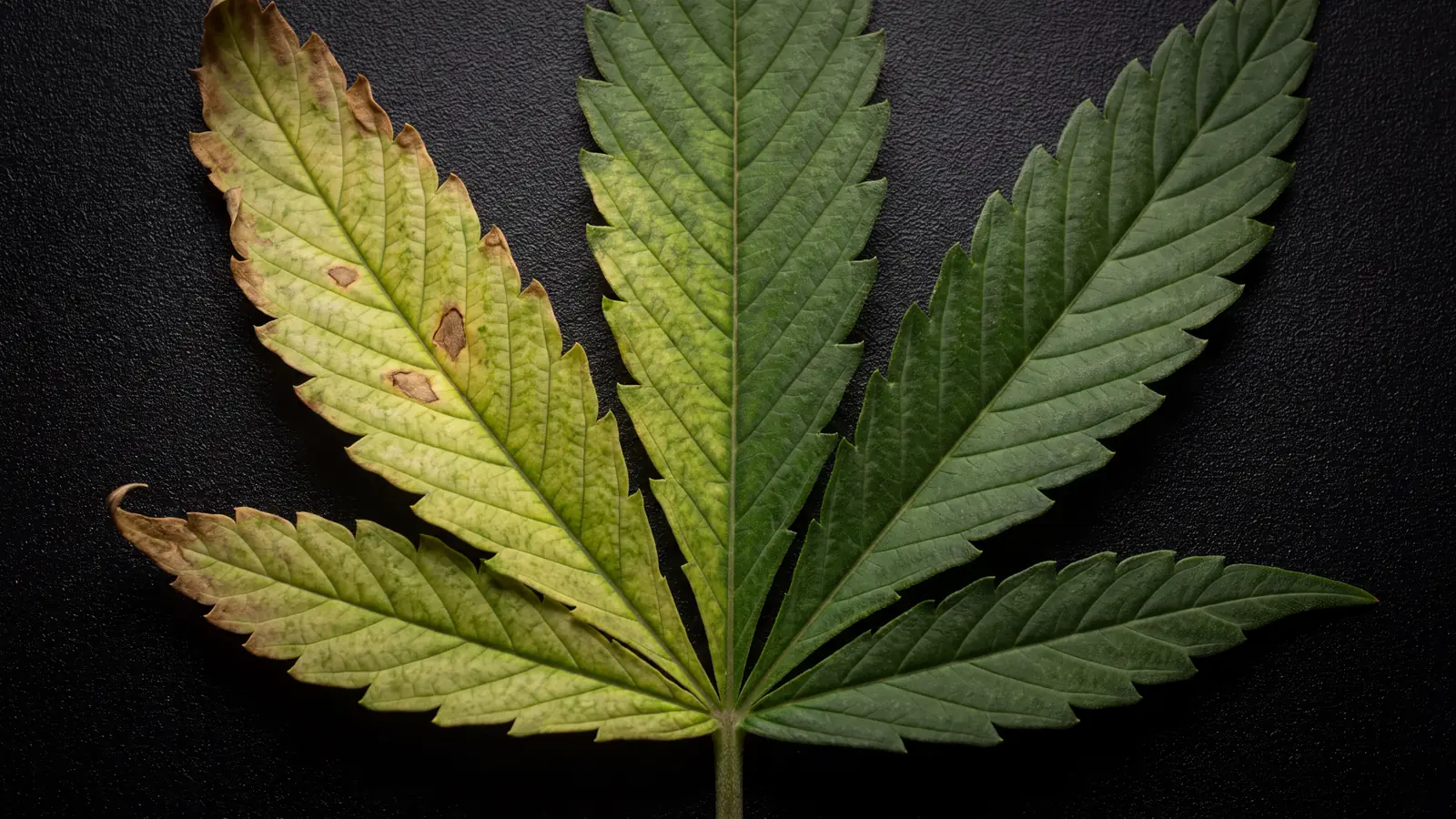
A cannabis leaf symptom chart links what you see on a leaf, and where it shows up on the plant, to the problems most likely behind it. Leaves are usually where trouble shows first, whether it comes from feeding, watering, heat, light, pests or pathogens, so they're the natural place to start looking.
The tricky part is that a symptom is a signal, not a diagnosis. Several unrelated causes can make cannabis leaves look almost identical, and treating the wrong one usually stacks a second problem on top of the first. If you’re growing your first plants from beginner seeds, learning to read leaves early offers a helpful way to assess a potential issue before you change anything.
Below you'll find what a healthy leaf should look like, how deficiencies give themselves away, how to tell lookalike problems apart, and what to do once you've pinned down the cause.
What Does a Healthy Cannabis Leaf Look Like?
A healthy cannabis leaf is evenly mid-green, firm and hydrated, sits flat to slightly raised, and has intact edges and tips. Posture and texture tell you as much as color does. The classic fan leaf is palmate, meaning several serrated leaflets spread out from the point where the leaf stem (petiole) meets the blade.
Mature fan leaves commonly carry five to nine leaflets, while smaller leaves can carry one or three. Leaflet count varies with plant age, node position and genetics, and it tells you nothing about plant health. Seedlings usually open with a single-blade leaf and then a three-blade set before the familiar shape appears, which is expected, not a sign of stunting.
Color sits fairly even across the blade, with veins only slightly lighter than the tissue around them. There's no sharp vein contrast, no patchwork and no washed-out zones. Newer growth up top often runs lighter and softer than hardened lower leaves, and that difference is normal.
Genetics shift the baseline too. Some plants naturally grow darker, lighter, broader or narrower leaves than others. Your best reference isn't a photo of a different strain. It's the same plant a week ago, and any siblings growing next to it in the same room.
How to Read Marijuana Leaves Before You Diagnose
Collect observations before you pick a cause. The same marking means different things depending on where it sits and how it got there. Compare what you see against a healthy leaf, then note these five things:
- Position: Are the affected leaves lower and older, mid-canopy, or the newest growth at the top?
- Pattern: Is the whole leaf fading evenly, yellowing between green veins, burning only at the tips and edges, spotting, or physically damaged?
- Spread: How many leaves are affected, how fast did they change, and is it still advancing?
- Distribution: Is it one plant or all of them? One plant points to that plant's root zone or its spot in the room. Every plant points to feed, water or environment.
- Proximity: Are the affected leaves the ones closest to the lamp, sitting in a direct fan stream, or out at the edge of the canopy?
Turn a few leaves over before ruling out pests. Undersides and growing tips hide most of the evidence, and a loupe or a phone macro lens beats the naked eye by a wide margin.
Cannabis Leaf Symptom Chart: Common Problems & Causes
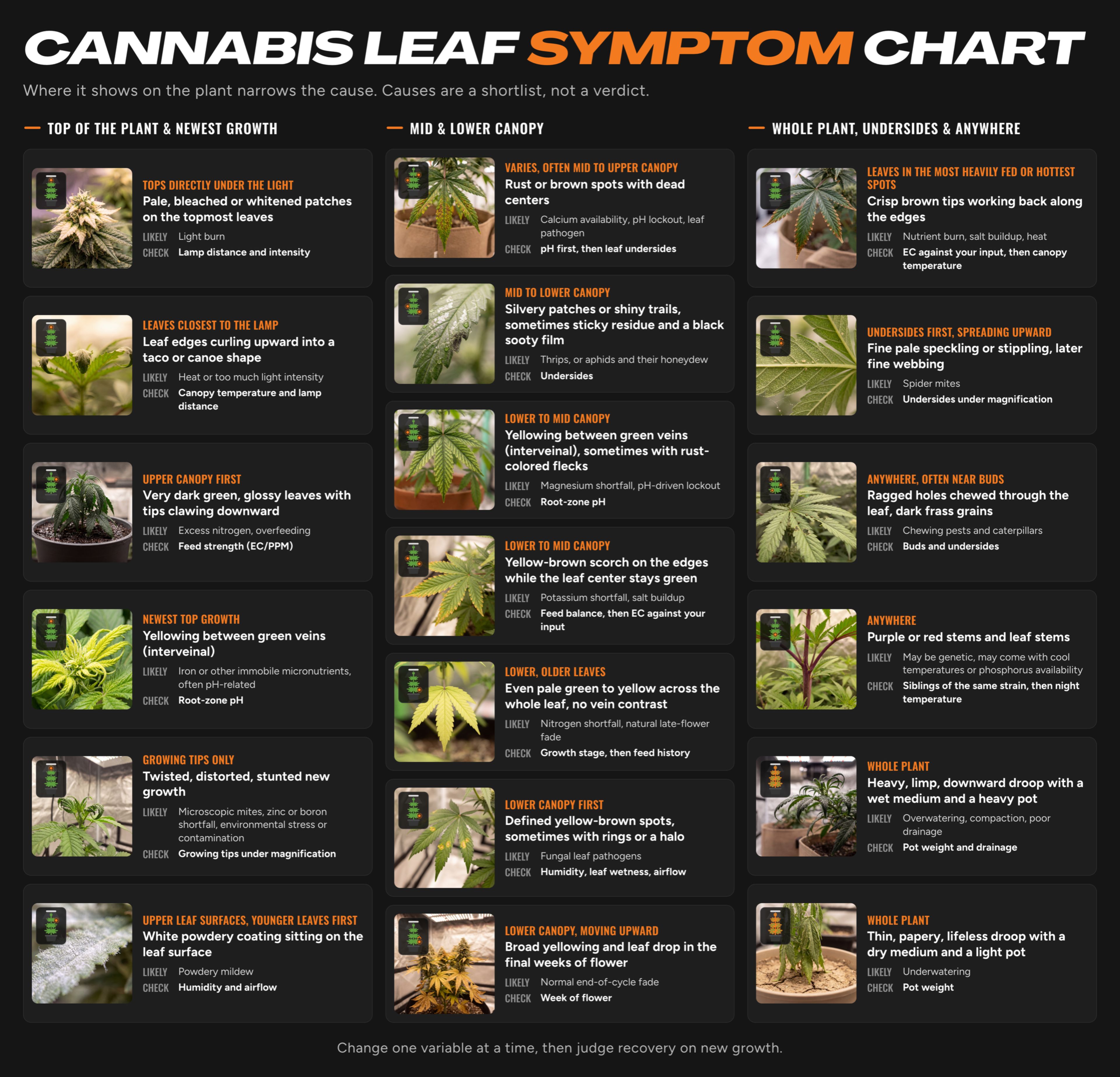

Use this cannabis leaf problems chart by matching appearance and position together, since most of these symptoms only separate once you know where on the plant they sit. Treat the causes column as a shortlist, not a verdict, and use the last column as the one thing to check before you change anything.
If your leaf matches two rows, that's common, and it's not a reason to treat for both. Take both candidates to the lookalikes table further down, where each pair has a single deciding test.
| What You See | Where It Appears | Most Likely Causes | First Thing to Check |
| Even pale green to yellow across the whole leaf, no vein contrast | Lower, older leaves | Nitrogen shortfall, natural late-flower fade | Growth stage, then feed history |
| Yellowing between green veins (interveinal), sometimes with rust-colored flecks | Lower to mid canopy | Magnesium shortfall, pH-driven lockout | Root-zone pH |
| Yellowing between green veins (interveinal) | Newest top growth | Iron or other immobile micronutrients, often pH-related | Root-zone pH |
| Rust or brown spots with dead centers | Varies, often mid to upper canopy | Calcium availability, pH lockout, leaf pathogen | pH first, then leaf undersides |
| Very dark green, glossy leaves with tips clawing downward | Upper canopy first | Excess nitrogen, overfeeding | Feed strength (EC/PPM) |
| Crisp brown tips working back along the edges | Leaves in the most heavily fed or hottest spots | Nutrient burn, salt buildup, heat | EC against your input, then canopy temperature |
| Yellow-brown scorch on the edges while the leaf center stays green | Lower to mid canopy | Potassium shortfall, salt buildup | Feed balance, then EC against your input |
| Purple or red stems and leaf stems | Anywhere | May be genetic, may come with cool temperatures or phosphorus availability | Siblings of the same strain, then night temperature |
| Heavy, limp, downward droop with a wet medium and a heavy pot | Whole plant | Overwatering, compaction, poor drainage | Pot weight and drainage |
| Thin, papery, lifeless droop with a dry medium and a light pot | Whole plant | Underwatering | Pot weight |
| Leaf edges curling upward into a taco or canoe shape | Leaves closest to the lamp | Heat or too much light intensity | Canopy temperature and lamp distance |
| Pale, bleached or whitened patches on the topmost leaves | Tops directly under the light | Light burn | Lamp distance and intensity |
| Fine pale speckling or stippling, later fine webbing | Undersides first, spreading upward | Spider mites | Undersides under magnification |
| Silvery patches or shiny trails, sometimes sticky residue and a black sooty film | Mid to lower canopy | Thrips, or aphids and their honeydew | Undersides |
| Ragged holes chewed through the leaf, dark frass grains | Anywhere, often near buds | Chewing pests and caterpillars | Buds and undersides |
| White powdery coating sitting on the leaf surface | Upper leaf surfaces, younger leaves first | Powdery mildew | Humidity and airflow |
| Defined yellow-brown spots, sometimes with rings or a halo | Lower canopy first | Fungal leaf pathogens | Humidity, leaf wetness, airflow |
| Twisted, distorted, stunted new growth | Growing tips only | Microscopic mites, zinc or boron shortfall, environmental stress or contamination | Growing tips under magnification |
| Broad yellowing and leaf drop in the final weeks of flower | Lower canopy, moving upward | Normal end-of-cycle fade | Week of flower |
Cannabis Leaf Deficiency Chart: Why Symptoms Appear Where They Do
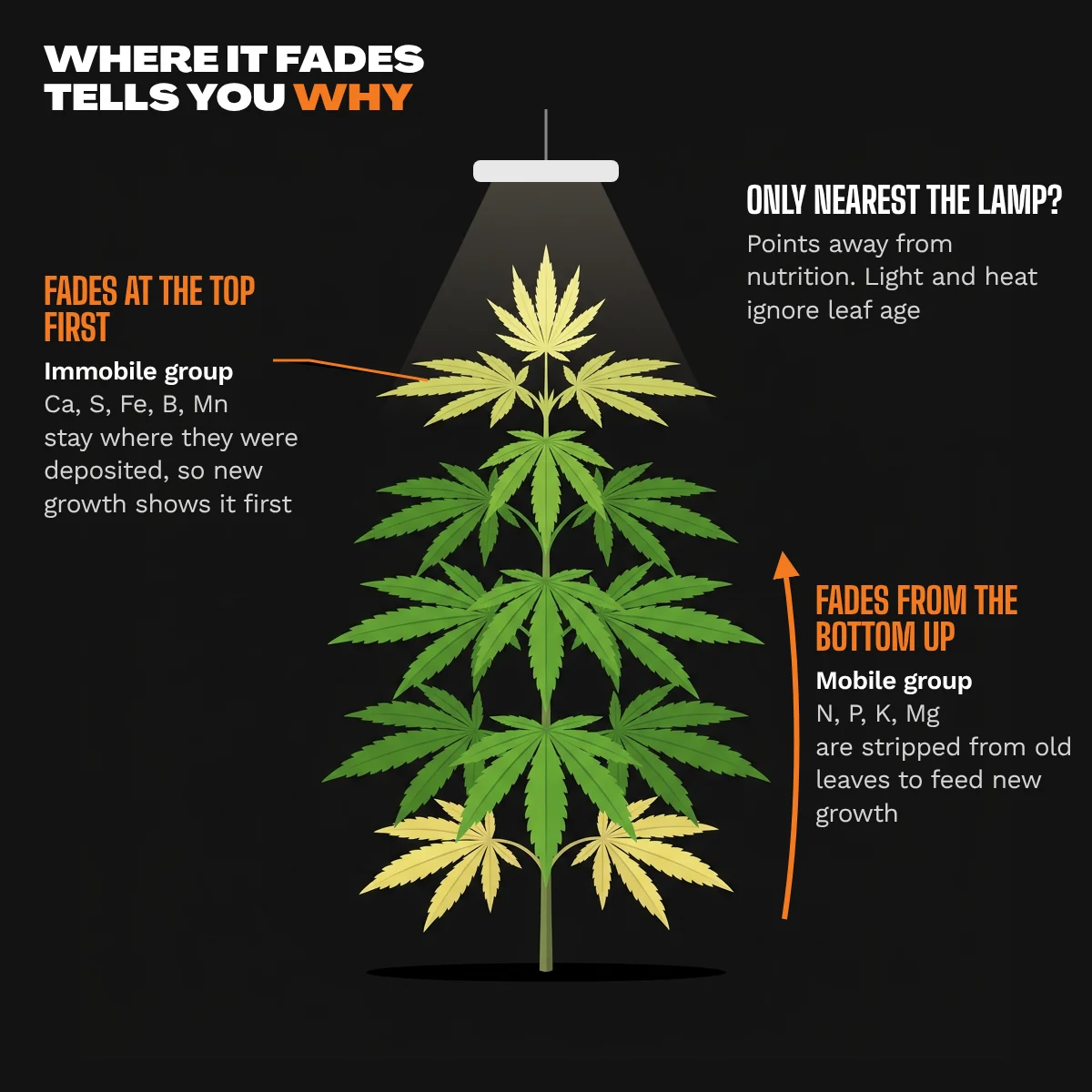
Cannabis nutrient deficiencies show up with symptoms appearing where they do because the plant can move some nutrients around inside itself and not others. That's what turns leaf position into a clue rather than a coincidence. This cannabis deficiency chart sorts the key nutrients by how mobile they are:
| Nutrient Group | Elements | Where Symptoms Start | Why |
| Relatively mobile | Nitrogen, phosphorus, potassium, magnesium | Lower, older leaves first, working upward while the top stays green | The plant commonly pulls these from older tissue to keep new growth supplied |
| Relatively immobile | Calcium, sulfur, iron, boron, manganese | Newest top growth first, with lower leaves looking untouched | These stay where they were first deposited |
Within each group, the pattern narrows things further. Even, whole-leaf fading and yellowing between green veins are different signatures, which is why the first two rows of the symptom chart sit apart even though both get called "yellow."
Keep two limits in mind. Mobility explains location, not severity or certainty, and a plant can show two patterns at once when more than one thing is wrong.
The bigger limit is this: a deficiency pattern tells you the element is short at the leaf, not that it's necessarily missing from the feed, and most failed corrections happen in the gap between the two. Position narrows it to a group, but telling individual nutrient deficiencies apart takes element-specific signs.
Nutrient Lockout, pH & Nutrient Burn: When Feeding Is the Problem
Most feeding problems come down to one of three things. The nutrient is there but your roots can’t absorb it, the plant is getting more than it can use, or salts have piled up in the medium. Each needs a different fix, so work out which one you’re facing before you touch the feed.
- Nutrient lockout is the sneaky one. It mimics a nutrient deficiency so well that you want to add more of the “missing” nutrient. That tends to make things worse, so rule out lockout before you change the feed.
- Cannabis pH decides which nutrients your roots can take up, which makes pH drift the usual cause of nutrient lockout. Check your root-zone pH first, aiming for the right range for your medium.
- Nutrient burn is the opposite problem. Dark, glossy leaves and crisping tips mean the plant has more nutrients than it can use. Overfeeding one nutrient can also block another, so nute burn and a deficiency can show up on the same plant.
Salts can also build up in the medium, restrict uptake and are commonly linked to burnt tips and edges. An EC reading well above what you’re feeding confirms it. Flush with plain, pH’d water until roughly 30% drains, then reset pH. Feed again only for a shortage that’s still showing.
How Water, Light & Temperature Stress Show on Marijuana Leaves
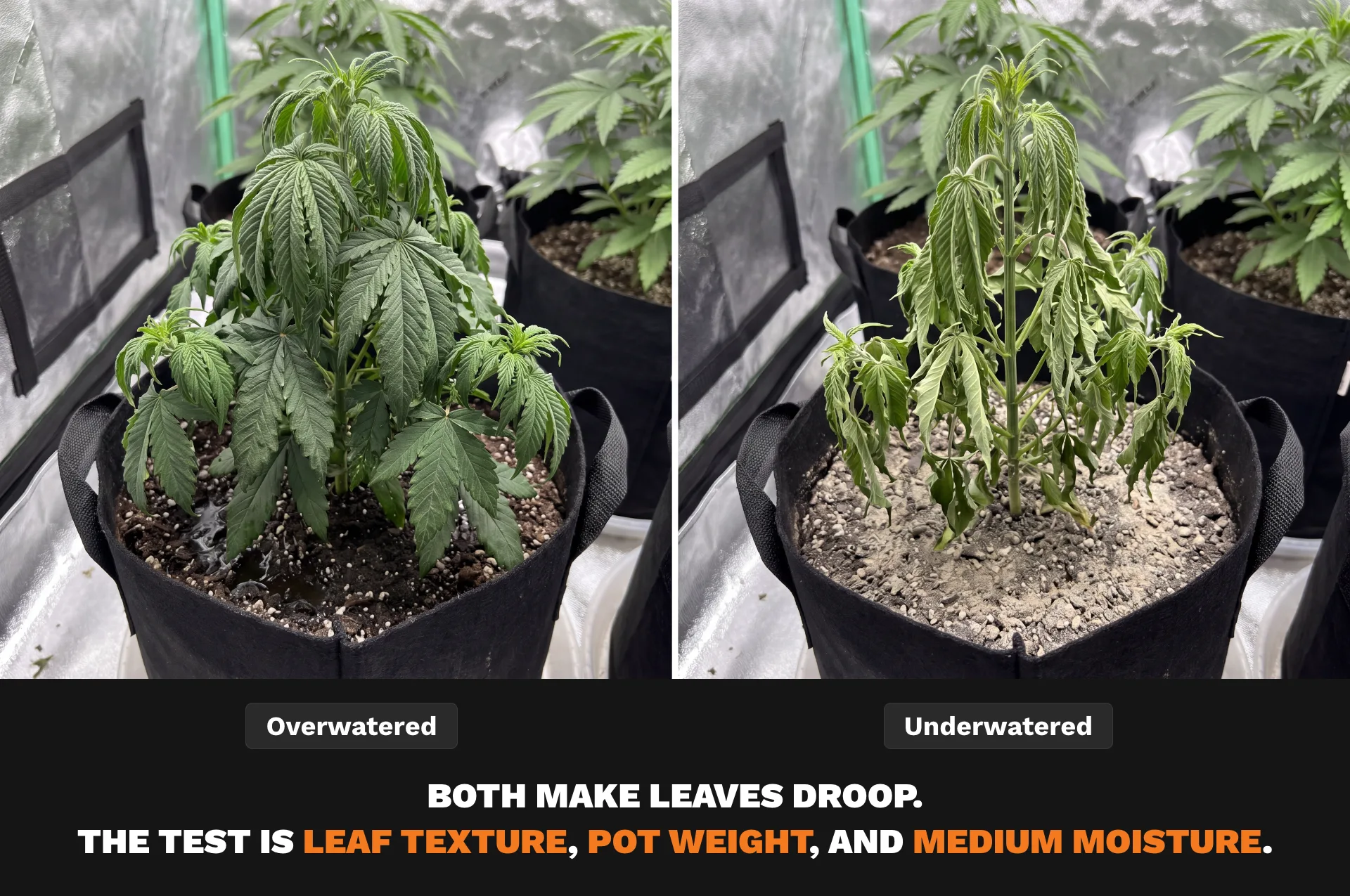
Non-nutrient stress shows on marijuana leaves mostly through posture and position, not color, and that's the fastest way to separate it from a feeding issue.
- Overwatering vs. underwatering: Both make leaves droop, but the texture gives them away. Overwatered leaves stay thick and firm as they curl down, while underwatered leaves turn thin, limp and papery. Confirm with pot weight and medium moisture. Heavy and wet means roots are short of oxygen, while light and dry means they’re short of water.
- Heat and light stress: Both hit the leaves nearest the lamp. Heat curls leaf edges up into a taco shape, while light burn bleaches the tissue without curling it.
- Cold stress: Foliage turns dull, sluggish and sometimes purple, so night temperature is the number worth logging.
- Airflow: Fan damage shows as tattered, curled or dried leaves on the side facing the fan, not across the whole canopy.
- Humidity: Big swings can exaggerate tip crisping and drooping, which is easy to mistake for nutrient burn.
One rule ties it all together: environmental stress usually lines up with a position in the room, while nutrient patterns line up with an age group of leaves. So check whether the affected leaves are the nearest ones or the oldest ones.
How to Spot Pest Damage on Cannabis Leaves
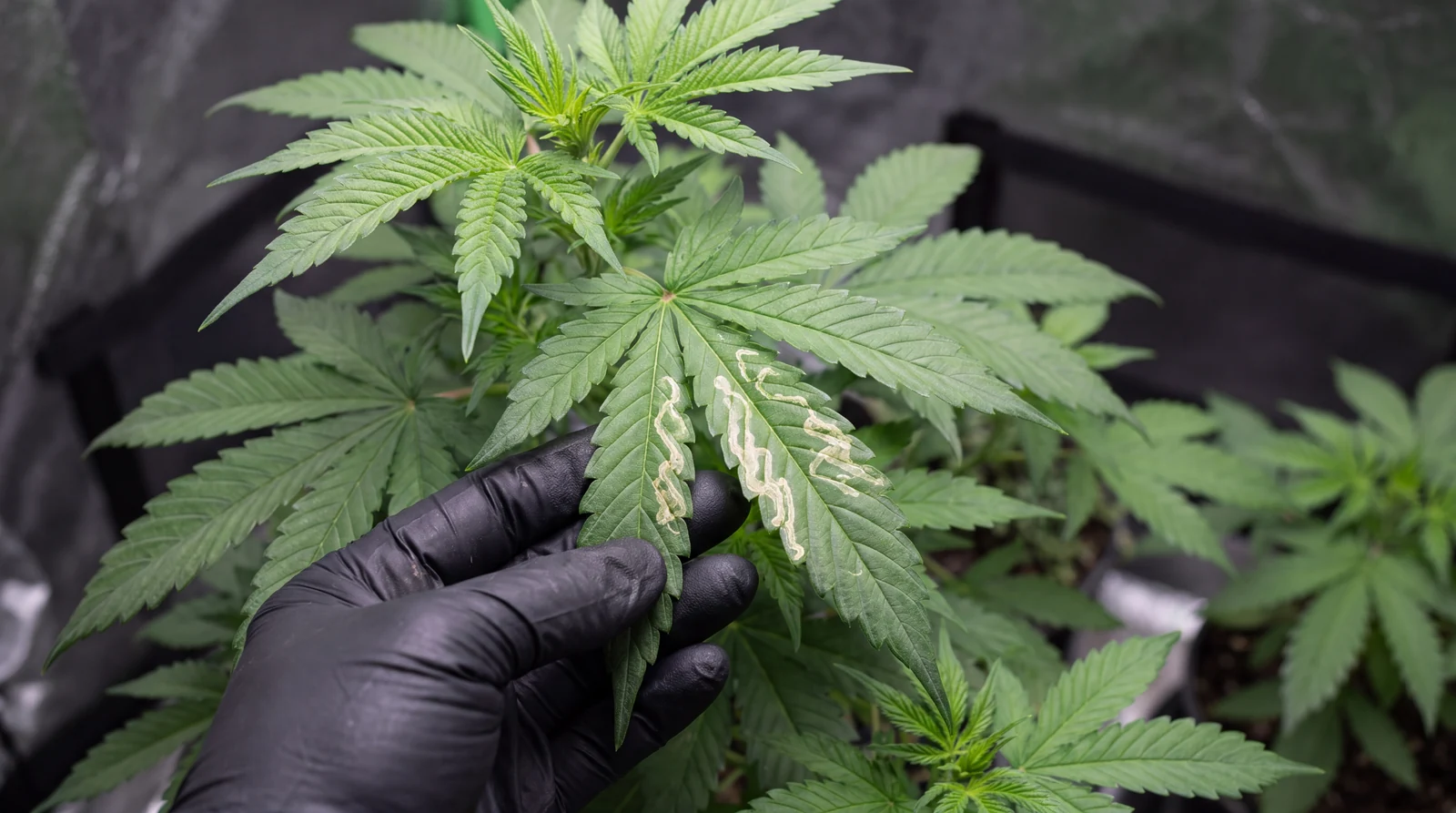
The leaf damage from cannabis pests often shows up as speckling, silvering, sticky residue or chewed tissue, and the pest responsible is usually still close by on the leaf underside or in the growing tips. The type of damage tells you which kind of pest you’re dealing with:
- Sap-feeding pests puncture tissue and leave speckling, stippling, silvering and sticky residue.
- Chewing pests remove tissue and leave holes, notches and frass.
A few details the chart doesn’t show help confirm what you’ve found. Fine webbing on the undersides points to spider mites. A black sooty film can grow on the honeydew aphids leave behind, so treat it as a pest sign. If new growth comes out twisted and distorted, check the growing tips under magnification, since some mites are too small to see unaided.
Here’s where to look, in order:
- Leaf undersides, starting with leaves already showing marks.
- Growing tips and the newest unopened leaves.
- Stem junctions and the crotches where leaf stems meet branches.
- The medium surface and pot rims.
How to Spot Disease Damage on Cannabis Leaves
Cannabis diseases damage leaves with spots, coatings or rot that a pathogen leaves as it colonizes the tissue, and humidity, leaf wetness and airflow are the first things to check once you see it.
Powdery mildew sits as a white powdery coating on upper leaf surfaces, usually hitting younger leaves first. Fungal leaf spots are defined yellow-brown spots, sometimes with rings or a halo, and they tend to start low and inside the canopy, where the air is still.
Spots alone can still mislead you, since calcium problems also spot leaves, so use the lookalikes table below to separate the two before treating.
Cannabis Leaf Symptoms That Look Alike (& How to Tell Them Apart)
To tell lookalike symptoms apart, run the one test that separates them before treating either. Some unrelated problems leave almost identical marks on a leaf, so they’re easy to mix up even when you look closely. Each pair below has a test that points you the right way.
| Easily Confused | Deciding Test | What the Result Tells You |
| Nitrogen shortfall vs. natural late-flower fade | Week of flower, plus whether the fade is gradual and bottom-up or speeding up | Late in the cycle and gradual reads as fade. Early or fast-moving reads as a shortfall |
| Deficiency vs. lockout | Root-zone pH, before any feed change | In range sends you back to the feed. Out of range means an availability problem, and more feed makes it worse |
| Nutrient burn vs. heat or light burn | Are the crisped leaves the most heavily fed, or just the closest to the lamp? | Position outranks color here. Nearest the lamp points to the environment |
| Magnesium-type interveinal fade vs. light bleaching | Canopy position, plus whether veins stay green | Green veins in the mid or lower canopy reads nutritional. Washed-out tissue directly under the lamp reads as light |
| Overwatering droop vs. underwatering droop | Pot weight and medium moisture, never leaf appearance | Heavy and wet means too much. Light and dry means too little |
| Calcium-type spotting vs. fungal leaf spot | Defined edges or halos, spread from plant to plant, and what's on the underside | Defined and spreading reads as a pathogen. Scattered and static points back to the root zone |
| Deficiency stippling vs. early mite damage | Magnified check of leaf undersides for organisms | Finding mites settles it. Finding nothing sends you back to pH and feed |
| Genetic purpling vs. a cultural cause | Compare with siblings of the same strain, then check night temperatures | Siblings doing the same reads genetic. One plant alone with cold nights reads environmental |
When two causes are still in play, run the cheaper, reversible test first, the one that doesn't add anything to the plant. Measure before you add.
Don't treat for both at once. A deciding test only narrows the odds rather than proving the case, and changing two variables together means you'll never know which one the plant responded to.
Changes in Pot Leaves That Aren't a Problem
Plenty of changes in pot leaves are normal, and treating them creates a real problem where there wasn’t one. Here’s what to keep in mind when you’re looking at at cannabis leaf symptoms:
- Late-flower fade. Broad yellowing and leaf drop over the final weeks is how the cycle ends. But if you see leaves turning yellow early in flower, or the yellowing spreads fast, look for a real cause such as a nitrogen shortfall.
- Shaded lower leaves. Leaves getting almost no light are commonly dropped once they stop contributing much.
- Cotyledons. The first rounded seedling leaves yellow and fall away as true leaves establish.
- Handling damage. A torn, creased or bruised leaf from a fan, a trellis or your own hands is physical and local, not systemic.
- Genetic variation. A leaf that's darker, lighter, purpler, broader or narrower than the plant beside it often just reflects the strain-specific marijuana seeds it grew from.
- New growth. Lighter, softer top growth against hardened lower leaves is normal.
If you're unsure whether a change belongs on this list, watch it for a few days before doing anything. A brown patch that hasn't moved in ten days is a record of something that's already over, and chasing it only stacks new variables onto a plant that has already recovered.
Damage that keeps advancing, or shows up on other leaves and plants, means the cause is still active.
How to Fix Cannabis Leaf Problems Once You Know the Cause
Fix the conditions first, one change at a time, and add feed or additives only if a shortage is still showing.
- Stabilize the root zone. Check medium moisture by pot weight, then pH and EC against your input.
- Stabilize the environment. Check canopy temperature, airflow and humidity, plus lamp distance if position is what pointed you here.
- Change one thing. Make a single adjustment, take a dated photo of the affected area, then give the plant enough time to respond.
- Keep inspecting if the cause was a pest or pathogen. Confirmed pests and pathogens need follow-up checks because they come back and spread.
Recovery shows in new growth, not in the leaves that started all this, since damaged tissue won't turn healthy green again. Give the plant a full cycle of new growth after each change.
If the symptom is still advancing by then, revisit the diagnosis rather than the dose, because stacking extra feed, water and additives leaves you no way to tell which move helped and which one hurt.