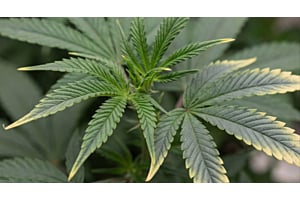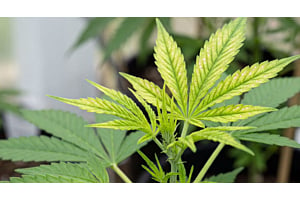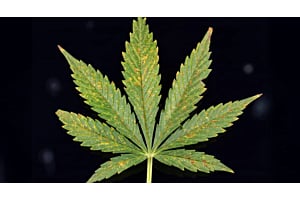
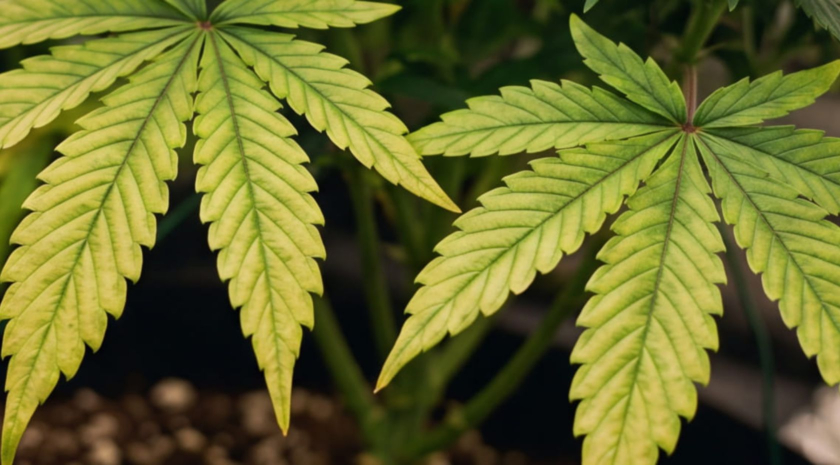
A cannabis magnesium deficiency starves leaves of the chlorophyll they need to turn light into energy. Left unchecked, it stunts growth, kills off lower leaves and shrinks your final harvest. It hits hardest during flowering, leaving you with airy, underweight buds. The good news is that a mag deficiency ranks among the most fixable problems you'll come across.
Catch it early and a simple correction turns things around within days. This guide walks you through the symptoms, lookalikes, causes and ways to prevent a repeat.
TL;DR: A magnesium deficiency looks like pale yellowing between the veins on your lower, older leaves while the veins stay green. It often turns up in hydro and soilless grows fed with RO or soft water. Check your root-zone pH first, then feed your plants magnesium with Epsom salt or Cal-Mag. New growth should recover within 3-5 days, though damaged leaves won't turn green again.
What Does Magnesium Do for Cannabis Plants?
Magnesium (Mg) fuels chlorophyll production in cannabis plants and drives the enzyme reactions behind healthy growth. Chlorophyll is the green pigment that captures light and powers photosynthesis.
Magnesium also helps move other nutrients around the plant and build the proteins that form new cells. It sits among the secondary macronutrients, alongside calcium and sulfur, so your plants need it in real quantities.
Starve a plant of magnesium and photosynthesis grinds down, since it can't make enough chlorophyll to feed itself. Growth slows to a crawl while older leaves yellow, die and drop. A shortage during flowering is especially costly, since the plant needs magnesium most as buds form. Severe cases stunt the plant for good, so ignoring it costs you real yield.
What Are the Signs of a Cannabis Magnesium Deficiency?
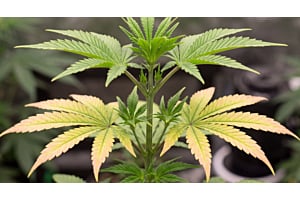
A magnesium deficiency shows up first on the lower, older leaves because the weed plant moves Mg to new growth. It’s a mobile nutrient, so your plant strips its old leaves to feed fresh shoots. That's why the damage starts at the bottom and climbs up the canopy if you leave it. Here's how it looks and how it progresses:
- Early, progressing and advanced signs: how the deficiency unfolds over time.
- Interveinal chlorosis: the tell-tale yellowing between green veins.
- Red or purple stems: a supporting clue, though not proof alone.
- Crispy edges and curling: signs the shortage is advancing.
Early, Progressing and Advanced Signs
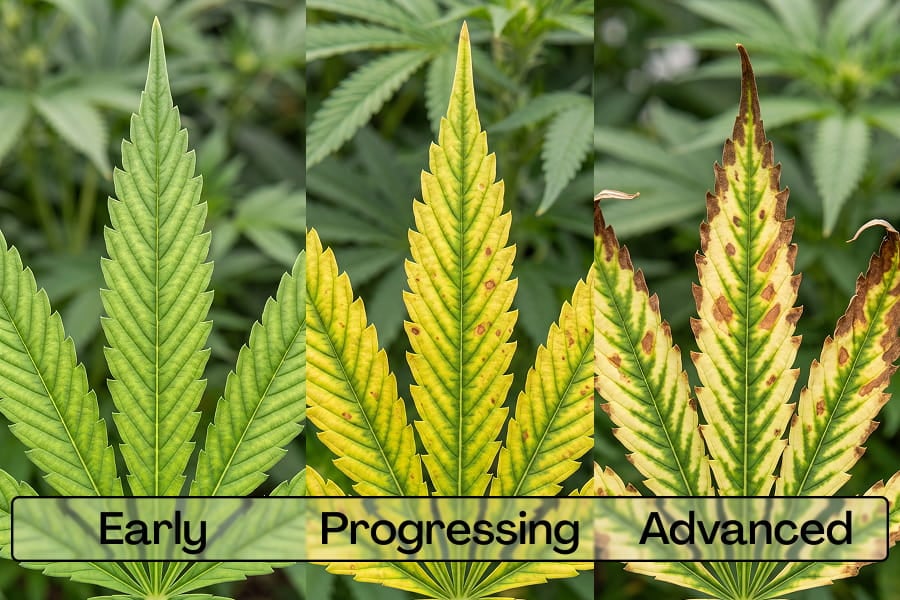
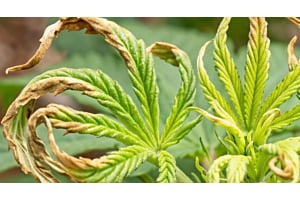
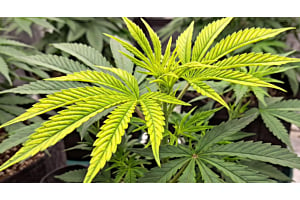
Side-by-side cannabis leaves showing how magnesium deficiency develops, from early yellowing between the veins to severe discoloration and leaf damage.
A magnesium deficiency follows a clear path, so knowing the stage helps you judge how urgently to act. Watch for this progression:
- Early: faint yellowing between the veins on the lowest, oldest leaves.
- Progressing: the yellowing climbs upward, leaf edges crisp up and stems may redden.
- Advanced: leaves brown, curl and die while new shoots fade toward white.
Interveinal Chlorosis: Yellowing Between the Veins
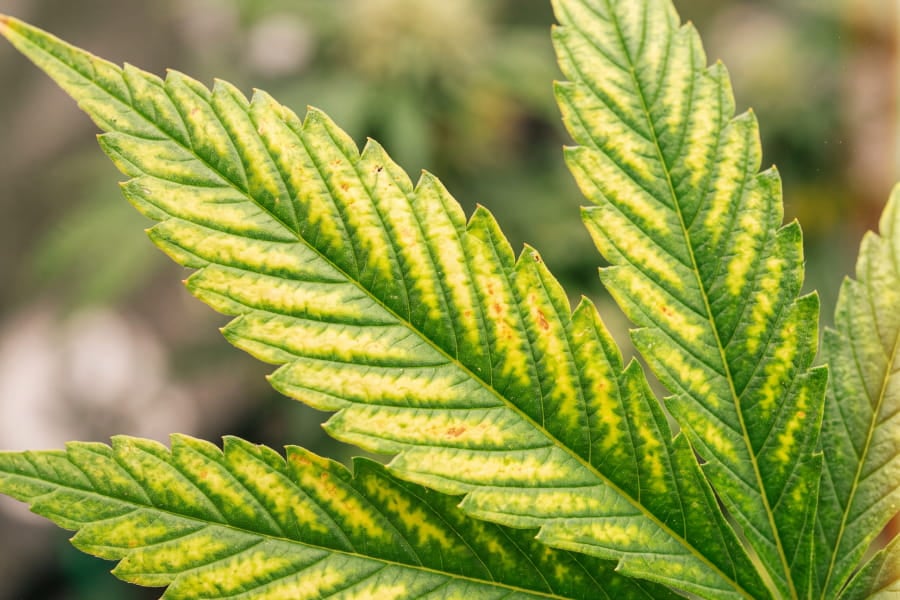
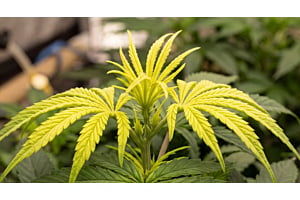
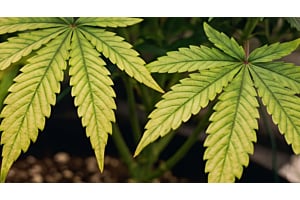
A close-up look at magnesium deficiency, with yellowing between the veins while the veins stay noticeably green.
Interveinal chlorosis turns the leaf tissue between the veins pale yellow while the veins themselves stay green. This green-vein, yellow-tissue pattern is the clearest single sign of a magnesium problem. It's the opposite of what the name might suggest, so remember the veins keep their color. Small rust-colored spots sometimes appear in the yellow patches as the shortage deepens.
Red or Purple Stems and Petioles
Red or purple stems and petioles often accompany a magnesium deficiency, though some cultivars show that color naturally. Petioles are the small stalks that join each leaf to the branch. On their own, reddish purple stems aren't proof, so treat them as a supporting clue. Make sure you see interveinal yellowing too before you reach for a supplement.
Crispy Edges, Curling and Dying Leaves
Crispy leaf edges that curl and eventually die are all signs of an advanced magnesium deficiency. The edges turn dry and brittle, and the leaves may curl or "taco" upward. That crispiness sits at the leaf margins, a texture you can feel. Left longer, whole leaves yellow, brown and drop from the plant.
How Does an Mg Deficiency Compare to Other Deficiencies?
A mag deficiency looks a lot like several other cannabis problems, so a wrong guess sends you down the wrong fix. Dosing magnesium when the real issue is iron or pH wastes time and builds up salts. The fastest tell is symptom-to-leaf position, since magnesium hits old, lower leaves while many lookalikes strike new growth. Here's how to tell them apart:
- Common look-alikes: the problems most often confused with magnesium deficiency.
- Cal-Mag deficiency: whether it's the same thing as a magnesium shortage.
- Nutrient excesses: how too much of one nutrient triggers issues with another.
Common Look-Alikes That Mimic Magnesium Deficiency
Several cannabis deficiencies mimic magnesium, but each one has a tell that sets it apart. Symptom position and the exact pattern usually give it away. This table covers the problems most often mistaken for a magnesium shortage:
| Problem | Where it appears | How it differs from magnesium deficiency |
| Potassium Deficiency | Lower, older leaves | Leaf edges brown and burn first, with rusty red and yellow spotting between them |
| Iron Deficiency | New top growth | Same interveinal yellowing, but on young leaves not old |
| Calcium Deficiency | New growth | Brown spots and hooked, curling new leaves |
| Zinc Deficiency | New growth | Twisted new leaves with short gaps between nodes |
| Manganese Deficiency | New growth | Interveinal yellowing, but with small, brown dead specks in the yellow tissue |
| Sulfur Deficiency | Whole new leaves | Even yellowing across young leaves, veins included |
| Nutrient Burn | Leaf tips and margins | Burnt leaf tips from overfeeding, no interveinal yellowing |
| Natural Genetics | Stems and petioles | Red or purple coloring with no leaf yellowing |
The fastest sort is leaf position. A magnesium deficiency starts at the older, lower leaves, so anything hitting the fresh top growth is a different problem altogether. If you find a symptom on the older leaves, read the pattern first. When two causes still seem to fit, check your pH and water before you feed anything, since a lockout can wear almost any deficiency's face.
Is a Cal-Mag Deficiency the Same as a Magnesium Deficiency?
No. A "Cal-Mag deficiency" means calcium and magnesium are both running low at once. A magnesium deficiency is just one half of that. The two often show up together because the same grow conditions starve both nutrients at once: poor-quality water, an unbuffered coco or hydro medium or no cal-mag supplementation in the feeding schedule. A Cal-Mag product treats both deficiencies.
When Nutrient Excesses Cause Magnesium Issues and Other Problems
Nutrient excesses tip the balance in more than one direction, and each one is worth knowing.
- Excess potassium is a main driver behind a magnesium deficiency. High potassium levels crowd magnesium out at the root zone, so the plant runs short even when there's plenty of magnesium in the mix. The two nutrients compete for uptake in both directions, so heavy magnesium feeding can just as easily crowd out potassium.
- Excess magnesium can cause a potassium or calcium deficiency. It's the same root-level competition, this time with magnesium as the one crowding the others out.
- Outright magnesium toxicity is rarer. The plant can store surplus magnesium inside its cells, so it takes a lot to reach harmful levels. That said, heavy overfeeding will still eventually burn the leaf tips and yellow the older leaves.
Potassium and magnesium keep each other in check at the roots, so an excess of either one can crowd out the other. Very high ammonium-nitrogen feeding can crowd magnesium out too. Either way, proper nutrient balance beats piling on any single nutrient.
What Causes a Magnesium Deficiency in Cannabis Plants?
A cannabis magnesium deficiency usually comes down to a handful of grow-environment causes. It's common in hydro and soilless mixes and rare in healthy outdoor soil. These are the usual culprits:
- Mineral-poor water: RO (reverse osmosis), distilled and soft tap water carry little to no magnesium.
- Low or acidic pH: a root zone below the ideal range can reduce magnesium availability, even when it's present in the feed.
- Cation imbalance: heavy potassium feeding crowds magnesium out at the roots, even when magnesium levels in the feed are fine.
- Magnesium-poor medium: coco and some soilless mixes start with very little magnesium.
- Overwatering or poor drainage: soggy roots can't absorb magnesium properly.
- Heavy leaching: frequent heavy watering or rain flushes magnesium out of the medium.
If your water already has a moderate mineral content (around 125 ppm on a TDS meter), it usually supplies enough magnesium on its own. The risk sits with near-zero sources like RO and distilled water.
How Do You Fix a Cannabis Magnesium Deficiency?
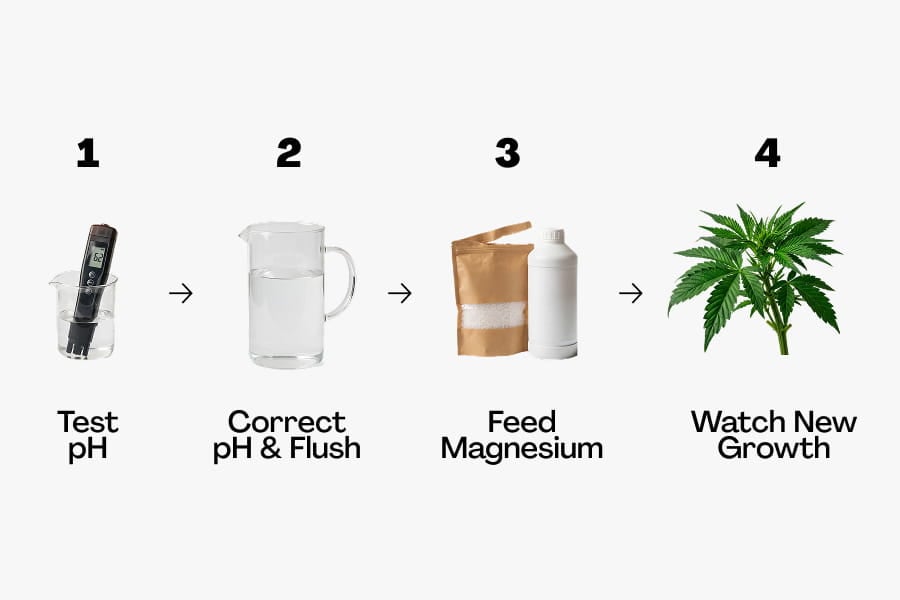
A simple four-step guide to correcting magnesium deficiency in cannabis, from checking and adjusting pH to adding magnesium and monitoring healthy new growth.
Fixing a cannabis magnesium deficiency works best as a set order, so tackle these four steps in sequence. Rushing to dose magnesium before checking pH is the most common mistake, so start at the top. Give your plants a few days to respond before you judge the result.
Here's the sequence:
- Step 1: Test your pH. Find out whether lockout is the real problem.
- Step 2: Correct pH and flush if needed. Clear the path for uptake.
- Step 3: Feed magnesium. Dose Epsom salt, Cal-Mag or dolomite lime by medium.
- Step 4: Watch new growth. Confirm recovery and ease back off.
Step 1: Test Your pH
Testing your pH tells you whether magnesium is missing or just locked out. Use a pH pen on your soil runoff or your hydro reservoir. In soil, keep the root zone at 6.0-6.3, and treat 6.5 as the hard ceiling.
Climb past that and you start locking out iron, manganese and zinc, the very micronutrients whose deficiencies mimic a magnesium problem. In hydro or coco, hold pH at 5.8-6.2, with 5.6-6.4 as the workable range.
Step 2: Correct pH and Flush if Needed
Correcting pH reopens magnesium uptake, so adjust it before you add any supplements. In hydro or coco, mix your feed and bring that solution into range with pH Up or pH Down. Soil depends on your program. If you run synthetic nutrients, pH the mixed feed the same way.
But living, organic soil holds its own pH through the microbes at the roots, so you leave the water alone there. If it has genuinely drifted, correct the soil itself with slow amendments:
- Dolomite lime to bring up a too-acidic root zone (which also adds magnesium).
- Elemental sulfur and acidic materials like coffee grounds to pull a high pH down.
Since an acidic root zone is one of the most common causes of a magnesium lockout, raising it with dolomite often fixes the pH and the shortage together.
Flushing is a separate job from correcting pH. If salts have built up from heavy feeding, run clean, pH-balanced water (no nutrients added) through the medium until about 30% drains out. This clears the buildup and resets your starting point. Sort the pH on that fresh baseline, then move on to feeding.
Step 3: Feed Magnesium With Epsom Salt, Cal-Mag or Dolomite Lime
Once pH is in range, feed the magnesium directly. Which product you pick depends on your water and what else is running short:
Epsom salt (magnesium sulfate) is the quick, cheap fix for a straight magnesium shortage. In hydro or as a foliar spray, dissolve it into water and apply directly; both act fast since leaves and reservoir-fed roots take up magnesium quickly. In soil or a planting mix, it works differently: mix it straight into the medium as a one-time correction rather than watering it in. Use the doses below, then drop to a lighter maintenance feed once the plant recovers:
| Application Application | Epsom salt dose | Method |
| Hydro reservoir or planting mix |
1 teaspoon per gallon (or about ¼ teaspoon per liter) |
Mixed directly into the reservoir |
| Soil or planting mix |
1 teaspoon per quart of soil (or about 1 teaspoon per liter) |
Mixed directly into the medium |
| Foliar spray (fastest acting) |
1 teaspoon per gallon (or about ¼ teaspoon per liter) |
Dissolved into water as a spray solution |
Maintenance dose after correction: A quarter dose delivered as a liquid feed at each subsequent watering or reservoir change, which works out to about 1 teaspoon per gallon of water. This is the steady-state rate once the plant's recovering, regardless of which method you used to correct it
A Cal-Mag supplement supplies magnesium alongside calcium and usually a little iron, which makes it the better pick for RO and soft-water grows. Because a calcium shortfall often shows up next to the magnesium one, Cal-Mag covers both at once. Mix it at the label rate in your reservoir or watering can, or spray it on the leaves.
Dolomite lime and slow-release options suit soil growers who want steady magnesium without regular dosing. Dolomite feeds magnesium slowly and nudges an acidic soil pH upward over several months, so mix a fine grade into your soil before planting and water it in to settle. Worm castings work as a gentler, longer-term source alongside it.
Step 4: Watch New Growth and Ease Off
Watching your new growth confirms whether the fix worked. Fresh leaves should come in green within 3-5 days, and the yellowing should stop spreading. Damaged leaves won't turn green again, so judge success by new growth, not old. Once the plant recovers, drop to a lighter maintenance dose to avoid overloading magnesium.
How Do You Prevent a Magnesium Deficiency in Cannabis?
Preventing a cannabis magnesium deficiency comes down to steady pH, the right water and balanced feeding.
- Test your pH regularly, since even plenty of magnesium won't help if the root zone drifts acidic.
- Feed on a consistent schedule and resist the urge to overfeed any single nutrient.
- Avoid overwatering, which stresses roots and slows how well they take up magnesium.
- Add Cal-Mag from the start rather than waiting for symptoms, especially if you grow with RO or distilled water. Soil growers can mix dolomite lime in before planting for a steady, slow-release supply.
Prevention takes far less effort than nursing a damaged plant back to health.
Start Your Grow With Healthy Genetics
Starting a grow with premium-quality weed seeds gives your plants the vigor to shrug off minor nutrient stress and bounce back faster. Seed Supreme’s wide-ranging catalog includes top-shelf feminized seeds and autoflowering seeds, available to eligible adults where local law permits.