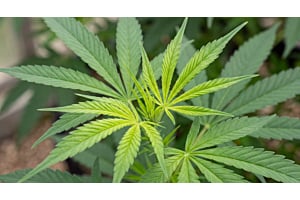
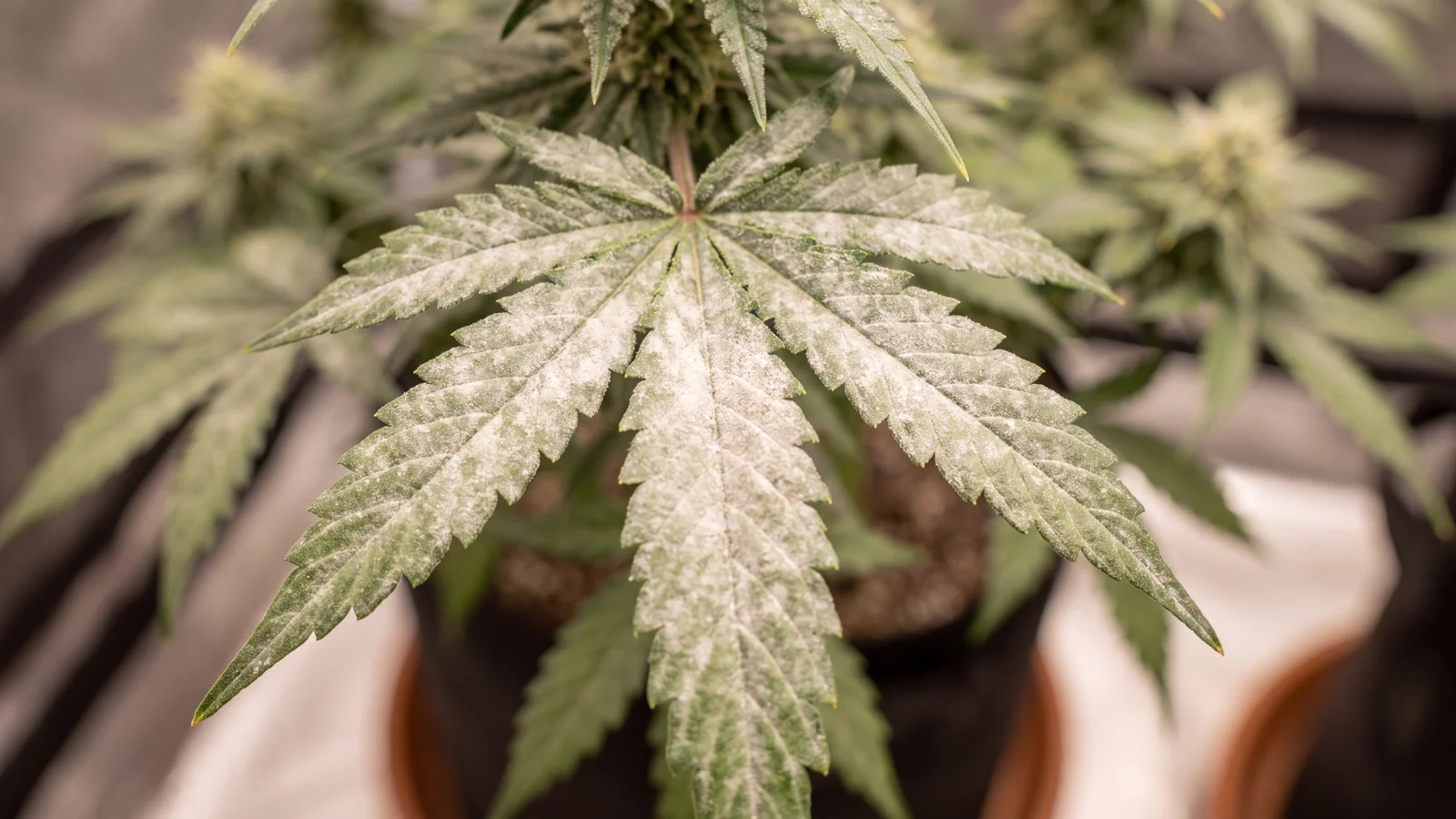
White mold on plants is likely powdery mildew on cannabis — a fungus that leaves dusty white to pale-gray patches on leaves. Confirm it by wiping a patch, then remove infected leaves, improve airflow and treat early before it reaches your buds. Younger leaves in shaded, poorly lit parts of the canopy are most at risk. From there, it can move onto stems and buds.
Humid, still air and a dense canopy let it take hold. No cultivar is fully immune, whether you’re growing indoor cannabis seeds in a tent or plants in the garden. Powdery mildew can be brought under control, but your options narrow once plants are in flower.
White powdery stuff on plants isn’t always mildew, though, since trichomes, pests and spray residue cause false alarms too. Below, you’ll learn how to confirm powdery mildew on cannabis, rule out the lookalikes, treat it in veg and flower and keep it out of your next grow.
Seeing White Mold on Plants? Here’s What Powdery Mildew on Cannabis Looks Like
Powdery mildew on cannabis plants first appears as small, round white spots or patches on the upper side of fan leaves. Sometimes it looks like a faint grayish film that widens and becomes a dusty coating over a few days. Left alone, powdery mildew yellows leaves, distorts growth and causes early leaf death, on top of degrading harvested buds.
Unlike most white spots on weed leaves, powdery mildew patches sit on top of the leaf rather than in it. Other signs that point to powdery mildew:
- A dry, dusty texture that’s never wet, slimy or cottony.
- A patchy spread that’s worse on shaded interior leaves and in still corners. An even coating that hits every plant overnight points to something else.
- Powdery patches on petioles and stems, which usually means the case is already established.
- White spots on fan leaves during flowering that creep onto sugar leaves and bracts.
How to Confirm Powdery Mildew on Cannabis Plants
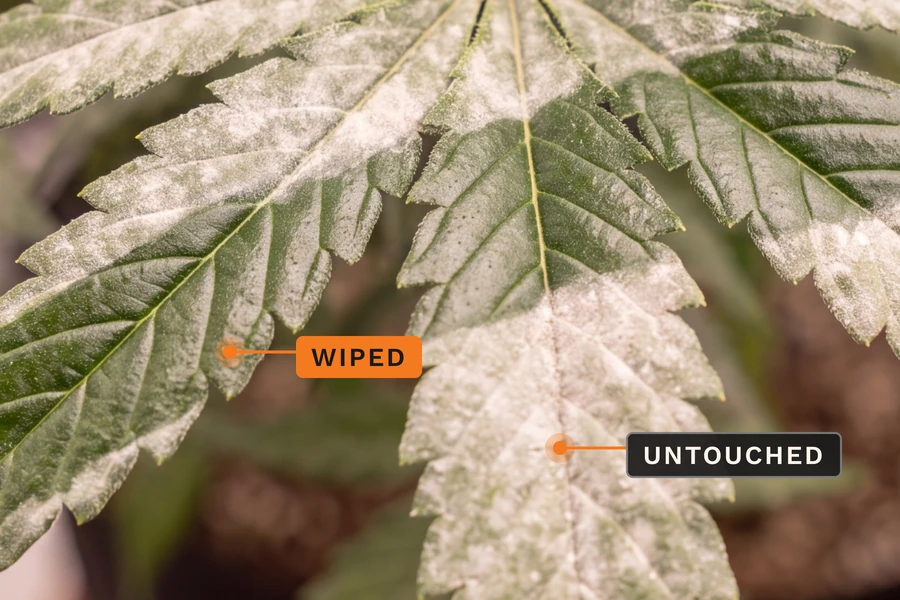
A quick wipe test confirms powdery mildew. If the white powder smears off, it’s mildew, because it grows across the leaf surface while marks in the tissue stay put. Wiping removes the evidence, not the infection, which keeps producing spores.
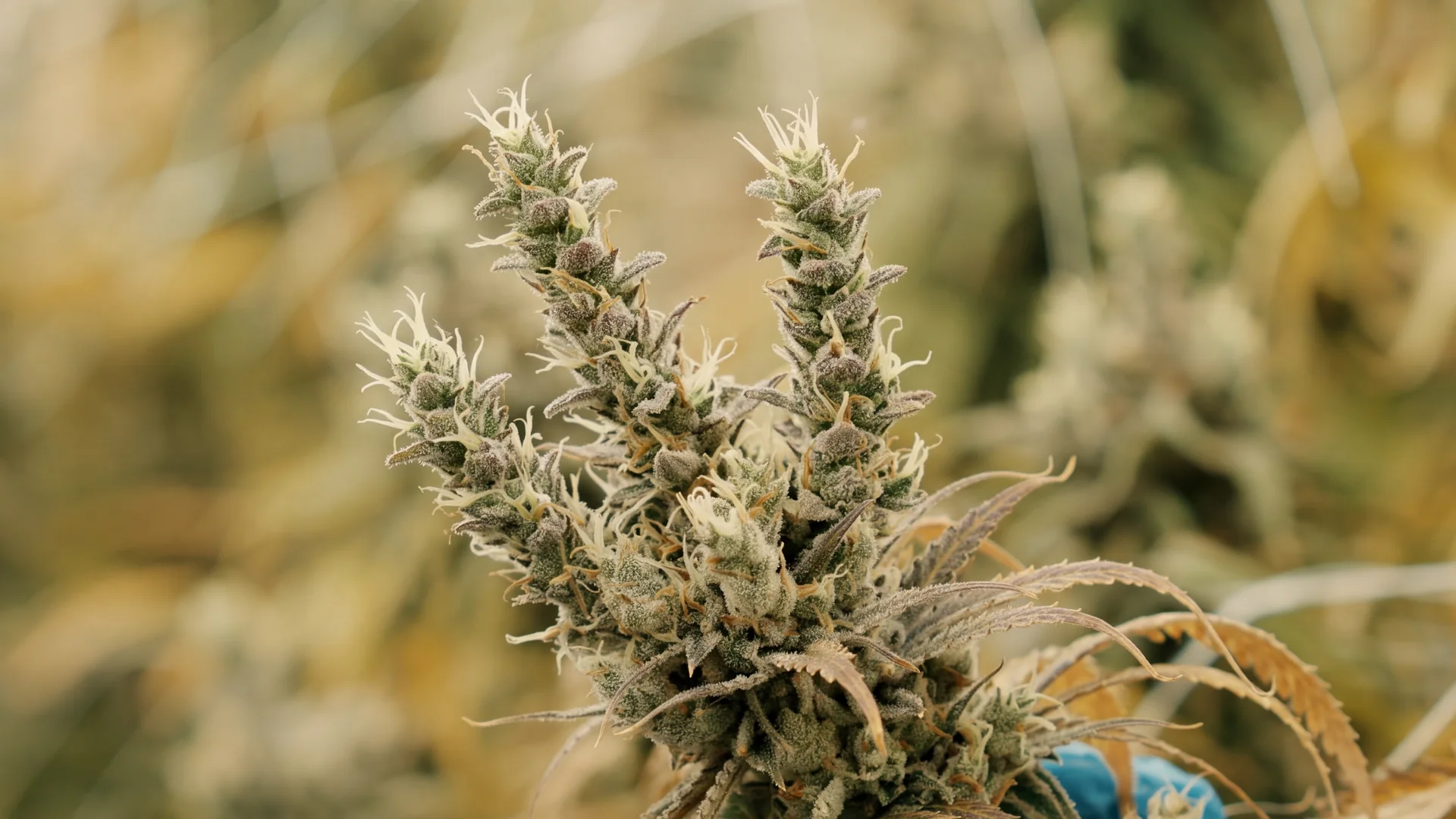
Inspect under bright light and pull leaves toward you instead of pushing through the canopy, since brushing coated leaves spreads spores. In flower, check from underneath. A closed canopy hides interior leaves, and early mildew on sugar leaves is easy to mistake for frost, since both look like white specks at a glance.
White Spots on Cannabis Leaves That Aren't Powdery Mildew
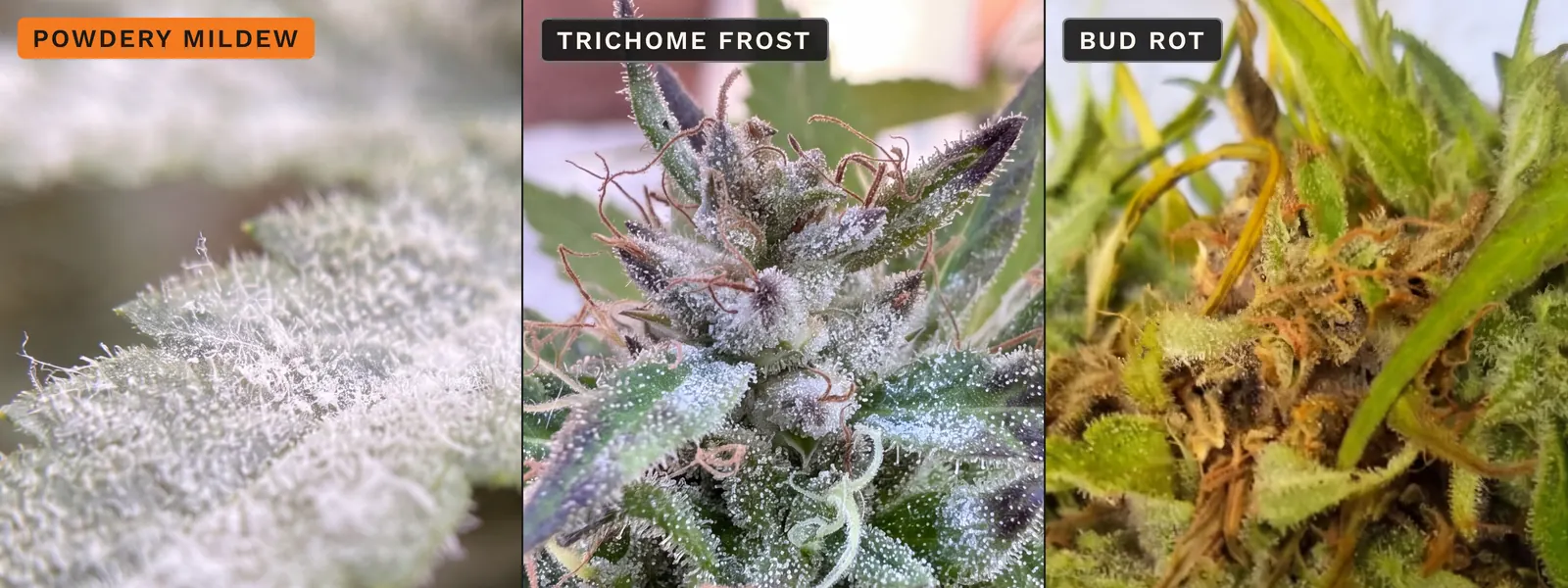
Trichomes, bud rot, mold on the medium, spider mites, thrips, spray residue and light bleaching can all pass for powdery mildew. Rule them out before you spray anything, because treating the wrong problem gives the real one time to spread.
| Lookalike | What It Looks Like | How it Differs From Powdery Mildew | Where It Shows Up |
| Trichomes | Even, sparkling resin coverage that builds as buds mature | Uniform frost, not dull patches that spread and merge | Buds and nearby sugar leaves, late in flower |
| Bud rot (Botrytis) | Fuzzy gray mold inside the bud, yellowing sugar leaves, brown or gray buds and a musty smell | Grows inside the bud and collapses tissue, not dry dust on a leaf surface | Inside dense colas, hidden until well established |
| Mold on the medium | Fluffy white growth on the soil or coco surface | It's on the medium, not living leaves, and most of it feeds on decaying organic matter | Top of the medium, usually after overwatering or with still air |
| Spider mites | Tiny white or yellow stippling dots, often with fine webbing | Damage sits in the tissue and won't wipe off, and the mites are present on leaf undersides | Upper leaf surfaces, with webbing below and at leaf joints |
| Thrips | Elongated silver streaks with tiny black specks of frass | Streaked, metallic scarring with no powder to lift | Wherever they feed, often newer growth |
| Spray or hard-water residue | Gritty, crusty specks that won't budge, or a whitish film in a droplet pattern | Appeared after a spray or watering and doesn't spread or regrow | Wherever the spray landed, often evenly |
| Light bleaching | Dry, pale patches on the side facing the light | Pale tissue with nothing on top, tied to distance from the lamp | Top of the canopy, closest to the lamp |
| Leaf spots & downy mildew | Marks with yellow haloes, defined edges or dark centers, or growth under the leaf | Different texture and surface side, and many sit in the tissue | Varies by pathogen, often the leaf underside |
Four questions settle most cases:
- Is the mark on the surface or in the tissue?
- Does it have a texture you can feel or lift?
- Is it spreading to new leaves over several days?
- Does its position line up with something else, like distance from the lamp, a recent spray pattern or the shaded middle of the canopy?
Bud rot is the mix-up worth taking seriously, because it runs on a much faster clock. Also known as botrytis, it spreads rapidly once it takes hold, and catching it early can be the difference between losing one bud and losing a harvest.
The quickest way to tell what kind of moldy weed you’re working with is by looking at where the growth sits. Gray fuzz inside a cola needs a much faster response than dusty patches on a fan leaf.
Two combinations catch growers out. Mildew and pests can show up together, so finding mite stippling doesn't necessarily clear the plant of fungal growth. Finish the inspection instead of stopping at the first match. If you’re seeing white growth on the medium with clean leaves above it, it’s usually a watering and air movement issue, not a leaf pathogen.
If nothing here matches what you see, work through the other common cannabis diseases before you commit to a treatment.
What Causes Powdery Mildew on Cannabis & How Fast Does It Spread?
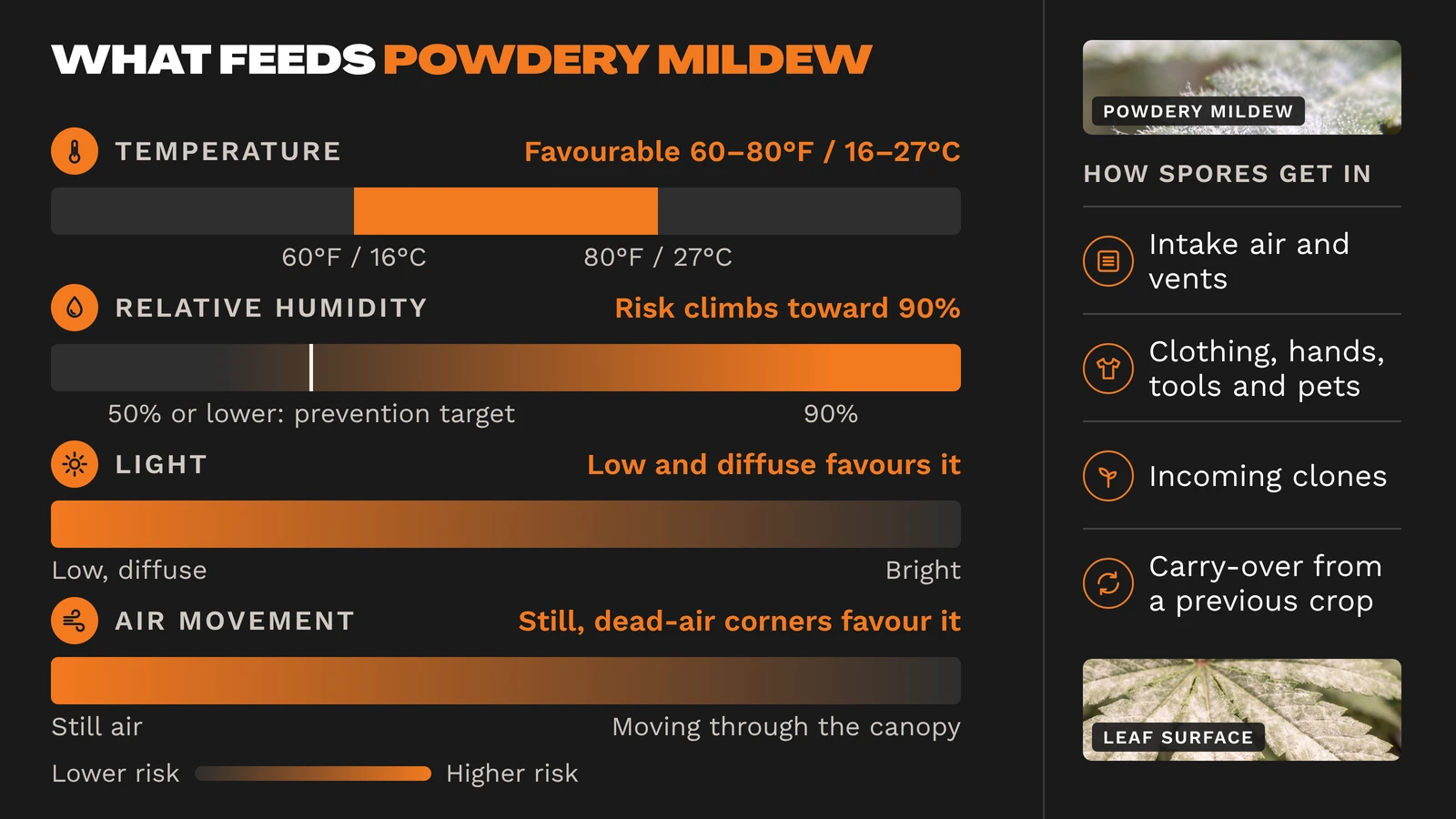
Powdery mildew spreads quickly once airborne fungal spores find humid, still air and a dense, shaded canopy. The main species on cannabis, Golovinomyces ambrosiae, is an obligate biotroph. It needs living plant tissue to grow, unlike molds that feed on dead or stored material. A case caught on three leaves is a far smaller job than the same case two weeks later.
Spores ride in on intake air, open doors and vents, clothing, tools, pets and unquarantined clones, and they can linger in a room that housed an infected crop. Whether they cause a problem depends on conditions:
- Humidity: infection increases as relative humidity rises toward 90%.
- Temperature: infection risk climbs in mild, slightly cool rooms, especially when temperatures drop below about 75°F overnight.
- Light & canopy: low, diffuse light, overcrowding and dead-air corners all raise the risk.
- Feeding: high nitrogen rates produce tender, dense growth that's more susceptible.
Powdery mildew can infect your marijuana plant without free water, and water sitting on leaves actually inhibits most powdery mildew spores. Humidity in the air is the driver, which is why risk climbs after lights-off indoors and on dewy nights outdoors. Airflow breaks up those humid pockets, but it also carries spores between plants, and so do your hands.
How to Get Rid of Powdery Mildew on Cannabis
To get rid of powdery mildew on cannabis crops, contain it, remove the worst leaves, fix humidity and airflow, then apply a control suited to the growth stage. Spraying without fixing the conditions is the most common reason mildew comes back. Follow these detailed steps in order:
- Contain it. Isolate affected weed plants if you can, wash hands and disinfect tools between plants, and work from clean plants toward affected ones.
- Remove the worst leaves. Bag heavily coated leaves as you cut them, but don't strip the plant bare. Removal cuts the spore load, but it won't end the infection on its own.
- Fix the environment. Lower humidity, thin dense growth out and get air moving through the canopy, not just across the top.
- Apply a stage-appropriate control. See the veg and flower sections below.
- Re-inspect on a schedule. Judge success by the absence of new patches on lower and interior leaves.
Treatment Options for Powdery Mildew on Weed
The least-toxic options to treat powdery mildew on weed include horticultural oils, neem oil, jojoba oil, sulfur, potassium bicarbonate and biological fungicides. But they don't all work the same way:
| Powdery Mildew Treatment Option | Main Role | How It Works |
| Horticultural, neem & jojoba oils | Eradicant, with some protectant activity | Work best against mildew that's already present |
| Sulfur | Preventive | Protects leaves before infection takes hold |
| Potassium bicarbonate | Preventive, with some eradicant activity | Upsets the fungus's cell chemistry so its hyphae collapse, and mildew can't easily develop resistance to that |
| Biological fungicides (e.g. Serenade) | Preventive | Uses the bacterium Bacillus subtilis to help stop infection. New growth isn't protected, so reapply every 7-14 days |
Always read the label and confirm that fungicides — even organic ones — are permitted on cannabis where you live. Then keep these cautions in mind:
- Keep oil and sulfur sprays at least two weeks apart to avoid injuring plants.
- Don't apply sulfur near or above 90°F, and skip sulfur burners around electronics like digital ballasts.
- Spot-test potassium bicarbonate on a few leaves first, since it can injure plants.
- Avoid spraying under strong light or in high heat, and rotate products instead of relying on one.
Expect suppression, not eradication. Powdery mildew spores may never fully leave your space, so keep conditions working against the fungus and inspect neighboring plants too, since they share the same air.
How to Treat Powdery Mildew in Veg
In veg, remove coated fan leaves, bring humidity and airflow back in line, then spray a labeled control such as potassium bicarbonate, sulfur, a horticultural oil or a biofungicide. It's the widest treatment window you'll get, because there's no flower to contaminate and you have time to confirm a treatment worked.
- Remove coated fan leaves freely, since losing leaf area in veg costs far less than in flower.
- Choose products by label and local rules, not harvest timing, because there are no buds to worry about yet.
- Fix spacing, training and canopy structure so you solve the airflow problem instead of working around it.
- Deal with the source if mildew came in on a new clone or from a shared space.
Before you flip to 12/12, make sure there are no new patches on interior leaves across repeated inspections. Flipping to flower with an active powdery mildew infection carries a leaf problem into the stage where your options narrow. There's no set number of clean days to wait, so weigh another week in veg against managing it in flower.
How to Treat Powdery Mildew in Flower
In flower, lower humidity, get air moving through the canopy and remove affected fan leaves selectively, keeping sprays to a minimum because residue lands on developing buds. As harvest gets closer, your options become more limited so most of the useful work is environmental:
- Pull humidity down after lights-off, when a cooling room can't hold as much water vapor.
- Stop sulfur before flowers form and keep bicarbonate to early flower. Sulfur taints bud aroma and flavor, and bicarbonate past around week two can hurt bud quality.
- Avoid wetting dense buds, since moisture trapped inside dries slowly and creates a second mold risk on top of the mildew.
- Follow the label's pre-harvest interval and handle marijuana plants carefully so you don't brush spores onto colas.
Mildew confined to fan leaves with weeks left is usually manageable. If it reaches sugar leaves and bracts in the final stretch, cutting a few days early to stop it advancing is a defensible call. Either way, keep affected branches separate from clean ones from the moment they come off the plant.
Can You Still Use Weed That Had Powdery Mildew?
No, you can’t use weed that had powdery mildew if the mildew reached the buds. Standard grower practice is to discard any bud with visible mildew on it. Here's how to make a call on the rest:
- Mildew only on fan leaves, controlled early: the buds are usually still usable. Inspect them before they go into cure.
- Unsure, or mixed across the plant: separate suspect material from clean flower and judge conservatively.
- Spotted during drying or curing: treat that material as compromised and keep it away from the rest.
To check dried buds, break them open. Trichomes look even and crystalline and catch the light. Mildew looks dull, dusty and patchy, more like a film. A musty smell is a reason to look harder, not a verdict on its own.
Drying, washing and peroxide dips aren't reliable fixes. Drying stops the fungus spreading, since it needs living tissue, but leaves existing growth in place. Bud washes and hydrogen peroxide dips are still debated, and some growers report mildew returning and trichomes lost.
At harvest, separate suspect buds from clean ones right away, and never jar suspect buds in a shared cure container.
How to Prevent Powdery Mildew on Weed
The best way to prevent mildew on weed is to keep humidity down, air moving, the canopy open and spores out, and to inspect your plants regularly.
- Humidity: aim for 50% RH or lower, and watch the hours after lights-off, when a cooling room pushes it up.
- Temperature: hold the room at about 75°F or above, day and night, which also prevents humidity spikes after lights-off.
- Canopy: space your plants out, train for an even canopy and thin enough leaves for air to reach interior growth. Avoid pushing soft, lush growth with heavy feeding.
- Exclusion: quarantine and inspect new clones, filter intake air and keep hands, clothes and tools clean.
- Sanitation: disinfect tents, pots, tools and equipment between runs, and clear out plant debris.
- Monitoring: inspect the lower and interior canopy regularly, and log temperature and humidity at canopy level, including after lights-off.
Genetics help, but they don't replace environmental control. Cannabis genotypes differ in how they respond, and researchers have mapped a powdery mildew resistance gene in Cannabis sativa. When you're choosing cannabis seeds, read any mildew-tolerance claim as a tendency, never immunity.
Outdoors, pick a spot with real air movement and morning sun, space plants wide and stay alert through humid, dewy stretches. Mildewed plants nearby are a standing spore source all season.
Cannabis Powdery Mildew FAQs
Is White Mold on Plants the Same as Powdery Mildew?
Usually, yes — most white spots on marijuana leaves point to powdery mildew. If the white dust or powdery stuff is dry, sits on top of the leaf and wipes off, it’s almost certainly powdery mildew. Bud rot is different: it starts inside dense buds as gray-brown fuzz and turns the center mushy. Fluffy white growth on the soil is a different mold, and white marks that won’t wipe off are usually pest damage or spray residue.
Can Powdery Mildew Spread to Cannabis From Houseplants or Garden Plants?
Yes, some houseplants and garden plants can pass powdery mildew to cannabis. The Golovinomyces species that infects cannabis has also been reported on sunflower, dahlia, zinnia and ragweed, and Podosphaera macularis, found on hemp, also infects hops. If you see white powder on plants, keep them away from your grow.
Are Autoflowers Harder to Treat for Powdery Mildew?
Yes, autoflowers can be harder to treat for powdery mildew, mainly because you have less time. The mildew behaves the same, but autoflowers start flowering according to age rather than waiting for a 12/12 schedule, so you can't hold them in veg to treat. Catch it early and keep the environment in check.