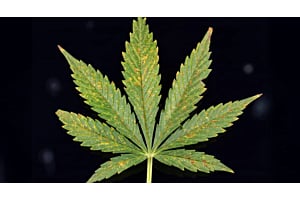
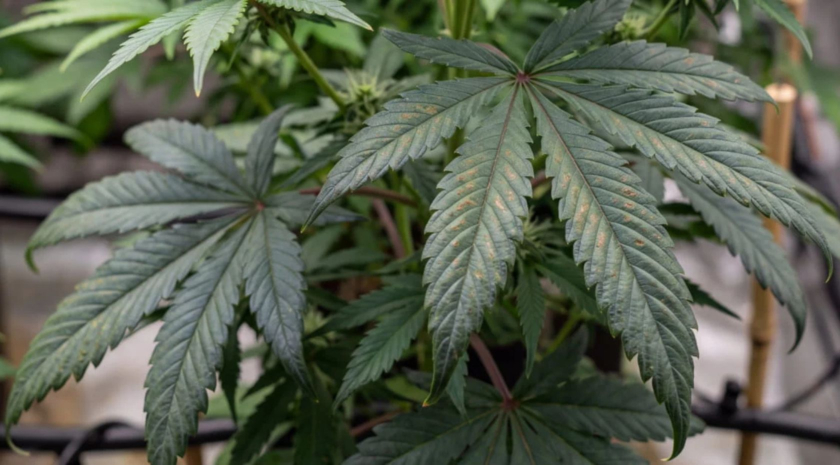
Dark, spotted lower leaves and reddening stems usually point to one thing: a cannabis phosphorus deficiency. Phosphorus (P) is the macronutrient your plants burn through fastest in flowering, so a shortage hits hardest as buds form. Left unchecked, a phosphorus deficiency in a weed plant can shrink bud size, resin and final yield.
The good news? With the right know-how, it’s quick to spot and fix. This guide covers:
- Early and late signs of a P deficiency.
- How to confirm phosphorus is the real culprit.
- The step-by-step fix, starting with pH.
- Ways to prevent a phosphorus shortage.
TL;DR: Phosphorus is mobile, so the lower, older leaves show it first, darkening to blue-green with bronze spots and stems that sometimes turn purplish-red. Rule out genetics and cold, then check root-zone pH. A lockout is often the real cause, not a true shortage.
What Does Phosphorus Do for Cannabis Plants?
Phosphorus drives root growth, energy transfer and bud formation in cannabis plants. It's one of the three main macronutrients, shown as the N-P-K numbers on your nutrient bottle, where P is the middle figure.
Weed plants lean on it hardest during flowering, when they're building dense buds. That's why a shortage tends to surface in bloom, right when it costs you the most.
What Are the Signs of a Cannabis Phosphorus Deficiency
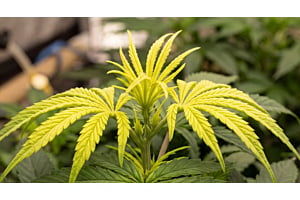
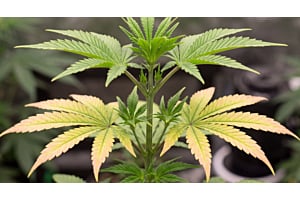
A cannabis phosphorus deficiency shows up on the lower, older leaves first. Phosphorus is mobile, so the plant pulls it from old growth to feed new growth, which is why a shortage appears at the bottom of the plant first. Here’s what to look for:
- Dark leaves and spots: the first and most reliable sign, showing on old growth.
- Purple or red stems: a real clue only when other symptoms back it up.
- Slow growth and lower yields: the knock-on effects that harm your harvest.
- Early vs late signs: visual symptoms that signal severity.
Dark Leaves and Brown or Bronze Spots
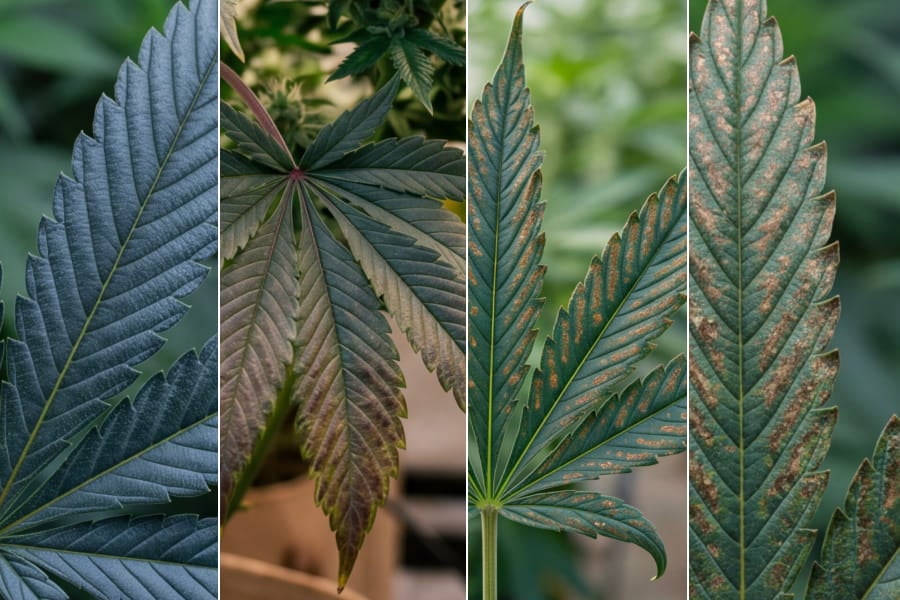
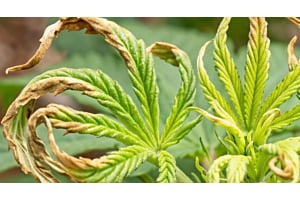
Three-stage progression of a phosphorus-deficient cannabis leaf.
Cannabis leaves darken to a deep green or blue-green before browning with bronze or purple spots. The edges can turn tan, curl downward and feel stiff or dry to the touch. Left alone, the damage spreads inward and the lowest leaves yellow, then die off.
Purple or Red Stems: Genetics, Light or Deficiency?
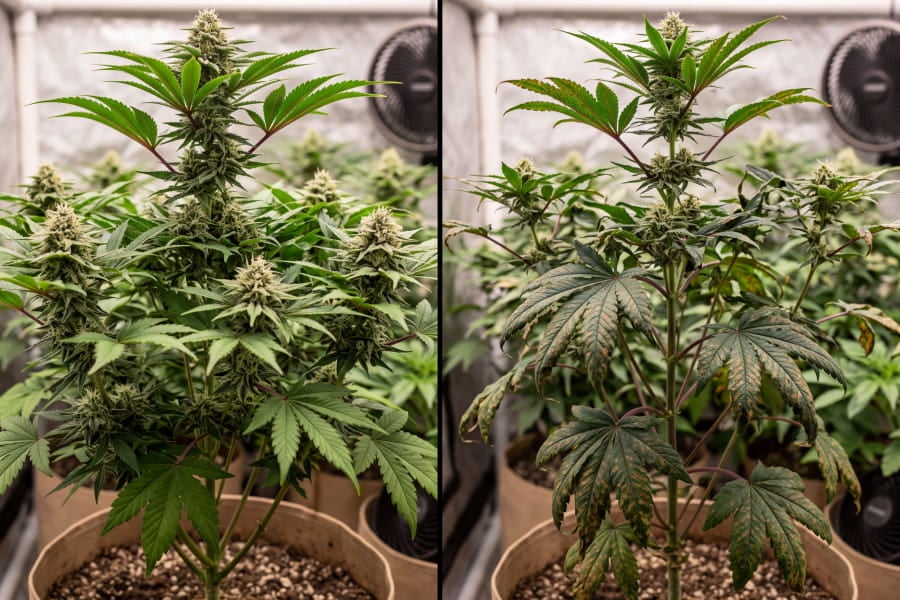
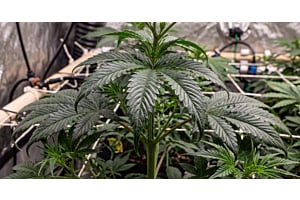
Side-by-side comparison of naturally purple cannabis stems versus true phosphorus-deficient stems.
Red or purple stems signal phosphorus deficiency only when other symptoms appear alongside them. On their own they prove nothing, because so many things cause them. Plenty of cannabis strains grow colored stems purely from genetics, and light exposure can redden them too.
Nitrogen, potassium and magnesium deficiencies also redden stems and petioles, so the color alone can't tell you which nutrient (if any) is short. If your plant looks healthy everywhere else, colored stems are almost certainly normal. Read them with other leaf symptoms and their position on the plant, never as proof by themselves.
Slow Growth, Stunting and Lower Yields
A phosphorus shortage slows the whole plant down, and that's where the real cost sits. Young cannabis plants stall out and stay smaller than healthy ones. In bloom, plants lean on phosphorus hardest, so a deficiency during flowering hits your harvest on both fronts.
Buds come in fewer and looser - and with less phosphorus driving flower development - resin and overall quality tend to suffer alongside the weight. Phosphorus lost during peak flower demand is yield you don't get back.
Early vs Late Phosphorus Deficiency Signs
A phosphorus shortage looks different depending on how far it's progressed. Here's what to watch for at each stage:
- Early signs: Slow, stunted growth and smaller-than-normal leaves. Lower, older leaves darkening to deep green or blue-green.
- Progressing signs: Dull blue or purple tints spreading across affected leaves. Bronze or brown spots, with tan leaf edges that curl downward and feel stiff. Red or purple stems and petioles (a supporting clue).
- Late signs: Damage climbing inward and upward as the lowest leaves yellow and die. Poor bud development and reduced yield in flowering.
How Do You Confirm a Cannabis Phosphorus Deficiency?
You confirm a cannabis phosphorus deficiency by reading the lower-leaf symptoms together, not any single sign alone. The most trustworthy signals are dark old-growth leaves with bronze spots, plus damage that starts low and climbs. This table ranks each sign by how reliably it points to phosphorus:
| Sign | Points to phosphorus deficiency | Points to another cause | Reliability |
| Dark blue-green lower leaves with bronze spots | Yes, the classic sign | Can overlap with calcium issues | High |
| Damage starting on old growth | Yes, phosphorus is mobile | New-growth damage suggests other nutrients | High |
| Downward-curling, stiff leaf edges | Supports it with the signs above | Overwatering can mimic it | Medium |
| Red or purple stems | Only with other symptoms | Genetics, lighting and other deficiencies | Low |
Read the high-reliability rows first. If they line up, you've likely found your problem. Once you've matched the signs, use this quick check to decide your next move:
| What you see | What it means | Confidence | What to do |
| Dark lower leaves, bronze spots and stunting together | Phosphorus deficiency is likely | Confirmed | Check pH, rule out cold, then feed |
| Purple stems only, plant otherwise healthy | Genetics or light, not phosphorus | Low | Leave it alone and keep watching |
| Dark spots but pH and temperature untested | Cause still unclear | Suspected | Test pH and root temperature first |
| Symptoms in flowering after heavy high-P feeding | Not a shortage | Confirmed lockout | Fix pH or flush |
When the cause is still fuzzy, test before you treat. Feeding blind usually makes things worse.
What Causes a Phosphorus Deficiency in Cannabis?
A cannabis phosphorus deficiency often comes down to an uptake problem rather than a true shortage, because most soils and quality nutrients already carry plenty of phosphorus. When symptoms show up, it pays to rule out lockout before assuming the mix is short. The trouble starts when something blocks your plant from taking it up. These are the usual causes:
- pH lockout: phosphorus uptake falls off sharply when your root-zone pH drifts out of range, and it's one of the most common causes. In soil, availability drops above 6.5; in coco or hydro the window is tighter still.
- Cold root zone: Marijuana plants struggle to absorb phosphorus when temperatures are below 50°F (10°C). Cold soil early in the season or a chilly grow space is a common trigger, and warming the roots often clears it without touching your feed.
- Nutrient imbalances: excess calcium or iron can bind phosphorus into forms the roots can't absorb, especially in soil. That means a heavy Cal-Mag or a high-iron source can leave phosphorus locked out even when it's present.
- Overwatering or root stress: waterlogged, compacted roots can't take nutrients up properly, so a deficiency can show even with phosphorus available. A constantly soggy medium also starves roots of oxygen and invites rot, which makes uptake even harder.
- Poor growing medium: compacted, heavy or low-quality soil restricts root growth and holds phosphorus where roots can't reach it. Fine, dense mixes with poor drainage make this worse. A light, well-aerated medium keeps roots spreading and feeding freely.
- Water quality: very hard water (high in calcium and carbonates) pushes root-zone pH up and can lock out phosphorus. It's an easy cause to miss because nothing looks wrong with the feed itself, so test your source water if deficiencies keep recurring.
How Do You Fix a Cannabis Phosphorus Deficiency?
You fix a cannabis phosphorus deficiency by correcting the cause first, then feeding phosphorus once uptake returns. Adding more phosphorus to a locked-out root zone only compounds issues, so order matters. Work these four steps in sequence:
- Step 1: Test and correct root-zone pH.
- Step 2: Rule out cold and root problems.
- Step 3: Feed your plant with phosphorus-rich nutrients.
- Step 4: Watch new growth for recovery.
Step 1:Test and Correct the Root Zone pH
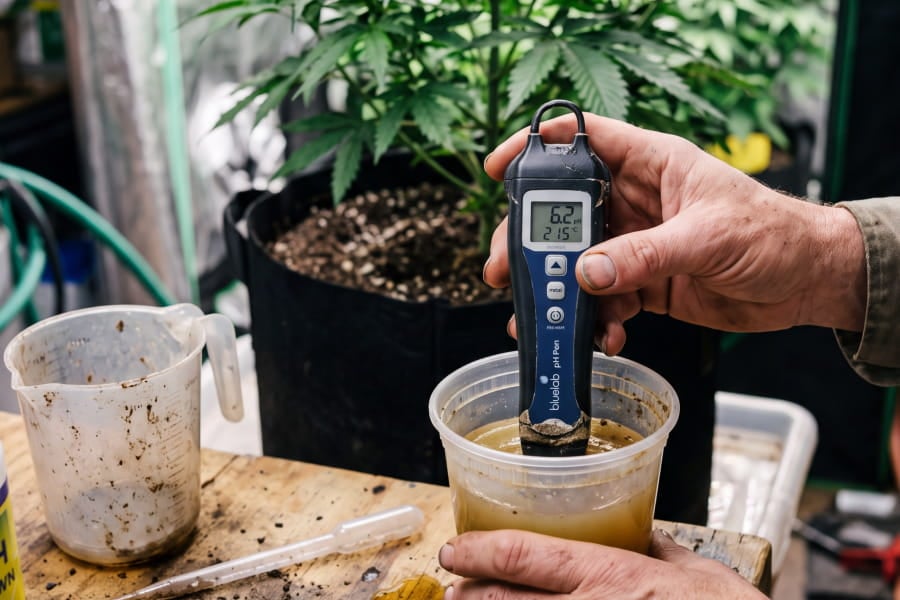
Grower testing root-zone pH with a pH pen.
Root-zone pH decides whether your plant can use the phosphorus that's already there, so it’s your starting point. Take a runoff or slurry reading with a calibrated pH meter. In soil, aim for a pH of 6.0-6.3 (5.5-6.5 is still workable). In coco or hydro, hold pH to 5.8-6.2 (5.6-6.4 is also acceptable).
That runoff sample gives you two numbers: pH flags a lockout, EC flags salt buildup. If the EC is running well above what you fed in, flush with clean, pH-balanced water until about 30% drains, then feed at the right pH. If only the pH is off, skip the flush and just correct it.
How you correct pH depends on your medium:
In living, organic soil the microbes hold pH where the plant wants it, so you generally don't pH your water or use pH Up and Down at all. If the soil itself has genuinely drifted, fix it at the source with amendments: garden lime to bring pH up, elemental sulfur to bring it down. Both act slowly, so give them time to work.
In coco, hydro, or soil you're feeding synthetic nutrients, you correct pH at the feed instead. Mix your nutrients into the water first, then adjust that solution with pH Up or pH Down until it lands on target before you water.
Step 2: Rule Out Cold and Root Problems
A cold root zone blocks phosphorus uptake even when your pH and nutrients are spot on. Below 50°F (10°C), your marijuana plant can barely pull phosphorus in. Warm the root zone with a heat mat or by lifting ambient temperatures, and keep it steady.
Check for overwatering and compacted or damaged roots too, since soggy, airless media block phosphorus uptake the same way. Sort these issues before touching your feed, they often solve the problem on their own.
Step 3: Feed Your Plant With Phosphorus-Rich Nutrients
Once uptake is restored, top up phosphorus. A water-soluble bloom-specific nutrient formula is high in phosphorus and acts fast, as does high-P guano. Rock phosphate and bone meal release slowly, so use them to amend the medium rather than rescue a plant mid-deficiency.
Start at the low end of the label rate. Piling on phosphorus risks nutrient burn and a harsh, chemical taste in the finished flower.
Step 4: Watch New Growth For Recovery Signs
The leaves already damaged won't green back up, so judge the fix by fresh growth instead. The phosphorus deficiency should stop spreading within 3-5 days, and healthy new leaves should come in within about a week. If symptoms persist or worsen, recheck pH and root temperature before adding anything more.
How to Prevent a Cannabis Phosphorus Deficiency
Prevention comes down to steady uptake and a balanced feed, not piling on extra phosphorus. Keep these in check:
- Hold pH in range. Test regularly and keep soil at 6.0-6.3 and coco or hydro at 5.8-6.2. Stable pH is the single best defense against lockout.
- Feed a complete bloom nutrient. Give flowering plants a formula with enough phosphorus for the stretch, and don't strip nitrogen too early, a little is needed for the plant to use phosphorus and potassium properly.
- Keep roots warm. Hold the root zone above 50°F (10°C) so cold never stalls uptake.
- Water correctly. Water before the medium fully dries out, once the top 1-2 inches (2.5- 5 cm) has lost some moisture, so roots stay healthy and aerated. Waterlogged roots can't take up phosphorus.
- Start with a good medium and amendments. In organic soil, mix in slow-release phosphorus like rock phosphate or bone meal at the outset so phosphorus supply lasts longer.
- Watch your water and EC. Test source water and monitor EC or TDS to catch salt buildup before it triggers a lockout.
Can You Give Cannabis Too Much Phosphorus?
Yes. It's hard to do by accident, but overfeeding phosphorus causes real problems, and most of them come from what it does to other nutrients. High phosphorus levels suppress the uptake of calcium, zinc and iron, leading to a range of additional issues.
The accompanying symptoms are often those lockouts showing up as new deficiencies, interveinal yellowing, pale new growth or spotting rather than a phosphorus problem itself.
Push levels high enough and your weed plant may even show signs of nutrient burn: dark, clawing leaves and burnt tips. On top of that, excess phosphorus can leave a chemical or metallic taste in your finished flower.
This is why phosphorus is one to correct carefully, not boost by default. Add more only when you've confirmed a genuine deficiency, and remember the usual problem is too little uptake, not too little phosphorus in the mix.
Phosphorus Deficiency vs Other Deficiencies
Phosphorus works alongside nitrogen, potassium, calcium and magnesium in cannabis plants. Shortages of any of these nutrients can produce the same dark leaves or reddened stems — symptoms easily mistaken for a phosphorus deficiency.
Potassium is the closest mimic, with nitrogen and magnesium not far behind. The tell is the sign’s position on the plant and the exact leaf pattern. Use the table below to place a symptom before you treat it:
| Deficiency | Where it appears | Signature symptom | How it differs from phosphorus |
| Phosphorus Deficiency | Lower, older leaves | Dark blue-green leaves, bronze/brown spots and red-purple stems | Baseline |
| Potassium Deficiency | Lower, older leaves | Browning leaf tips with necrotic spots, red-yellow interveinal mottling and red stems | Leaf edges (not the whole leaf) show signs first |
| Nitrogen Deficiency | Lower, older leaves | Even pale yellowing, red-purple stem tinge and sparse growth | Leaves go pale yellow rather than dark bluish green |
| Magnesium Deficiency | Lower to middle leaves | Yellowing between green veins, purple stems and crispy leaf edges | Interveinal yellowing on leaves instead of darkening leaves |
| Calcium Deficiency | New, upper growth | Tan necrotic blotches on new leaves, twisted shoots and weak stems | Affects new upper growth first instead of older, lower growth |
Knowing which nutrient is short, and where on the plant to look, saves you from treating the wrong thing.
How Seed Choice Affects Cannabis Plant Resilience
Strong genetics give your plants more headroom to shrug off feeding swings and bounce back after a corrected deficiency. Some cultivars use more phosphorus or handle stress better than others.
Starting with top-shelf marijuana seeds sets your grow up with that baseline vigor. Feminized weed seeds take seed-sex guesswork off the table, so you can focus on pH and feeding. With autoflower seeds racing through a short cycle, catching a deficiency early matters even more.
Always check your federal, state and local rules before buying or growing any cannabis seeds.