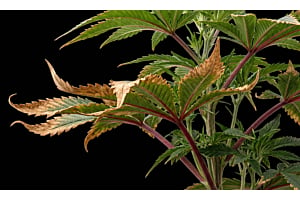
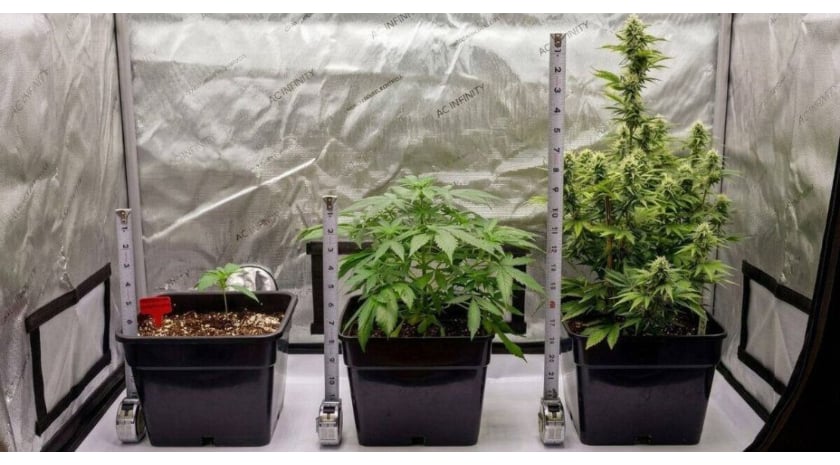
Autoflower week-by-week pictures are the fastest way to check whether your plant is on track, because autoflowers finish from seed to harvest in roughly 7-12 weeks (most strains land at 9-10) and every week brings a visible change. This guide walks through each stage from germination through harvest, with healthy size ranges, the signals that tell you when autoflowers start flowering and when buds fatten.
By the end you will know what a 1-week, 3-week, 6-week and 2-month old autoflower should look like, how to tell if your plant is stunted or behind schedule, and what to do about a small or stunted autoflower while there is still time to recover.
How Long Does an Autoflower Take From Seed to Harvest?
Autoflower cannabis plants finish their full life cycle in 7-12 weeks from germination, with most strains landing between 9 and 10 weeks. The slowest sativa-leaning varieties can stretch to 13-14 weeks. The cycle starts the day your autoflower cannabis seeds break the soil and ends at harvest.
The exact timing depends heavily on genetics and growing conditions, with stress, low light levels, or inconsistent watering often extending the cycle, while optimal environments with stable feeding and strong lighting can help plants finish toward the shorter end of the range.
That window covers seven visible stages: germination, seedling, vegetative growth, pre-flower, flowering, ripening and harvest. Autoflower plants move through every stage on an age-based schedule, not a light-based one, because ruderalis genetics inside the seed trigger flowering by plant age instead of by a change in the light cycle.
Autoflower Week by Week Pictures: Full Life Cycle
Autoflower cannabis plants move through germination, seedling, vegetative growth, pre-flower, flowering, ripening and harvest in roughly 9 to 10 weeks. Each week brings visible changes you can match against the pictures below.
- Week 1: Germination and seedling break
- Week 2: Late seedling and first true leaves
- Week 3: Early vegetative growth
- Week 4: Late vegetative growth and pre-flower signs
- Week 5: Pre-flower and stretch
- Week 6: Early flowering and bud sites form
- Week 7: Mid flowering and bud weight
- Week 8: Late flowering and resin build
- Week 9: Ripening and pistil shift
- Week 10: Harvest window opens
- Week 11: Flush and final ripening for late strains
- Week 12: Late-strain harvest
Week 1: Autoflower Seedling Stage
Week 1 autoflower seedlings break the soil 1-5 days after germination, then push the first round cotyledon leaves up toward the light. Cotyledons are the two smooth, oval-shaped embryonic leaves the seed carries inside its shell, and they feed the plant until true leaves take over.
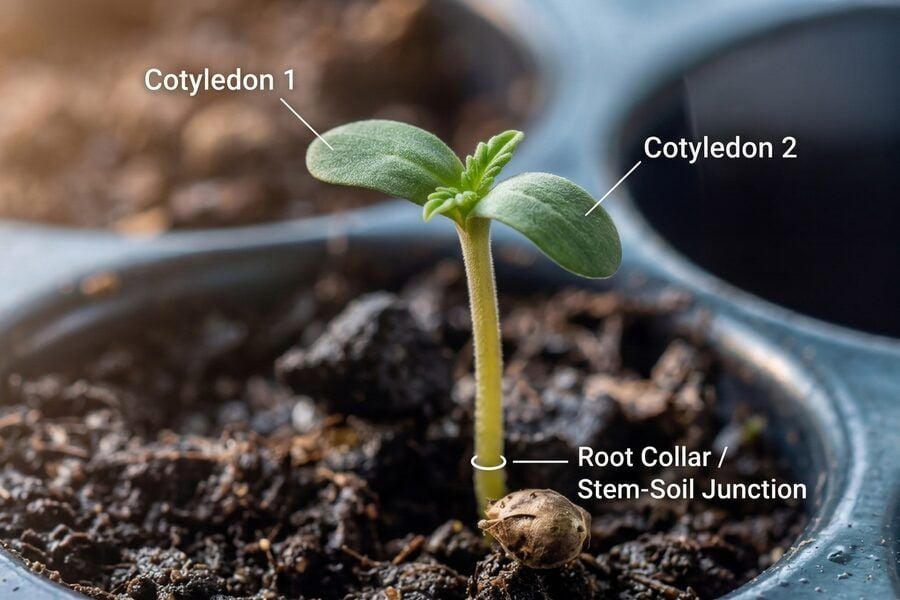
A healthy Week 1 autoflower seedling shows two smooth oval cotyledons and a short, sturdy stem
The seedling is fragile in this first week. Keep the soil damp but not wet, hold light close enough to prevent stretch but far enough to avoid heat stress, and skip nutrients entirely because the cotyledons supply everything the plant needs.
Week 2: Late Seedling and Early Veg
Week 2 autoflower plants form the first set of serrated true leaves and shift from cotyledon energy to early photosynthesis. The true leaves carry the classic cannabis blade shape, usually with one or three points on this first set.
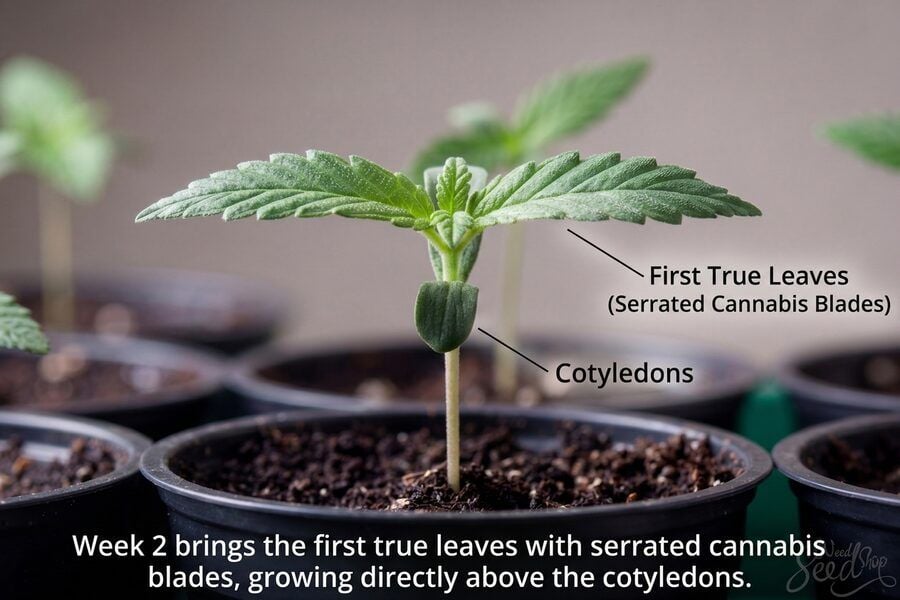
The plant stands roughly 2-4 inches tall by the end of the week. Some growers introduce a light feed at a quarter strength now, but autoflowers do well on plain water for another few days because their root mass is still small.
Week 3: Early Vegetative Growth
Week 3 autoflower plants stand around 4-6 inches tall, push 2-3 sets of fan leaves, and start spreading the root mass. The blade count climbs from three to five to seven across each new fan leaf set.
Growth speeds up sharply this week because the root zone catches up to the canopy. The plant takes regular light feeding now, with humidity around 55-65% supporting steady leaf expansion.
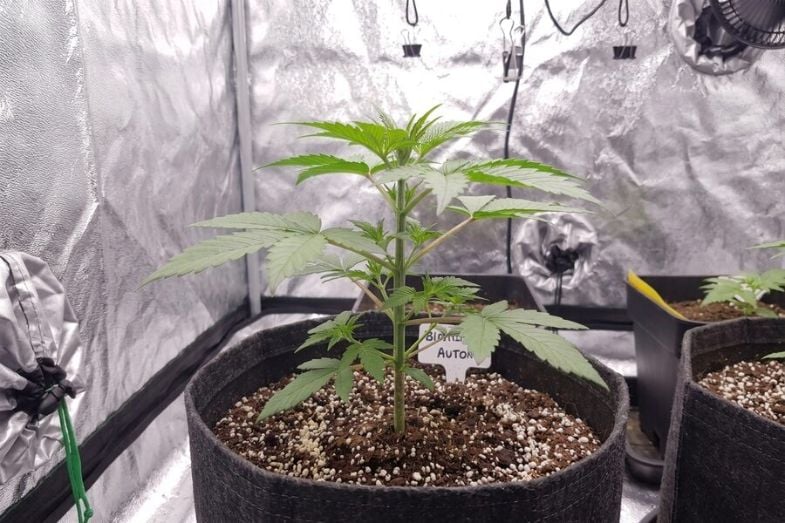
A healthy Week 3 autoflower stands 4 to 6 inches tall with two to three sets of fan leaves and tight node spacing.
Week 4: Late Veg and First Pre-Flower Signs
Week 4 autoflower plants double in size, fill the canopy with fan leaves, and often show the first pre-flower hairs at the nodes. The nodes are the joints where branches and leaves meet the main stem, and pre-flower hairs are the early white pistils that mark the start of the flowering transition.
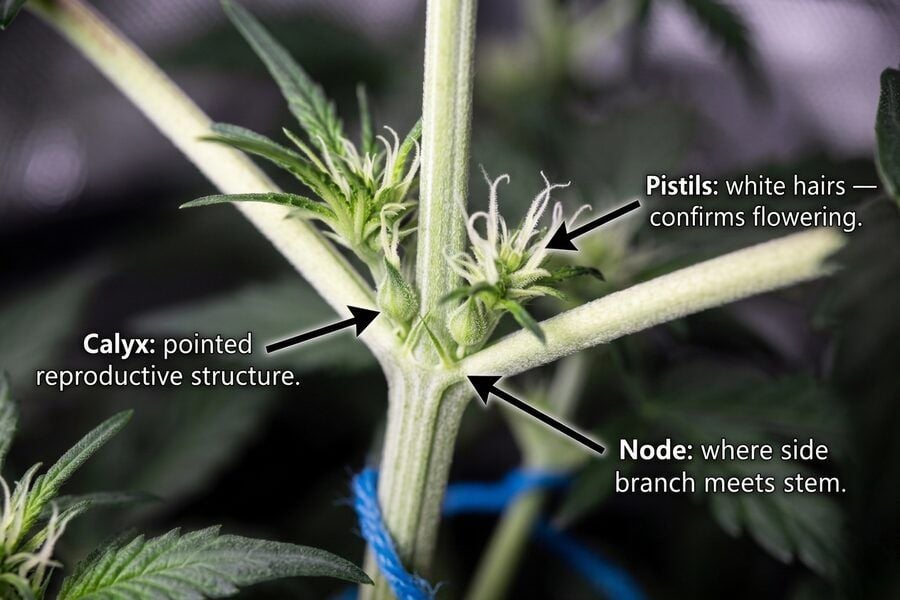
Week 4 often brings the first pre-flower hairs at the nodes, the white pistils that mark the start of the flowering transition.
Some growers begin low-stress training this week, gently bending the main stem to spread the canopy and even out light exposure. By the end of week 4 the plant runs 6-10 inches tall and may begin to give off a faint cannabis smell, depending on the strain.
Week 5: Pre-Flower and Stretch
Week 5 autoflower plants enter pre-flower in earnest, with white pistils sprouting at most nodes and the stem stretching to set future bud sites. The stretch can add 30-50% to the plant's height across this week and the next.
Pistil clusters form at every internode. The leaves stay green and healthy, the smell sharpens, and the plant shifts its energy from new leaf growth to flower preparation. Stop low-stress training by the end of the week because the plant needs that energy for the next phase.
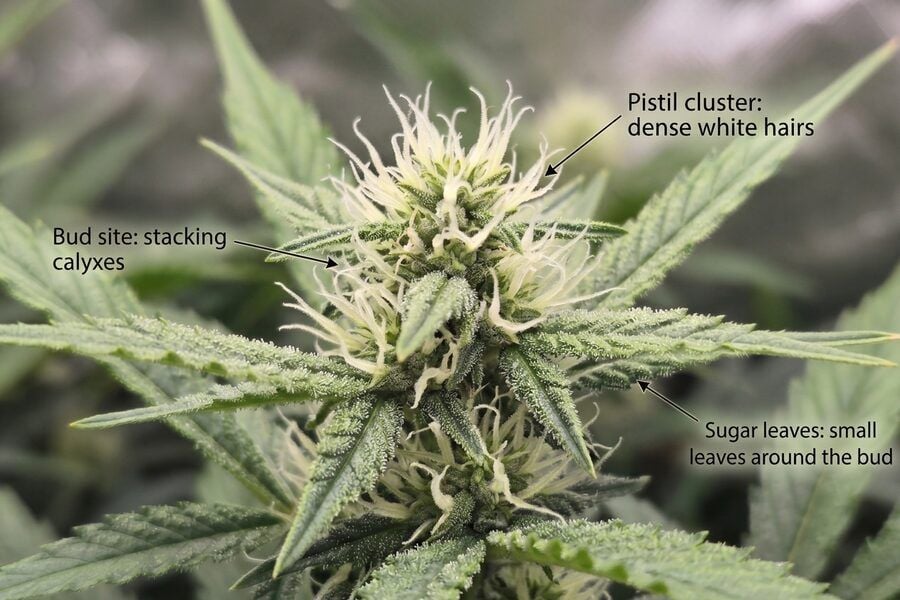
Week 5 fills the nodes with white pistil clusters as the plant stretches and sets up its future bud sites.
Week 6: Early Flowering and Bud Sites
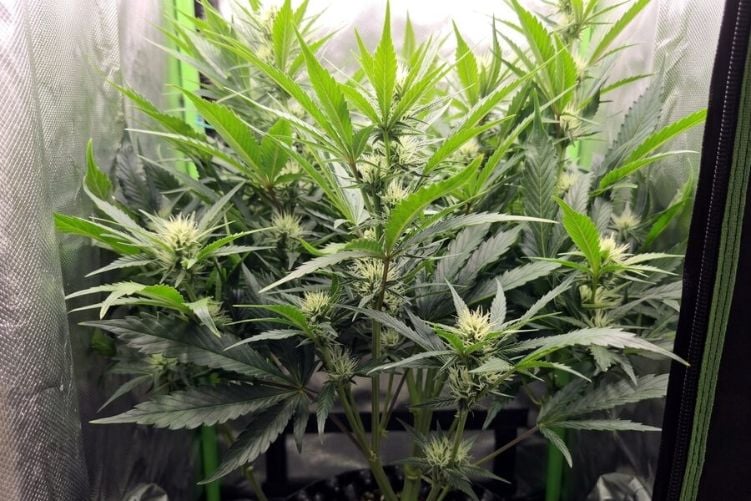
Week 6 forms the first true bud sites, where pistils cluster around the swelling calyx that will become the finished nug.
Week 6 autoflower plants form the first true bud sites where pistils cluster around the calyx, and the smell starts to develop. A calyx is the small teardrop-shaped sac at the base of each pistil, and the calyx is the structural building block that eventually swells into a finished bud.
The plant slows its vertical growth and turns its energy toward flower production. Many growers shift to a flowering nutrient mix this week, with higher phosphorus and potassium and lower nitrogen to match what the plant now uses.
Week 7: Mid Flowering and Bud Weight
Week 7 autoflower plants pack on bud weight, with calyxes swelling and trichomes coating the sugar leaves. Trichomes are the tiny resin-producing glands on the surface of the buds and surrounding leaves, and they look like a fine frost or sugar dusting at this stage.
Bud sites along the main cola merge into longer flower clusters. The smell strengthens, the pistils still run mostly white, and the plant drinks more water as the flowers expand.
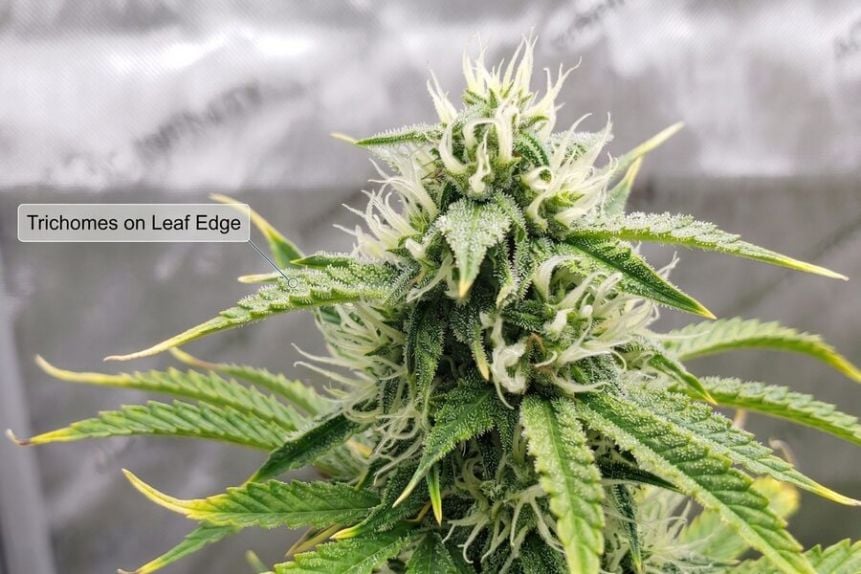
Week 7 packs on bud weight as calyxes swell, flowers merge along the cola and trichomes start to frost the sugar leaves
Week 8: Late Flowering and Resin Build
Week 8 autoflower plants thicken the cola, build trichome resin across the buds, and start to shift pistil color from white to amber. The cola is the main flower formation at the top of the plant and side branches, and the cola carries most of the harvest weight.
Resin production peaks across this week and the next. Some pistils curl inward and darken to a reddish-orange, the smell hits its strongest point, and the plant starts to yellow on the lower fan leaves as it moves mobile nutrients from those leaves into the developing flowers.
Week 9: Ripening and Pistil Shift
Week 9 autoflower plants ripen, with 50-70% of pistils turning amber and trichomes shifting from clear to milky. A milky trichome looks cloudy rather than glass-clear under a magnifier, and milky trichomes signal peak cannabinoid expression.
Fan leaves yellow further as the plant finishes its nutrient cycle. Many growers begin flushing with plain water this week to clear residual salts from the root zone. Flushing is a contested practice with limited research support, and some growers prefer to taper nutrients gradually rather than flush. Both approaches are widely used, though.
Week 10: Harvest Window Opens
Week 10 autoflower plants reach the harvest window for most strains, with milky trichomes, amber pistils and yellowing fan leaves signaling peak ripeness. Pull the plant when the trichome mix sits at roughly 70% milky and 30% amber, the traditional starting point. Harvesting earlier in the milky window favors a clearer, more cerebral profile, and waiting for heavier amber shifts toward a more sedating effect.
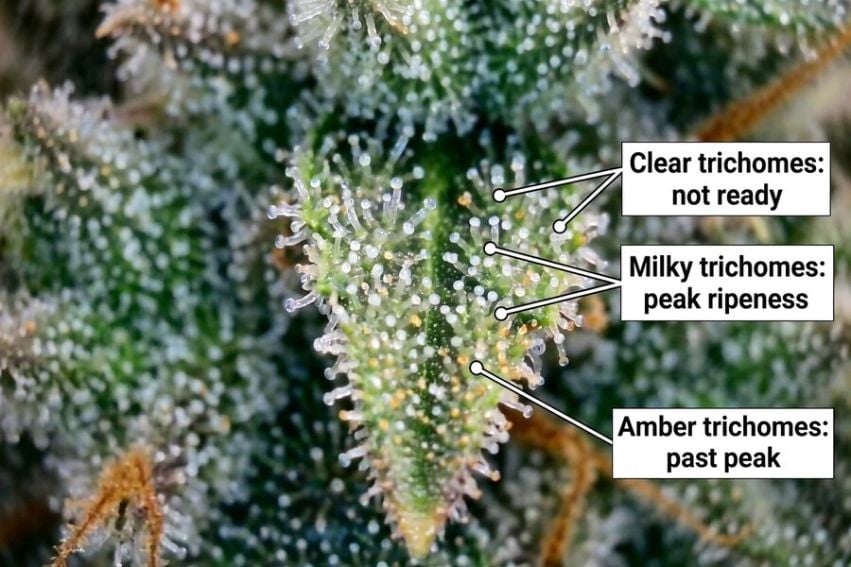
Week 10 trichomes run mostly milky with the first amber appearing, the visual cue most autoflower growers use to call harvest.
A jeweler's loupe or USB microscope helps read trichome color accurately. Cut the main stem, hang the plant upside down in a dark, ventilated space, and let the drying phase start.
Week 11: Flush and Final Ripening
Week 11 autoflower plants on a longer timeline finish ripening, with growers flushing plain water through the root zone to clear residual nutrients. Plants that didn't reach the trichome target in week 10 use this extra week to deepen amber coverage and finish swelling the late bud sites.
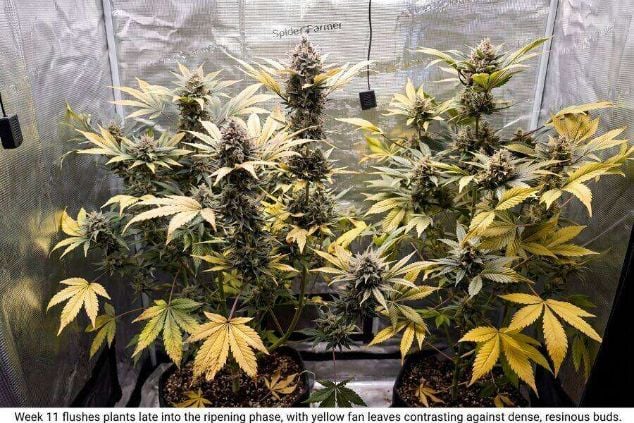
Late-finishing strains like Amnesia Haze Auto, Durban Poison Auto, and some Sour Diesel autoflower phenotypes routinely use week 11 to come into full ripeness. The fan leaves yellow heavily, the smell starts to drop slightly, and the trichome mix moves further toward amber.
Week 12: Late-Strain Harvest
Week 12 autoflower plants reach harvest for late-finishing strains, with trichomes split between milky and amber and pistils mostly brown. The 12-week mark is the outer edge of the autoflower window, so most plants harvested here come from sativa-heavy genetics.
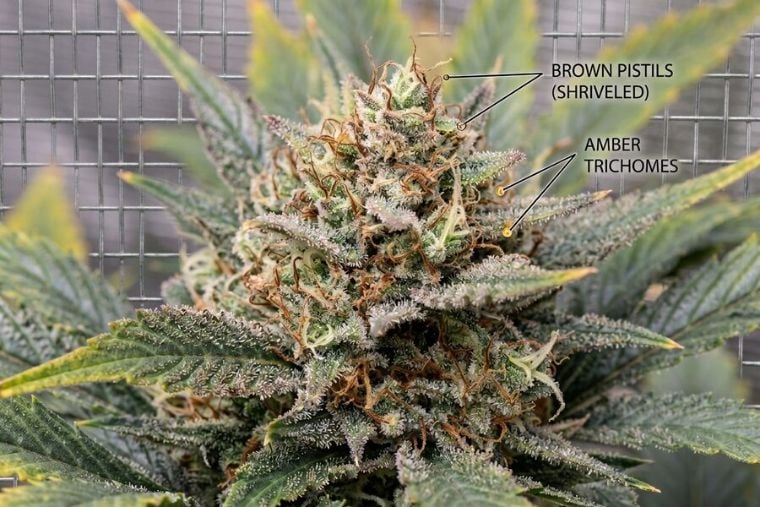
Week 12 brings final harvest for late-strain autoflowers, with brown pistils and a milky-to-amber trichome mix.
Cut, dry and cure exactly the same way as a week 10 harvest. Dry over 7-10 days in a cool, dark space, then cure in glass jars. Burp the jars once a day during week one, 2-3 times a week during week 2, and once a week from week 3 onward.
When Do Autoflowers Start Flowering?
Autoflowers start flowering between week 4 and week 5 from germination, triggered by plant age rather than a change in the light schedule. Pre-flower hairs appear at the nodes first, then pistil clusters form, then the plant moves into early bud development by week 6.
Modern autoflower seeds carry ruderalis genetics crossed with indica or sativa lineage, so the plant flowers automatically on an 18/6, 20/4 or even 24-hour light schedule without any cycle flip. Ruderalis is the wild cannabis subspecies that originated along the Volga River in southern Siberia and evolved to flower by age rather than by light cycle, an adaptation to the region's short summers.
When Do Autoflowers Fatten Up and Pack on Bud Weight?
Autoflower buds fatten up between week 6 and week 8, when calyxes swell, trichomes thicken and the cola structure takes its final shape. Most weight comes on across this 3-week window, with week 7 typically driving the heaviest gain.
Higher phosphorus and potassium support the swell because the plant uses both minerals heavily during flower formation. Reported bud weight depends on strain genetics, growing environment and lawful cultivation conditions, so the same strain can fatten differently from one grow to the next.
How Big Should a Healthy Autoflower Be at Each Stage?
Depending on strain genetics, a healthy autoflower stands roughly:
- 2-4 inches at week 2
- 6-10 inches at week 4
- 12-18 inches at week 6
- 18-30 inches at harvest
Indica-leaning autoflowers like Northern Lights Auto and Blueberry Auto typically finish shorter, while sativa-heavy autoflowers like Amnesia Haze Auto and Durban Poison Auto stretch taller during pre-flower and week 5.
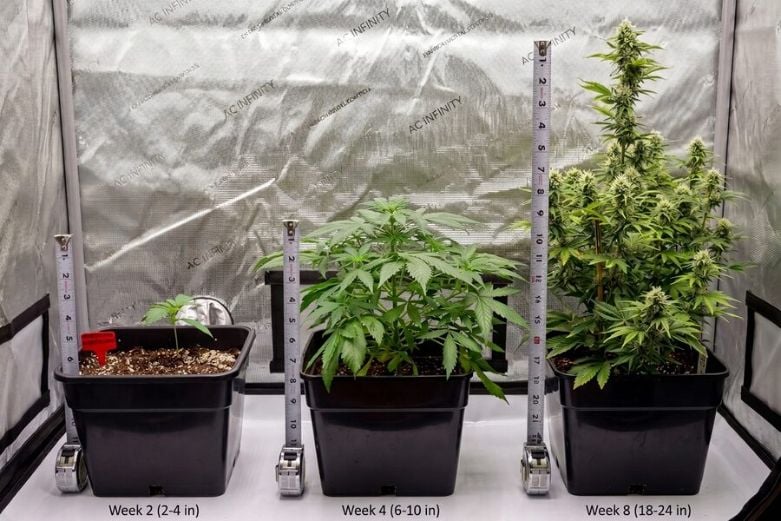
Most autoflower plants stop adding height around week 6 or week 7, when flowering takes over from the stretch phase. Growers chasing taller plants and heavier bud weight often pick high yield cannabis seeds bred for size and density.
Why is My Autoflower So Small or Stunted?
An autoflowering cannabis plant is stunted when it lags two or more weeks behind the size reference for its age, with pale leaves, stalled node spacing and visibly slower growth. Most cases trace back to weak light, root-zone problems, overwatering, nutrient burn or early transplant stress. Healthy auto plants can also be small due to their genetics.
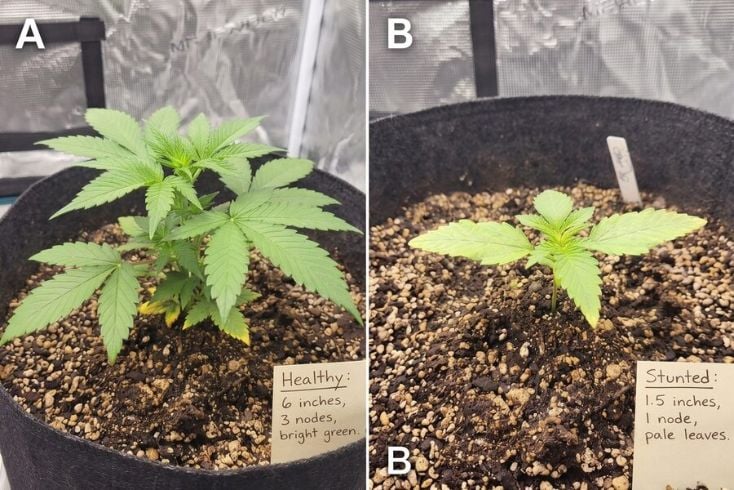
Stunted seedlings can often recover. Plants stunted in flowering rarely catch up. This section covers three things:
- The most common causes of stunting
- The visual signals that confirm it
- And what recovery looks like depending on when the stress hit.
Common Causes of a Stunted Autoflower
The common causes of a stunted autoflower include weak light, an over-sized or compacted root zone, overwatering, excess nutrients, or transplant stress in the first two weeks. Each cause leaves a different visible signal, so the fix depends on the signal:
- Weak light produces a tall, leggy stem with wide gaps between nodes and small pale leaves.
- An over-sized pot can drown a young seedling because the unused soil holds too much water for the small root mass.
- Nutrient burn shows up as yellow or brown leaf tips that creep inward.
- Transplant stress freezes growth for 5 to 10 days while the roots recover.
How to Tell If Your Autoflower is Stunted
An autoflower is stunted when it lags two or more weeks behind the size reference for its age. The signals below help confirm what you are seeing:
| Signal | Healthy autoflower | Stunted autoflower | Reliability |
| Height at Week 3 | 4 to 6 inches | Under 2 inches | High |
| Leaf color at Week 3 | Bright green | Pale yellow or purple | High |
| Node spacing | Tight and even | Wide gaps or stalled | Medium |
| New leaf size | Steady increase | Same size for 7+ days | High |
| Root visible at pot drain | White and fine | Brown, none or root-bound | Medium |
Can a Stunted Autoflower Recover?
Yes, a stunted autoflower can recover when the root cause is fixed in the seedling or early veg stage, but the final yield usually comes in smaller than a healthy plant. Recovery depends on how early the stress hit and how quickly the cause is corrected.
Plants stunted in week 1 or week 2 catch up well because the auto trigger has not started flowering yet. Plants stunted after week 4 finish small because the genetic age clock keeps moving toward flower whether the plant is ready or not.
Growers who lost a plant to early stunting often start the next grow with the best cannabis seeds for beginners, which tend to forgive watering and lighting mistakes during the first two weeks.
How Strain Genetics Shift the Autoflower Timeline
Strain genetics shift the autoflower timeline by 1-3 weeks, with indica-leaning autoflowers like Northern Lights Auto finishing closer to 8 weeks and sativa-heavy autoflowers like Amnesia Haze Auto pushing past 11 weeks. The ruderalis trigger is consistent across strains, but the indica or sativa parent decides how long the plant stays in flower before ripening.
From the angle of the week-by-week timeline, the strains in this niche group into three finish windows:
- Indica-fast finishers like Northern Lights Auto and Blueberry Auto typically wrap by week 8 or week 9.
- Balanced hybrid autoflowers like Bruce Banner Auto, White Widow Auto, Wedding Cake Auto, Zkittlez Auto, and OG Kush Auto usually finish between week 9 and week 10.
- Sativa-leaning long finishers like Amnesia Haze Auto, Durban Poison Auto and Sour Diesel Auto run from week 10 to week 12.
Indoor vs Outdoor Autoflower Week by Week
Indoor autoflowers follow the same 9-10 week timeline as outdoor autoflowers, but outdoor plants face slower seedling growth in cold soil and faster vegetative growth once temperatures climb. The week 1-3 visuals can shift by 4-7 days outdoors because soil temperature controls the seedling pace.
Indoor autoflowers run on a controlled 18/6 or 20/4 light cycle, steady humidity and steady temperature, so they finish more predictably. Outdoor autoflowers face weather pressure during week 6-9 because heavy rain at flowering can trigger bud rot in dense colas.
How Autoflower Seed Choice Shapes the 12-Week Cycle
Autoflower seed choice shapes the 12-week cycle from day one because the seed carries the ruderalis genetics that trigger flowering by age and the strain genetics that set height, stretch and harvest weight.
Every autoflower timeline starts at the seed, and the marijuana seeds for sale at any reputable U.S. seed bank fall into a few main categories that change what the next 9 weeks will look like.
Buyers weighing autoflower vs feminized seeds usually land on autoflowers when they want a shorter, predictable timeline. Most autoflower cannabis seeds sold today are also feminized weed seeds, which means the plant will almost always grow female and omit the sexing step.
Skipping the male vs female weed plant check is one of the workflow shortcuts feminized autoflower seeds give a grower (for eligible adult buyers where cultivation is lawful, of course).
Autoflower Week by Week FAQs
Autoflower week by week questions cluster around timing, sizing, flowering triggers and recovery from stress, so here are short answers to the ones not already covered above.
When Do Autoflowers Stop Growing in Height?
Autoflowers stop adding height around week 6 or week 7, when flowering takes over from the stretch phase. Most plants gain their final 30-50% of height between week 4 and week 6 during pre-flower stretch.
What Does Week 1 of an Autoflower Look Like?
Week 1 of an autoflower looks like a tiny sprout with two smooth oval cotyledon leaves, a short stem and no true leaves yet. The seedling stands roughly half an inch to one inch tall by the end of the week and shows no pistils, branches or fan leaves.
How Long is the Autoflower Flowering Stage?
The autoflower flowering stage runs roughly 5-7 weeks, from pre-flower at week 4 or week 5 to harvest at week 9 or week 10. Pre-flower covers the first two weeks, mid-flower and bud build covers the next 2-3 weeks, and ripening closes out the final two weeks.
How Often Should You Water Autoflowers Week by Week?
Watering autoflowers week by week shifts with plant size and root depth, not a fixed schedule. Week 1 and week 2 seedlings need only a small spray or 2-3 fl oz every 2-3 days. Week 3-5 plants take 1-2 cups every 1-2 days as roots fill the container. From week 6 onward, most plants drink 2-4 cups daily in flower, and the pot should feel light before each water.
Can You Grow Autoflowers Outdoors Year-Round?
No, most U.S. climates limit outdoor autoflower grows to the warmer months because cold soil slows seedling growth and frost ends the cycle. Growers in mild-winter regions like southern California, Florida and parts of the Gulf Coast can run autoflowers across more months of the year, where outdoor cultivation is lawful.