The main types of cannabis seeds are feminized seeds, autoflower seeds, regular seeds, photoperiod seeds and fast-flowering seeds. Each type reflects a different breeding attribute: sex probability, flowering behavior, growing timeline and best-use fit for the grower.
- Feminized seeds are bred to produce female plants.
- Autoflower seeds flower based on age rather than a light-cycle change.
- Regular seeds can grow into male or female plants.
- Photoperiod seeds flower when the light schedule shifts.
- Fast-flowering seeds target a shorter bloom window and aren't always autoflower.
Compare cannabis seeds by type to see which cultivars are available in each category.
Check local laws before germinating or growing cannabis seeds, as cultivation rules vary by location. If you're newer to the process, check out the best weed seeds for beginners - it’s a helpful starting point.
What Are Cannabis Seed Types?
Cannabis seed types are classified into distinct categories based on specific inherited traits, including sex probability, flowering behavior, growth timeline, breeding purpose and indoor or outdoor fit. Each category tells you what kind of plant behavior to expect before you ever put a seed in the ground.
Seed type and strain type aren't the same thing. "Feminized" describes sex probability, while "indica" or "sativa" describes genetic or growth classification. A single strain can exist as a feminized, autoflower or regular seed depending on how the breeder developed it, so those are separate decisions to consider when you’re choosing cannabis seeds.
Choosing a seed type before germination is important because it determines the growth structure you'll be working with. Whether you'll manage light schedules, monitor plant sex or plan around age-based timelines all depends on the type you select.
The seed type shapes everything that follows as you learn about growing marijuana, so getting that decision right before you start matters.
Different Types of Weed Seeds Explained
The different types of weed seeds are feminized seeds, autoflower seeds, regular seeds, photoperiod seeds and fast-flowering seeds. Each type reflects a different inherited attribute that shapes flowering behavior, plant sex and the level of management you'll take on during the grow:
| Seed Type | Main Attribute | Best For | Main Advantage | Main Limitation |
| Feminized | 99% Female-plant probability | Flower production | Fewer male plants | Not ideal for breeding |
| Autoflower | Flowers by age | Fast harvests / beginners | No light-cycle switch needed | Less control over veg time |
| Regular | Male or female plants | Breeding / pheno hunting | Natural male/female variation | Requires sexing plants |
| Photoperiod | Flowers by light cycle | Growers who want control | Longer veg control | Needs light-cycle management |
| Fast-flowering | Shorter bloom period | Faster photoperiod harvests | Quicker flower cycle | Needs light-cycle management |
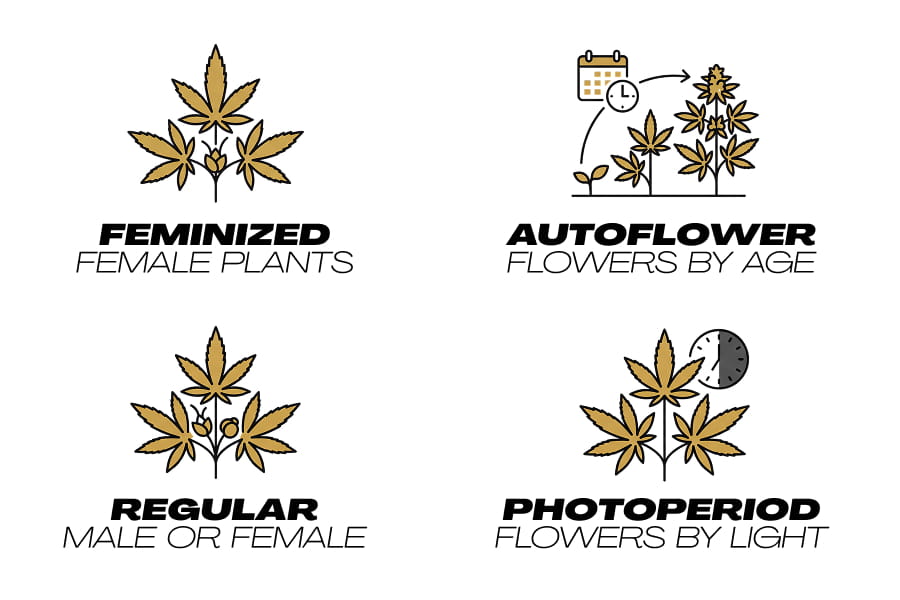
Infographic comparing cannabis seed types - feminized, autoflower, regular, and photoperiod.
Growers focused on bud production often choose feminized cannabis seeds. Those who want plants that flower by age choose autoflower cannabis seeds. Breeders and pheno hunters working with natural male and female outcomes use regular cannabis seeds.
Photoperiod seeds depend on light-cycle changes to begin flowering, which appeals to growers who want more control over plant development before the flower stage starts. As for fast-flowering seeds, these suit growers with shorter seasons or those who want quicker harvests.
Feminized Seeds: Female-Plant Genetics for Flower Production
Feminized seeds are bred to produce female cannabis plants, which are the plants that develop the cannabinoid-rich flower most growers are working toward.
The ‘feminized’ label comes from breeding genetics, not seed appearance. A female weed seed can't be identified as feminized just by looking at it. Sex probability is inherited from how the parent plants were crossed, and plant sex doesn't express until the plant is actively growing.
That’s why male vs female cannabis plants are only identifiable once the plant starts forming pre-flowers.
Feminized seeds virtually eliminate the need to identify and remove male plants mid-grow, but they aren't guaranteed to produce 100% female plants every time. In rare cases a male or hermaphrodite can still appear, so it's worth keeping an eye on your plants through to the flowering stage.
For the vast majority of grows, though, female seeds mean you're working with an all-but-guaranteed female crop from the start.
If you’re still deciding between fem and auto seed types, our guide on autoflowering vs feminized cannabis seeds covers the differences in sex probability and flowering behavior.
Autoflower Seeds: Day-Neutral Seeds for Faster Harvests
Autoflower seeds carry genetics that trigger flowering based on age, not on changes to the light schedule. This behavior traces back to ruderalis genetics, a cannabis subspecies native to mountainous Russia. The result is a plant that enters its flower cycle automatically once it reaches a specific stage of maturity.
That automatic trigger is a big part of why autoflower seeds are one of the most popular starting points for beginner growers. There's no light-cycle switch to manage, which removes one of the more technical elements of the grow process.
Because autoflowers run on a fixed timeline, they don't have the recovery time to bounce back from high-stress techniques the way a photoperiod plant can, and vegetative time isn't something you control either. Plants typically stay more compact as a result.
It's a straightforward trade-off: A simpler grow with a shorter grow cycle, smaller plants and less management overall. The upside is that autos can grow at any time of the year in ideal conditions — great for running multiple harvests in a single grow season.
For growers choosing between feminized and autoflower types, our guide on autoflowering vs feminized cannabis seeds covers how sex probability and flowering behavior differ as a decision factor. A breakdown of how age-based flowering compares to light-cycle control is also available in our guide on photoperiod vs autoflowering cannabis.
Regular Seeds: Male-or-Female Seeds for Breeding and Selection
Regular cannabis seeds can produce either male or female plants, making them the type most associated with breeding and phenotype selection. They preserve the natural male-to-female variation that breeders use to develop new cultivars, cross plants and work toward specific genetic outcomes.
Regular cannabis seeds suit growers who want to work with unmodified male-female genetics rather than breeding-altered sex probability.
Because regular seeds produce male plants alongside females, growers using them need to identify plant sex after the vegetative stage begins. Male cannabis plants that share a grow space with females will seed the buds, which most flower-focused growers want to avoid (since it diminishes final harvest weight and quality).
Our guide on male vs female cannabis plants covers how to identify plant sex once the plant starts developing. Yield-focused growers who don't want to sort plants by sex often choose feminized cannabis seeds instead. Feminized types are bred to greatly reduce the likelihood of male plants across the grow.
Photoperiod Seeds: Light-Cycle Dependent Flowering
Photoperiod seeds produce plants that begin flowering when the light schedule shifts to a 12-hour-on, 12-hour-off cycle. The plant's flowering response depends on the extended dark period, not just total light exposure.
Autoflower plants transition based on age, while photoperiod plants stay in the vegetative stage until the light schedule changes. That distinction gives indoor photoperiod growers more control over plant size and vegetative duration before flowering begins.
Growers who want to train plants, run longer veg periods or maximize plant size before triggering the flowering stage often prefer photoperiod seeds.
A detailed comparison of how light-cycle flowering and age-based flowering differ is available in our guide on photoperiod vs autoflower cannabis. Light-cycle management is also a core part of the broader cannabis grow process, connecting seed type choice to every stage that follows.
Fast-Flowering Seeds: Shorter Bloom Windows for Quicker Harvests
Fast-flowering seeds are bred to complete the flowering stage in less time than a standard variety. They typically reduce the total bloom window by 1-3 weeks, but the term covers more than one seed type depending on how a seed bank classifies them.
The most common use of the ‘fast-flowering’ label refers to photoperiod seeds bred for a shorter bloom window. These plants still need a light-cycle change to initiate flowering - they just spend fewer weeks in flower once that switch happens.
That said, some seed banks also classify autoflowering varieties under the fast-flowering label, since their seed-to-harvest timelines are naturally shorter. Whether a fast-flowering seed is photoperiod or autoflowering depends on how the breeder or seed bank has categorized it, so it's worth checking the product details before assuming one or the other.
Photoperiodic fast-flowering seeds appeal to growers who want quicker harvests without necessarily switching to autoflowers. They sit between standard photoperiod timelines and the shorter cycles typical of autoflowers. For growers focused on harvest timing, comparing fast-flowering and autoflower seeds side by side can clarify which approach fits better.
Male vs Female Weed Seeds: Can You Tell the Difference by Looking?
No, you can't reliably tell whether a cannabis seed will grow into a male or female plant by looking at the seed itself.
Male and female traits in cannabis plants are expressed during growth, not at the seed stage. A seed's appearance can suggest maturity or viability, but it doesn't reveal plant sex. Male vs female cannabis plants are only identifiable after the plant begins developing pre-flowers, which happens during or just before the flowering stage.
This is one of the more persistent misconceptions about male vs female weed seeds. Seed size, color, pattern and shell texture are quality indicators, not sex indicators. Even products marketed as "female seeds" don't describe a visible seed trait — that terminology refers to a breeding outcome.
Feminized seeds are developed through a process that produces seeds with a high probability of becoming female plants, but that outcome is expressed by the plant, not visible in the seed.
Regular seeds are the type most associated with male and female outcomes since they can produce plants of either sex. There's no method of looking at a regular seed and predicting which sex it will express. Choosing a feminized seed type is the only reliable way to increase the probability of a female plant before germination.
What Do Cannabis Seeds Look Like?
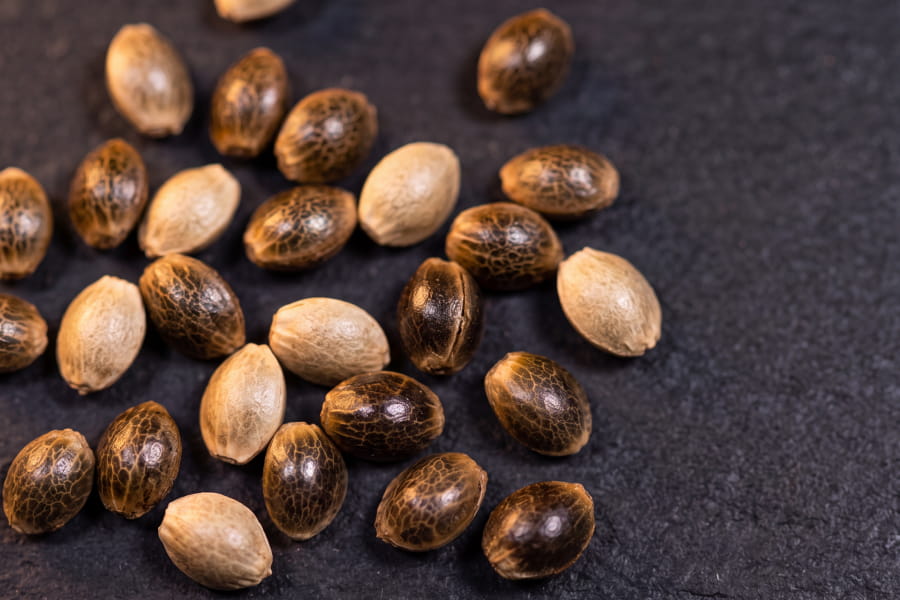
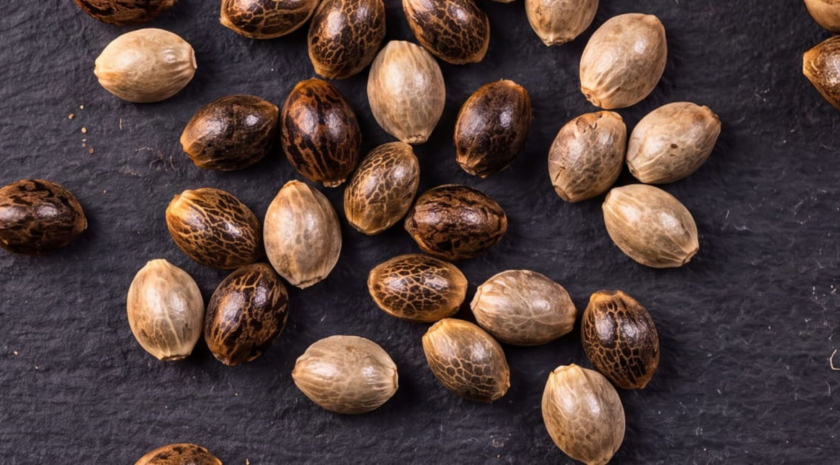
Close-up of cannabis seeds showing color variation from pale green to dark brown.
Cannabis seeds are typically small, oval-shaped and hard-shelled, with coloring that ranges from pale tan to deep brown. Mature marijuana seeds often display darker stripes or mottled patterns across the shell.
| Seed Appearance | What It May Suggest | What It Doesn't Prove |
| Brown/tan/mottled | Mature seed | Sex or strain identity |
| Pale/green | Possibly immature | Non-viable |
| Cracked shell | Damaged seed | Strain identity |
| Tiger stripes | Common mature pattern | Male/female |
Seed appearance gives you a rough read on maturity and shell condition, but not on sex or strain. Pale or soft seeds may indicate immaturity. Cracked or damaged shells suggest the seed was compromised during handling or storage. None of those visual traits reveal which strain a seed comes from or which sex the plant will be.
Germinating cannabis seeds is the actual test of viability, since germination success is the clearest indicator of seed health. Cool, dark and dry conditions preserve seed viability over time, that’s why it’s vital to know how to store cannabis seeds correctly.
Which Weed Seeds Are Best to Grow?
The best seed type depends on your specific goals, experience level and grow setup rather than a single universal answer.
If you're new to growing, comparing the best weed seeds for beginners is a useful starting point for filtering seed options by ease of management. For broader seed type decisions, the table below maps each type to the scenario where it fits best.
| Goal | Best Seed Type | Why |
| Beginner grow | Autoflower or feminized | Easier selection path |
| Flower production | Feminized | Reduces male plant sorting |
| Breeding | Regular | Allows male/female selection |
| Timeline control | Photoperiod | Grower controls veg length |
| Faster harvest | Autoflower or fast-flowering | Shorter total timeline |
Feminized seeds suit growers focused on flower production because they reduce the need to monitor plant sex. Autoflower seeds work well for beginner growers or anyone on a fixed timeline, since age-based flowering removes light-cycle management.
Regular seeds fit breeders and experienced growers who want to work with male and female plants intentionally. Photoperiod seeds give you the most control over plant size and veg duration before triggering flower.
Starting with one or a few seeds is possible where growing is permitted. Most growers germinate extras either because they want larger harvests or to account for germination rates and plant variability.
After choosing your seed type, the next step is knowing how to germinate cannabis seeds, which covers the conditions each seed needs to sprout successfully. Everything that follows falls under understanding how to grow marijuana from seedling through harvest.
Feminized vs Autoflower vs Regular Seeds
Feminized, autoflower and regular seeds each describe a different primary attribute of how the seed was bred.
Feminized seeds target sex probability, breeding for female plants. Autoflower seeds target flowering behavior, triggering the flower stage by age. Regular seeds preserve the natural male-to-female variation in unmodified genetics.
These attributes can also overlap: autoflower seeds are frequently feminized as well, combining age-based flowering with a high female-plant probability in one seed type.
| Comparison | Main Difference | Best For |
| Feminized vs Autoflowering Seeds | Sex probability vs flowering behavior | Flower-focused vs fast/easy grows |
| Feminized vs Regular Seeds | Female-focused vs male/female variation | Flower production vs breeding |
Cannabis Seed Type Comparison Chart
The table below summarizes the main attributes across all five seed types, including sex probability, flowering behavior and best use case. Use it as a final checkpoint before choosing which seed type to explore further.
| Seed Type | Sex Probability | Flowering Behavior | Best Use Case | Beginner Friendly? | Explore |
| Feminized | Bred for female plants | Usually photoperiod unless auto-feminized | Flower production | Yes | Feminized Seeds |
| Autoflower | Typically feminized | Flowers by age | Fast/easy harvests | Yes | Autoflower Seeds |
| Regular | Male or female | Usually photoperiod | Breeding/ phenotype selection |
Medium/advanced |
Regular Seeds |
| Photoperiod | Depends on seed type | Flowers by light cycle | Grower control | Medium | Photoperiod Seeds |
| Fast-flowering | Depends on seed type | Shorter bloom window | Faster photoperiod harvest | Medium | Photoperiod vs Autoflower |